Our Top Picks
 DEWALT DWHT34036L 100-Foot Closed Case Long TapeSE30.5 m9.31 x 8.63 x 8.5 inches0.15 poundsCheck on Amazon
 CRAFTSMAN 25-Ft Tape Measure with Fraction Marketing7.6 m5.7 x 3.5 x 0.1 inches1.06 poundsCheck on Amazon


What's inside
As an Amazon Associate I earn from qualifying purchases. This post may contain affiliate links at no extra cost to you.
Two tapes on the same wall, two different numbers. That is where most accuracy problems begin, and it is why choosing the best tape measure for your work matters more than what it rings up for. Every cut, reveal, and rafter angle inherits whatever error your measuring and marking tools bring to the job.
What follows is organized like a tool aisle: tapes, squares, marking tools, then lasers. Each section leads with the one spec that separates a good tool from a frustrating one, plus the sizes and ratings worth paying for.
As an Amazon Associate we earn from qualifying purchases at no extra cost to you.




| Category | What it controls | Spec that matters most |
|---|---|---|
| Tape measure | Nearly every dimension you cut to | Hook fit, standout, blade width |
| Combination square | Marking, depth setting, machine checks | Ground blade, lock that holds |
| Speed and framing squares | Crosscut and rafter angles | Cast or thick body, not flimsy |
| Chalk line | Long straight lines on decks and roofs | Gear ratio and chalk type |
| Laser level or distance measure | Level lines and long spans | Stated accuracy at full range |

Sections
What Makes the Best Tape Measure Different From a Throwaway
Lead criterion: the hook. The end hook should float exactly its own thickness so inside and outside measurements both read true zero. Loose rivets or slop past that thickness means the tape is wrong by a sixteenth or more, and no technique fixes it. Wiggle the hook before you buy: smooth travel, tight rivets, no rattle.
Standout comes second. That is how far the blade reaches unsupported before it folds. Bargain tapes quit around 5 to 7 feet. A good 1 inch blade holds 9 to 11 feet. Wide 1-1/4 inch blades push past 11 feet, which is what you want measuring solo across a room.
Then the blade. Look for a nylon coating over at least the first 6 to 12 inches, and stamped or etched markings rather than printed. Fractions should run to 1/16 inch the full length, with legible 16 and 24 inch stud marks. Better tapes cite EC Class II accuracy, roughly within 1/16 inch over 10 feet. Most no-name tapes are not certified at all.
Which length fits which work
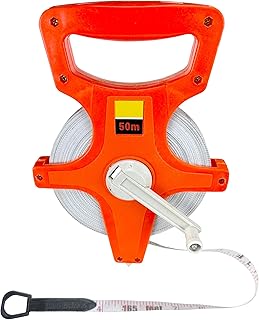
12 to 16 feet: trim, cabinets, furniture, pocket carry. 25 feet: the default for framing, remodeling, and stud layout. 30 to 35 feet: open framing, decks, and concrete. 100 foot open reel: site layout, squaring foundations, fence lines. Most shops end up with one compact tape and one 25 footer.
Compact 16 ft tape measure for trim and cabinet work
A narrow blade and short case beat a jobsite tape inside cabinets and on molding. Prioritize a tight hook and clear 1/16 inch markings over extra length.
- ✔ Long standout for measuring alone
- ✔ Stiff blade resists kinking
- ✔ Easier to read at arm’s length
- ✔ Usually better hooks and cases
- ✘ Bulky in a pocket
- ✘ Wide blade will not fit tight cabinet interiors
- ✘ Costs noticeably more
- ✘ Large case makes short inside measurements awkward
Squares: The Reference Everything Else Gets Checked Against
Lead criterion: is it actually square, and can you prove it? Use the flip test. Draw a line off a known straight edge, flip the square end for end, and draw again from the same point. Any gap is double the error. Do it before the tool goes in the pouch and again after a drop.
A 12 inch combination square with a hardened, ground blade and a lock that does not creep handles marking, depth setting, and 45s. Add a 4 to 6 inch machinist square for machine setup, where a small error compounds. A 7 inch speed square guides circular saw crosscuts and the 12 inch version handles wider stock; a 16 by 24 inch framing square covers stairs and sheet goods. Cast or thick machined bodies stay true, while thin stamped ones bend the first time they hit concrete.
Marking Tools: Line Width Is the Spec
Lead criterion: how thin and repeatable the line is. A carpenter pencil leaves close to 1/16 inch of ambiguity, which is fine for framing and poor for joinery. Keep a carpenter pencil for rough work, a 0.5 mm mechanical pencil for casework, and a marking knife for joints that must close.
For long references, a chalk line is still fastest on a roof or deck. Compare gear ratio: 3:1 is standard, 6:1 rewinds 100 feet without wearing out your wrist. Blue and white chalk are the erasable choices and belong near anything that stays visible; red and orange are effectively permanent and should stay on sheathing.
Fast-rewind chalk line reel and marking chalk
A 100 foot reel with a high-speed gear ratio and a sealed body is the sweet spot for framing and roofing. Choose erasable blue chalk if lines land on finish material.
Lasers: Compare the Accuracy Rating, Not the Beam Count
Lead criterion: stated accuracy at the stated range. Laser distance measures commonly claim about +/- 1/16 inch across 100 to 165 feet, which is enough for estimating and solo measuring. Anything rated +/- 1/8 inch or worse is a rough estimating tool.
Cross-line and cube lasers are rated per distance. The common standard is +/- 1/8 inch at 30 feet, with precision models near +/- 1/16 inch at 30 feet for cabinet runs, tile, and trim height. Check the self-leveling range, usually around +/- 4 degrees, and confirm the unit warns you when it is out of level. Green beams read brighter indoors than red at higher cost and battery draw. Outdoors you need a detector and a matching pulse mode. Look for IP54 and both 1/4-20 and 5/8-11 tripod threads.
Self-leveling cross-line laser level with green beam
For interior layout, a green cross-line unit near +/- 1/8 inch at 30 feet covers cabinets, tile, and trim without rotary pricing. Confirm the out-of-level warning and tripod thread.
Building a Kit That Agrees With Itself
Accuracy is mostly consistency. Pick one tape per project and mark it, because two tapes with different hooks will disagree at the worst moment. Cross-check tapes against each other and against a steel rule so you know which to trust. For repeat dimensions, transfer the measurement to a story stick and mark parts from it instead of doing arithmetic twice. Decide whether you hook or burn an inch and stay with it, and retire any tape with a wobbling hook.
Frequently Asked Questions
How accurate should a tape measure be? Tapes citing EC Class II hold within roughly 1/16 inch over 10 feet, well inside what carpentry needs. Uncertified tapes drift further, and a damaged hook causes more error than blade printing. The practical test is agreement between your tape, another tape, and a steel rule.
Do I still need a good tape if I own a laser distance measure? Yes. Laser measures win on long spans and solo work, but they are awkward at short distances, in obstructed corners, and for transferring a mark to a workpiece. Use the laser for numbers and the tape for marks.
Is a wide-blade tape worth the extra money? If you regularly measure long spans alone, yes, since the added standout saves real time. If you work inside cabinets or on trim all day, the bulk works against you and a compact 16 foot tape is the better buy.
Layout tools are the cheapest accuracy you can buy. One trustworthy tape, one verified square, a fine marking tool, and a laser rated for the work will do more for your results than another saw.
Check prices on Amazon →