Our Top Picks
 Zircon® MultiScanner™ A200 Stud Finder with Metal &Center Finding1.8 x 3.23 x 7.72 inches0.8 poundsCheck on Amazon


What's inside
As an Amazon Associate I earn from qualifying purchases. This post may contain affiliate links at no extra cost to you.
Most stud finder failures are not the wall’s fault. Drywall gives up its framing more easily than plaster or tile ever will. What puts the hole in the wrong place is a single-sensor scanner calibrated while it was already sitting over a stud, a 5/8 in ceiling read with a tool rated to 3/4 in, or a magnet that grabbed a drywall screw an inch off center. The best stud finder for drywall is simply the one that removes guesswork on your assembly, and that comes down to four checkable specs: sensing method, rated scan depth, whether the tool reports edges or full stud width, and whether it warns you about energized cable.
Sorted below the way a supply house counter would sort it: by wall build-up, and by how much repeat work you do. Hanging one TV is a different purchase than laying out cabinet rails all week.
As an Amazon Associate we earn from qualifying purchases at no extra cost to you.


Sections
What separates the best stud finder for drywall from the rest
The criterion is what the tool reports. Fastener magnets report screws. A single capacitive sensor reports a density change under one small window. Multi-sensor arrays and imaging scanners report the whole width of the member in one pass, which is what you need when a lag screw has to land near the middle of a 1-1/2 in stud face instead of 1/4 in from its edge.
| Type | Best for | Typical rated depth | Main trade-off |
|---|---|---|---|
| Fastener magnet | 1/2 in drywall, renters, backup checks | Screws near the surface | Finds fasteners, not centers |
| Single-sensor capacitive | Occasional use, tight budget | 3/4 in to 1 in | Needs clean calibration, edges only |
| Multi-sensor array | 1/2 in and 5/8 in drywall, repeat layout | Roughly 1-1/2 in | Wide body, higher price |
| Radar or imaging scanner | Plaster, double drywall, concrete | Several inches | Cost and a learning curve |
| App-connected scanner | Casual DIY, visual mapping | About 1 in | Phone and battery dependency |
Multi-sensor array scanner (Franklin ProSensor class)
A row of capacitive sensors lights up every position sitting over framing at once, so both edges and the center appear without sweeping or calibrating. This is the class most cabinet and drywall crews settle on. Worth the money only if you scan often enough to care about speed.
- ✔ Shows full stud width in one pass, no sweep or calibration
- ✔ Far fewer false positives on textured or heavily painted walls
- ✔ Deep mode reads 5/8 in Type X and doubled board
- ✔ Reads steel studs and blocking without switching modes
- ✘ Costs several times what a basic scanner does
- ✘ Wide body is awkward in corners and inside cabinets
- ✘ Some models drop AC or metal indicators to keep the array simple
Match scan depth to the board on your wall
Criterion: rated depth with margin, never at the edge of spec. Gypsum board made to ASTM C1396 shows up in two thicknesses in most US homes: 1/2 in on interior walls, and 5/8 in Type X on garage ceilings, party walls, and other fire-rated assemblies. A 3/4 in scan mode clears 1/2 in board. It does not reliably clear 5/8 in board plus texture, a skim coat, or a second layer added during a remodel. If your house has any of that, buy the 1-1/2 in deep mode.
Two free field checks. Framing runs 16 in on center in most US houses and 24 in on center in some non-bearing layouts, so a real hit repeats at that spacing left and right. And a dressed 2×4 face is 1-1/2 in wide, so if the tool marks a 4 in wide stud you have found a doubled member at an opening, a header, or pipe.
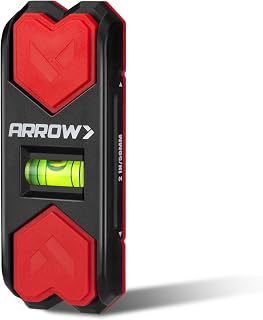
Neodymium fastener magnet
Rare-earth magnets snap onto drywall screws and steel framing for about the price of a pack of anchors. Nothing to calibrate, nothing to charge, so it belongs in the pouch even if you own something better. Mark two fasteners vertically to establish the stud line before you drill.
Live AC detection and what the electrical code assumes
Criterion: does the tool flag energized cable across the whole scan path, or only under the center mark? NEC 300.4(D) generally requires cable running parallel to a framing member to sit at least 1-1/4 in back from the face, or be protected by steel at least 1/16 in thick. That 1-1/4 in is your entire margin, and it is shorter than the lag screws in a heavy TV mount. Treat AC detection as a warning band, not a permission slip.
The blind spots matter as much. AC modes see energized nonmetallic cable; they do not reliably see dead circuits, wiring inside metal conduit, or anything behind foil-faced insulation. Copper supply lines show on a metal or all-scan mode. PEX is invisible to every tool in this class. Drilling deeper than an inch, kill the circuit at the panel first.
Walls where every scanner struggles
Criterion: honest failure behavior. A good scanner goes quiet or throws an overload warning. A bad one confidently marks a stud every 3 in. Expect trouble with plaster over wood lath, metal lath or wire mesh, heavy knockdown texture, wallpaper printed with metallic ink, tile over cement backer board, radiant ceiling heat, and board that has not fully dried. Corner bead and mesh-taped seams skew capacitive readings near edges.
The fix is triangulation. Cross-check with a magnet, confirm 16 in spacing in both directions, and remember that outlet and switch boxes are nearly always fastened to one side of a stud. If the wall still argues, a 1/16 in test hole behind the future mounting plate settles it.
Who should buy which type
One TV, one wall, once a year
A magnet or a basic capacitive scanner, plus better anchors. Calibrate away from any suspected stud, sweep slowly, mark both edges, drill the center.
Remodelers, cabinet and trim installers
The multi-sensor array. Speed on repeat layout, and not missing a cabinet rail by 3/8 in, pays for it inside one kitchen.
Plaster, lath, double drywall, or steel stud work
Step up to a deep-scan or imaging tool that reports depth. Keep a magnet for the fastener pattern in steel framing built to ASTM C645, which is thin enough that magnets read it clearly.
Deep-scan electronic scanner with AC warning
Look for a selectable deep mode near 1-1/2 in, separate metal and AC indicators, and a calibration routine that tells you when it failed instead of quietly guessing. Practical middle of the range for older houses with unknown wall build-up.
Frequently asked questions
Do stud finders work through two layers of drywall? Only in deep mode. Two layers of 5/8 in board put framing roughly 1-1/4 in below the surface, past the reach of a standard 3/4 in scanner. Use a 1-1/2 in deep mode or an imaging tool, then verify with 16 in spacing.
Why does my scanner mark studs every few inches? Usually calibration over a stud, a weak battery, or moisture in the board. Restart over a known hollow section and swap the battery. If the pattern repeats, you are probably reading metal lath, mesh, or radiant heat rather than framing.
Is a magnetic stud finder enough for a TV mount? It can be, if you mark two fasteners vertically to confirm the stud line and use lags long enough to bite 1-1/2 in into wood. For heavier mounts, a scanner that shows both edges keeps the lags nearer the center.
Buy for the worst wall in the house, not the easiest one. On 1/2 in drywall with light loads, a magnet and patience is a legitimate answer. On 5/8 in ceilings, remodeled walls, or anything carrying real weight, the multi-sensor array is the upgrade that changes outcomes.
Check prices on Amazon →