Our Top Picks
 Klein Tools 935DAG Digital Electronic Level and AngleLevel2.36 x 2.2 x 1.2 inches0.2 PoundsCheck on Amazon


What's inside
As an Amazon Associate I earn from qualifying purchases. This post may contain affiliate links at no extra cost to you.
The moment a digital angle finder earns its money is not at the bench, it is in a 1940s stairwell where no corner is 90 degrees and the crown still has to close tight. That is also where a bad one fails you: the number shifts when you snug the arm lock, the screen reads upside down, or auto-shutoff drops the value before you reach the saw. This digital angle finder review is organized around the specs and hardware that predict which afternoon you get, because price alone does not.
Four different products share the name, and they are not interchangeable. A hinged protractor measures the angle between two surfaces. A magnetic angle cube measures tilt against gravity. A digital level does the same over a longer reference edge. A digital bevel gauge splits the difference with rule-marked arms. Choose the wrong format and the tool will work perfectly while being useless for your job.
As an Amazon Associate we earn from qualifying purchases at no extra cost to you.



| Format | Who it suits | Typical published accuracy | Main weakness |
|---|---|---|---|
| Hinged digital protractor | Trim carpenters transferring wall and casing angles | 0.2 degree, tightening to 0.1 near 0 and 90 | Pivot slop and arm flex on long spans |
| Magnetic angle cube | Anyone setting table saw or miter saw bevels | 0.1 degree at 0 and 90, 0.2 elsewhere | Steel dust under the magnet destroys zero |
| Digital level or inclinometer beam | Slope, ramps, conduit, machine leveling | 0.1 degree at 0 and 90 | Too bulky for tight casework |
| Digital bevel gauge with rule arms | Layout plus direct transfer to a saw | 0.2 degree typical | Thin arms flex under hand pressure |
Sections
Digital Angle Finder Review: The Four Formats and Who Each Suits
Format comes down to one question: what does the tool reference? A hinged protractor references its own two arms, so it reads real corners. Everything else references gravity, so it reads tilt. Nothing else on the spec sheet matters until that is settled.
Hinged digital protractor
Two arms, a locking pivot, a readout in the hub. It does not care whether the work is level or plumb, which is why it owns remodel work. Arms in the 7 to 12 inch range suit casing, jambs and countertop scribes; the 24 inch class is for stringers and rafters. Insist on a half-angle function so the tool divides the corner and you set the miter saw without mental math.
Magnetic angle cube
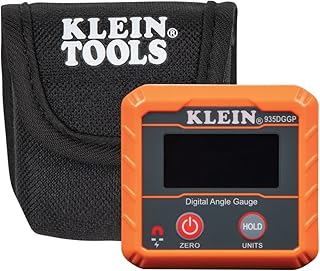
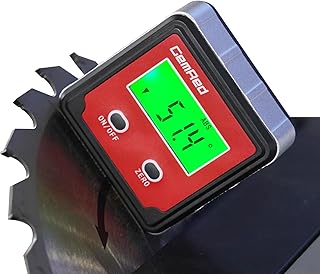
A palm-sized block with rare-earth magnets on two or three faces. Zero it on the saw table, stick it to the blade plate, tilt until the screen reads 45.0. Nothing is faster for bevels on a table saw, miter saw, jointer fence or drill press table. It cannot read a wall corner, because it only knows tilt.
Digital level or inclinometer beam
Same sensor, longer reference edge, and usually a unit toggle for degrees, percent grade and rise per foot. That toggle is the buying criterion, because drainage and accessibility slopes are specified as percentages or ratios far more often than as degrees.
Digital bevel gauge
Rule arms etched in inches and millimeters, so it does layout and angle reading in one pass. Convenient on a bench, but the thin arms flex under hand pressure, which shows up as a reading that changes depending on how hard you press.
Hinged Digital Protractor, 7 to 12 inch Arms
This is the format most people picture when they say angle finder. Filter for stainless arms, a published accuracy figure rather than resolution alone, and a half-angle button. Skip any unit that hides the battery behind four screws.
Accuracy, Resolution and the Numbers That Actually Matter
The criterion that separates honest listings from marketing is whether they distinguish resolution from accuracy. Resolution is what the display can show, commonly 0.05 or 0.1 degree. Accuracy is how far the reading may sit from truth, and reputable makers publish it as a pair: roughly 0.1 degree at 0 and 90 degrees, 0.2 degrees through the rest of the range. The tighter figure lands at the flats because MEMS accelerometer inclinometers are most sensitive there and because that is where the factory calibrates. A listing that quotes resolution and no accuracy spec should be read as unspecified.
Error also stacks. A 0.2 degree reading error at the wall becomes about 0.1 degree per miter after the half-angle split, and a four-corner room stacks four of those before the last joint has to close. That is why the reading matters less than repeatability.
You can check repeatability without a lab. Read a surface, rotate the tool 180 degrees in the same spot, read again: half the difference is your zero error. Only metrology-grade inclinometers ship with calibration traceable through an ISO/IEC 17025 accredited lab. Shop-grade gauges expect you to zero them yourself, which is fine so long as you zero on the surface you will actually cut on.
Magnetic Digital Angle Gauge (Angle Cube)
The most useful accuracy upgrade you can make to a saw you already own. Wixey, iGaging, Johnson Level and Klein Tools all sell credible versions. Wipe the blade and table before zeroing, or the magnet collects swarf and quietly lies to you.
Build Details That Decide Whether It Survives the Shop
Sealing is the first build criterion, and it is the one spec that is genuinely standardized. IP ratings under IEC 60529 use two digits, dust then water. IP54 means dust protected and splash resistant, which is the realistic minimum for a tool that rides in a bag. IP65 means dust tight and able to take low-pressure water jets, worth paying for on exterior and concrete work. An unrated gauge is fine if it lives in a drawer in a heated shop.
The hinge is second. Hold the arms and twist: any perceptible play at the pivot is permanent, and no recalibration removes it. The lock should clamp the arms without dragging the number as it tightens.
Then the small stuff that decides whether you keep it. A hold button that freezes the reading, an auto-shutoff long enough to walk to the saw, a display that flips when the tool is inverted, and a backlight for reading inside a cabinet. Battery type matters more than it sounds: a CR2032 behind a coin-slot door is easy to carry spares for, while an odd cell you have to order is a tool waiting to go dead.
- ✔ Reads angles to a tenth of a degree with no geometry or hand division
- ✔ Half-angle and hold functions transfer a corner straight to the miter saw
- ✔ Magnetic bases free both hands for blade and fence setup
- ✔ One tool covers layout, saw calibration and slope in degrees or percent
- ✘ Every reading depends on the flatness of the surface you zeroed on
- ✘ Batteries die at the worst time and auto-shutoff can drop a held value
- ✘ Steel swarf under a magnetic base creates error you cannot see
- ✘ Loose hinges develop slop that recalibration will never fix
Matching the Gauge to the Work
The deciding question is where your angles come from: a wall, a blade, or a run. Remodelers and trim carpenters work off walls, so the hinged protractor with a half-angle function is the primary tool and everything else is an accessory. Cabinet and furniture shops work off blades and fences, so the magnetic cube gets used daily and pays for itself the first time a case comes together square. Fabricators and welders want a sealed magnetic unit with a strong hold function, since readings often happen where the display is not visible. Homeowners doing occasional shelving and trim are usually better served by one well-specified protractor than by two cheap gauges.
Digital Level with Angle and Slope Readout
Choose this when your angles come with a run: drain lines, ramps, conduit, machine bases. Bosch and Johnson Level are the safe brands in this class. Confirm it toggles degrees, percent grade and rise per foot before you buy.
Digital Angle Finder FAQ
Is a digital angle finder accurate enough for crown molding? Yes, if you respect the tolerance stack. A 0.2 degree reading error becomes roughly 0.1 degree per miter after the half-angle split, invisible in painted work and borderline in stained hardwood. Read the corner in three spots, use the tightest value, and cut a scrap pair before touching real stock.
Do I need to calibrate mine? Any time the result matters. Zero on the exact surface you will cut on, then verify with the reversal check: read, rotate 180 degrees in place, read again, and treat half the difference as your zero error. Recalibrate after a drop and after the tool moves from a cold truck into a warm shop.
If I only buy one, which format? Shop and cabinet work: the magnetic cube, because blade and fence setup happens every day. Remodel and trim work: the hinged protractor, because out-of-square walls are the entire job. Carrying both is a common answer and not an extravagant one.
Buy on the accuracy spec, the sealing rating and the hinge, in that order, and let the marketing copy come last. A gauge that publishes 0.1 degree at the flats, carries at least IP54 for jobsite duty, and locks without dragging the reading will still be right in five years. One that lists only resolution and a color option will be in the junk drawer by spring.
Check prices on Amazon →