Our Top Picks
 Topcon RL-H5A Self-Leveling Construction Laser w/LS-80 Receiver1 Count (Pack of 1)17.5 x 10.3 x 12.3 inches12.3 poundsCheck on Amazon
 Klein Tools 93RLS Green Self-Leveling Rotary Laser Level32 x 16 x 8.75 inches4.36 PoundsCheck on Amazon


What's inside
As an Amazon Associate I earn from qualifying purchases. This post may contain affiliate links at no extra cost to you.
Most people shopping for a laser level compare the wrong number. Stated accuracy is the headline spec, and nearly every unit on the shelf claims something within a hair of the next one. What separates a tool you actually keep is beam visibility at your working distance, whether the pendulum survives a season of being thrown in a van, and whether the mount lets you nudge a line a quarter inch without starting over. This self leveling laser level review is built around those separators instead of brand loyalty.
The second trap is class. A two-line laser is a trim, tile, and cabinet tool. A 3×360 is a layout tool for framing and ceiling grid. A rotary with a receiver is a concrete, grading, and exterior tool, and it is the only category that works reliably in daylight. Get the class wrong and no accuracy figure rescues the purchase, so start with the table and work down to specs.
As an Amazon Associate we earn from qualifying purchases at no extra cost to you.


| Laser class | Who it is for | The spec that decides it | ||
|---|---|---|---|---|
| Cross-line, one horizontal and one vertical | Tile setters, cabinet and trim carpenters | Accuracy at 30 ft plus a magnetic pivot bracket | ||
| 3× | 360 or 4× | 360 multi-line | Framers, drywall and ceiling crews, electricians | Plumb-point offset and detector-ready pulse mode |
| Rotary, horizontal only | Concrete flatwork, footings, fence lines | Receiver working diameter and IP rating | ||
| Rotary with dual slope | Grading, drainage, ramp and slope work | Servo leveling with grade in two axes | ||
| Dot or plumb-spot laser | Anchor layout, sprinkler drops, stud transfer | Beam count and ceiling dot brightness |
Sections
Self Leveling Laser Level Review: What Self-Leveling Actually Buys You
The dividing line is what the tool does when it is outside its leveling range. Almost every unit in this bracket uses a magnetically damped pendulum hung in a gimbal, so gravity does the work inside a compensation window of roughly three to four degrees. A good laser blinks the beams or kills them once you exceed that window. A cheap one keeps projecting a confidently wrong line, and you find out when the lippage shows up.
The second thing to verify is a transport lock that cages the pendulum at power down. That lock is the best single predictor of whether a laser holds calibration after months in a truck bed. Rotary lasers step up to electronic servo leveling, which is what allows true single and dual axis slope modes rather than level only.
Green cross-line laser for tile and cabinet work
If your work is indoors and under about 40 feet, this is the class to buy. Prioritize a green beam, a locking pendulum, and a bracket with a fine-adjust knob over extra beam lines you will rarely switch on.
Reading Accuracy Specs Without Getting Fooled
The dividing line is distance: an accuracy claim without a distance attached is not a spec. The common consumer figure is around plus or minus 1/8 inch at 30 feet, with a tighter tier near 1/16 to 3/32 inch at the same distance. Error scales linearly, so 1/8 inch at 30 feet is roughly 1/2 inch at 100 feet. On a cabinet run that is irrelevant. Across a driveway pour it is not.
Rotating lasers have a published field test procedure behind them, ISO 17123-6, and makers who reference that series are quoting something repeatable rather than marketing. You can approximate it: project a line on a far wall, mark it, rotate the tool 180 degrees, re-mark from the same position, and compare. Drift beyond the stated tolerance means service. Some professional units allow user recalibration, most consumer models do not.
Green Versus Red, Laser Class, and Honest Visibility
The dividing line is whether you can see the line from where you actually stand. Eye sensitivity peaks near 555 nm, so green diodes in the 515 to 532 nm range read much brighter than 635 to 650 nm red at identical output. Most line lasers are Class 2 under IEC 60825-1, capped at 1 mW, which means the visible difference comes from wavelength rather than extra power. Some outdoor rotary units move to Class 3R and deserve more care around eyes.
Green costs you something. It draws more current, shortens runtime, and green diodes are often specified over a narrower cold-temperature range. Accept the ceiling, too: no line laser is dependably visible in direct sun past a few feet, and enhancement glasses raise contrast without improving accuracy. Outdoors the answer is a receiver and pulse mode, not a brighter diode.
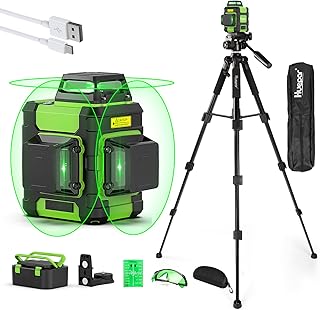
3x360 green beam layout laser
Three full planes wrap a room and keep walls, ceiling grid, and device boxes on one reference without moving the tool. Worth the jump if you frame, hang drywall, or set ceilings. Overkill if you only install cabinets.
- ✔ Full 360-degree planes remove most repositioning
- ✔ Pulse mode pairs with a detector for longer runs
- ✔ Usually includes both 1/4-20 and 5/8-11 mounting
- ✘ Higher battery draw than a red two-line unit
- ✘ More diodes means more that can drift out of calibration
- ✘ Costs several times a basic cross-line laser[/afk_cons>
Durability, Power, and Mounting Hardware
The dividing line is ingress protection and how the tool attaches to something solid. IP ratings follow IEC 60529, and IP54, meaning dust protected and splash resistant, is the realistic floor for job-site use. Concrete and exterior work wants IP65 or better. Drop-height claims have no common standard behind them, so read them as relative marketing rather than a guarantee.
Power is a platform decision. Alkaline AA cells are fine for occasional use and replaceable anywhere. If you already run DeWalt 12V MAX or 20V MAX, Milwaukee M12, or Makita CXT and LXT packs, staying on that battery is worth more than a small spec advantage. For mounting, 1/4-20 threads fit camera tripods, 5/8-11 fits surveying tripods and elevating poles, and a magnetic pivot bracket with a fine-adjust knob saves more time than any extra beam.
Rotary laser level kit with detector
Once you work in daylight or past roughly 100 feet, a rotary and receiver stops being a luxury. Buy it as a kit with tripod, grade rod, and detector clamp, since assembling those pieces separately usually costs more.
Frequently Asked Questions
Is green worth the extra money over red? Indoors, usually yes, because the eye perceives green as several times brighter at the same laser class. If your work is short range in dim interiors, or you need maximum runtime in cold weather, a good red unit is still a sound buy.
Can a self-leveling laser level work outdoors? Only with a receiver. Sunlight overwhelms any Class 2 beam, so you need pulse or detector mode plus a compatible receiver on a grade rod. Rotary lasers are designed for that workflow, most line lasers are not.
How often should I check calibration? Before any critical layout, and immediately after any hard fall. The 180-degree flip check takes two minutes and a pencil and catches nearly every fault that matters. Lock the pendulum in transit and store the tool in its case.
Match the class to the work first, then buy the tightest accuracy and best ingress rating your budget allows within that class. A homeowner hanging shelves is finished at cross-line. A remodeler doing walls and ceilings should be shopping 3×360. Anyone pouring concrete or setting exterior grade needs a rotary and a detector.
Check prices on Amazon →