What's inside
- Quick picks by garage situation
- How much heating capacity does a garage need?
- Electric heaters: easiest installation, highest running cost
- Propane heaters: fast heat and portability
- Natural-gas heaters: best for frequent heating
- Decision matrix: match the heater to the job
- Operating-cost example
- Installation and maintenance details that matter
- Final recommendation
- Related Guides
- Quick picks by garage situation
- How much heating capacity does a garage need?
- Electric heaters: easiest installation, highest running cost
- Propane heaters: fast heat and portability
- Natural-gas heaters: best for frequent heating
- Decision matrix: match the heater to the job
- Operating-cost example
- Installation and maintenance details that matter
- Final recommendation
- Related Guides
As an Amazon Associate I earn from qualifying purchases. This post may contain affiliate links at no extra cost to you.
The best garage heaters for cold weather depend on four numbers: your garage’s square footage, insulation level, ceiling height, and available fuel or electrical service. For most one- or two-car garages, a 240-volt electric heater is the simplest choice; propane suits occasional use or off-grid spaces; and a vented natural-gas unit is usually the lowest-cost option for frequent heating where gas service and professional installation are available.
As an Amazon Associate we earn from qualifying purchases at no extra cost to you.



Sections
- Quick picks by garage situation
- How much heating capacity does a garage need?
- Electric heaters: easiest installation, highest running cost
- Propane heaters: fast heat and portability
- Natural-gas heaters: best for frequent heating
- Decision matrix: match the heater to the job
- Operating-cost example
- Installation and maintenance details that matter
- Final recommendation
- Related Guides
Quick picks by garage situation
- Small, insulated garage up to about 400 square feet: a 1,500-watt electric heater can provide spot heat, while a 4,000- to 5,000-BTU propane heater offers more mobility.
- Typical one-car garage, 400 to 600 square feet: choose a 4,800- to 5,100-BTU electric heater for light-duty heating, or a 10,000- to 18,000-BTU propane heater for faster warm-up.
- Two-car garage, 600 to 1,000 square feet: a 240-volt electric unit in the 5,000- to 10,000-watt range or a 30,000- to 45,000-BTU vented gas heater is more appropriate than a household plug-in heater.
- Frequent winter use: a ceiling-mounted, vented natural-gas heater such as the Modine Hot Dawg or Mr. Heater Big Maxx range is usually more economical and durable than portable fuel heaters.
- No permanent installation: a portable propane radiant or convection heater is practical, provided it is specifically approved for indoor use and used with the ventilation required by its manual.
How much heating capacity does a garage need?
A rough starting point is 20 to 30 BTUs per square foot for an insulated garage, 30 to 45 BTUs per square foot for an average garage, and 45 to 60 BTUs per square foot for a poorly insulated or drafty space. These figures assume a ceiling around 8 feet high. Increase the estimate for higher ceilings, frequent door opening, severe winter temperatures, or large uninsulated doors.
For example, a 600-square-foot garage with average insulation and an 8-foot ceiling might need approximately 18,000 to 27,000 BTUs per hour. A 10-foot ceiling increases the air volume by 25 percent, so a heater near the upper end of that range is more suitable. This is a sizing estimate, not a substitute for a heat-loss calculation.
| Garage condition | Approximate capacity | Best heater types | Important limitation |
|---|---|---|---|
| Up to 400 sq. ft., insulated, 8-ft. ceiling | 8,000–15,000 BTU/h | Electric or portable propane | 1,500-watt plug-in heaters may be slow below about 55°F outside |
| 400–600 sq. ft., average insulation | 15,000–25,000 BTU/h | 240-volt electric or propane | Use more capacity if the garage door opens often |
| 600–1,000 sq. ft., average insulation | 25,000–45,000 BTU/h | Vented natural gas or larger 240-volt electric | Ceiling height and gas-line sizing become significant |
| Poorly insulated, drafty, or high-ceiling garage | 45–60 BTU per sq. ft. | Vented gas or professionally sized electric | Sealing doors and walls may reduce required capacity more than upsizing the heater |
Electric heaters: easiest installation, highest running cost
Electric garage heaters produce no combustion gases and do not require a flue, gas line, or fuel storage. That makes them attractive for attached garages and enclosed workshops. Portable 1,500-watt models generally produce about 5,100 BTUs per hour and plug into a standard 120-volt circuit. They are suitable for warming a person at a bench or maintaining a small, well-insulated garage above freezing, but they are rarely fast enough for a large cold garage.
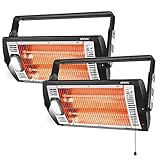
For regular heating, a 240-volt fan-forced or infrared heater is the better electric option. Typical models range from 4,000 to 10,000 watts. A ceiling-mounted fan heater distributes warm air more evenly, while infrared heat warms people and surfaces directly and can feel effective before the entire garage reaches the thermostat setting.
Electrical capacity matters. A 5,000-watt heater operating at 240 volts draws about 20.8 amps, so it normally needs a dedicated circuit sized according to the manufacturer’s instructions and local electrical code. Do not run a high-wattage heater from an extension cord or share its circuit with a compressor, table saw, or dust collector.
Propane heaters: fast heat and portability
Portable propane heaters are useful when the garage has no suitable electrical circuit or when heating is occasional. Radiant models warm nearby people and tools quickly, while convection models warm the air more gradually. The Mr. Heater Portable Buddy and Big Buddy families are established examples, with output ranges commonly reaching approximately 9,000 and 18,000 BTUs per hour respectively, depending on the model and setting.
Fuel consumption is the main ownership consideration. A 20-pound propane cylinder contains roughly 430,000 BTUs of usable fuel before losses. At 18,000 BTUs per hour, a heater could theoretically run for about 24 hours at full output, although cold temperatures, regulator performance, and incomplete use of the cylinder reduce the practical figure. A one-pound cylinder lasts much less time and becomes expensive for daily heating.
Use only a heater approved for indoor use, keep it away from sawdust, finishes, lumber, cardboard, and other combustibles, and follow the specified clearances. Unvented combustion also adds moisture and consumes oxygen. A carbon-monoxide alarm is a sensible additional safeguard, but it does not replace the ventilation, maintenance, and operating rules in the manual. Never use an outdoor construction heater in an enclosed garage.
Natural-gas heaters: best for frequent heating
Vented natural-gas unit heaters are often the best long-term choice for a permanently used workshop. Products such as the Modine Hot Dawg and Mr. Heater Big Maxx are designed for overhead installation, with common residential-garage capacities from roughly 30,000 to 80,000 BTUs per hour depending on the model. They use a thermostat, keep the floor clear, and exhaust combustion gases outdoors through a properly installed vent.
The disadvantages are installation complexity and upfront cost. A qualified professional may need to install or modify the gas line, vent, electrical connection, thermostat, and ceiling supports. Gas pressure, vent length, combustion-air requirements, and local permitting all matter. A natural-gas heater is not a sensible do-it-yourself swap for a portable appliance unless you are qualified to perform the work and comply with local requirements.
Natural gas is usually economical when the heater operates many hours each week, but occasional users may never recover the installation cost. If the garage is attached to a home, confirm that the selected unit and venting arrangement are permitted for that location.
Decision matrix: match the heater to the job
| Your situation | Recommended choice | Why | Watch out for |
|---|---|---|---|
| Budget-conscious, occasional weekend use | Portable indoor-rated propane | Low installation cost and rapid heat | Fuel storage, ventilation, moisture, and cylinder expense |
| Beginner, attached garage, no combustion wanted | 1,500-watt 120-volt or professionally installed 240-volt electric | Simple operation and no exhaust | Limited output from standard outlets |
| Large workshop used most days | Vented natural-gas unit heater | Strong output and lower operating cost for long runtimes | Professional gas and vent installation |
| High ceiling or frequent door opening | Ceiling-mounted gas or high-output 240-volt electric | Better recovery and air circulation | May require destratification fans or careful heater placement |
| Rented property or no permanent modifications | Portable electric or indoor-rated propane | Can be removed when needed | Never overload existing circuits or ignore clearance rules |
Operating-cost example
Suppose a 5,000-watt electric heater runs for four hours. It uses 20 kilowatt-hours. At an electricity rate of $0.18 per kilowatt-hour, that session costs about $3.60 before thermostat cycling. A 30,000-BTU gas heater running for four hours consumes 120,000 BTUs, or about 1.2 therms. At a general gas rate of $1.20 to $2.00 per therm, the fuel portion is approximately $1.44 to $2.40, excluding service charges and efficiency losses.
This comparison is not universal: local utility prices, heater efficiency, insulation, and cycling time can change the result. Improving door seals and insulating the garage ceiling often reduces operating cost regardless of fuel type.
Installation and maintenance details that matter
- Mount fixed heaters where vehicles, lumber, and stored materials cannot block airflow or violate clearance zones.
- Keep dust filters, intake screens, and fan guards clean. Fine woodworking dust can restrict airflow and overheat electric heating elements or fan motors.
- Inspect propane hoses, regulators, and cylinder connections for cracking or damage. Apply leak-detection solution to connections when checking for leaks; never use a flame.
- For gas units, have the vent, burner, heat exchanger, and combustion-air path inspected according to the manual and local requirements.
- Vacuum dust from electric heaters only when they are disconnected and cool. Do not spray finishes, solvents, or compressed sawdust toward a hot element.
- Replace damaged power cords immediately, and plug portable heaters directly into a properly rated wall outlet.
Final recommendation
Choose electric when clean operation and simple installation matter most, propane when portability and occasional high output matter most, and natural gas when you heat a larger garage frequently enough to justify professional installation. Before buying, measure the garage, check ceiling height, inspect insulation and door seals, confirm circuit or gas availability, and size the heater for the actual heat loss rather than choosing the largest model available.