What's inside
As an Amazon Associate I earn from qualifying purchases. This post may contain affiliate links at no extra cost to you.
Blade length changes how a chisel behaves in your hand. A short-blade chisel feels compact and easy to steer, while a long-blade chisel gives your hand more room to guide the tool and usually offers more reach into a joint. Neither is automatically better. The right choice depends on whether you are paring, chopping, fitting hardware, or working in a confined space.
As an Amazon Associate we earn from qualifying purchases at no extra cost to you.


Sections
Our Top Picks
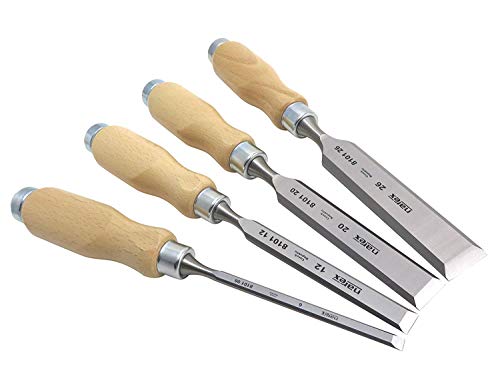
 Narex Czech Steel Premium 4 pc Set True1/4", 1/2", 3/4", 1"6.38 x 13.5 x 1.5 inches1.63 poundsCheck on Amazon

What blade length changes
A chisel is controlled at two points: the handle and the cutting edge. The greater the distance between them, the more the blade tends to magnify small movements at your hand. A long blade can therefore feel smooth and deliberate for paring, but it may feel awkward when you need to make a short, exact correction.
Short-blade chisels put the cutting edge closer to your grip. This reduces leverage and makes the tool easier to keep on a tight line. They are particularly useful for cleaning stopped dados, trimming hinge recesses, and fitting small joints. The trade-off is that your knuckles are closer to the work, and a short tool gives you less clearance when the recess is deep.
Long-blade chisels are easier to hold away from the work. That extra clearance matters when paring the bottom of a deep mortise or trimming a joint where the surrounding stock is already finished. A long blade also gives you more visual reference along its length, which some users find helpful for keeping the cut flat.
When short-blade chisels have the advantage
Short-blade chisels are at their best when the cut is close, shallow, and controlled by fingertips rather than force. They suit cabinetmaking and finish carpentry tasks where removing 0.5 to 1 mm matters more than clearing a lot of waste.
Typical jobs include paring a hinge leaf recess, trimming the shoulder of a tenon, removing glue squeeze-out, and cleaning the corners of a shallow housing. Their compact length also works well inside cabinets and between studs, where a long handle or blade can hit nearby surfaces.
The main failure mode is overdriving. Because the blade is short, users sometimes strike harder to compensate for limited reach. That can bruise the edge, split a thin workpiece, or bury the chisel past the intended line. Use a short-blade chisel for light mallet taps and hand pressure, not heavy waste removal.
If most of your work is fitting and trimming, a short-blade bench chisel set is a sensible addition. You do not need a premium set to get the control benefit; a properly ground edge and comfortable handle matter more than a fancy finish.
When long-blade chisels work better
Long-blade chisels provide reach, clearance, and a more gradual feel when paring. They are useful for deep mortises, long joint shoulders, and cuts where the chisel must stay flat over a wider surface. A long blade can also be easier to sight against the work when making a long, shallow cut.
They are not just for delicate work. Many long-blade bench chisels have enough blade and handle strength for moderate chopping with a wooden or composite mallet. However, blade length should not be confused with durability. A long, thin paring chisel is not a substitute for a stout mortising chisel.
The common failure mode is levering. The extra length encourages users to twist the chisel to pry out chips or widen a cut. That can roll the edge, bend a thin blade, or damage the corner of a joint. Withdraw the tool and remove waste in several shallow passes instead of forcing it sideways.
For deep joinery and general-purpose bench work, compare long-blade bench chisels with dedicated mortising chisels rather than expecting one set to do everything.
Short and long blades compared
| Characteristic | Short-blade chisel | Long-blade chisel |
|---|---|---|
| Best control | Close, precise cuts and small corrections | Long, steady paring cuts |
| Typical reach | Limited; best in shallow recesses | Better for deep joints and restricted access |
| Hand position | Close to the cutting edge | Farther from the work, with more clearance |
| Risk | Knuckle contact and overdriving | Levering, twisting, and edge damage |
| Good first use | Hinge recesses, small joinery, fitting | General bench work, deep paring, mortise cleanup |
Blade size and handle choice
Blade length is only one part of control. Width matters just as much. A 6 mm chisel is easier to place in a small corner than a 25 mm chisel, but it is also easier to twist. For general carpentry, widths around 12, 19, and 25 mm cover many fitting jobs. Add a 6 or 10 mm chisel for small hardware and a 32 mm chisel for wider shoulders.
Handle shape changes how accurately you can apply pressure. A rounded handle is comfortable for paring, while a striking handle needs a reinforced end and enough mass to survive mallet work. Avoid using a delicate paring chisel for repeated hammer blows. The edge may survive briefly, but the handle or tang may not.
For site work, a durable bevel-edge bench chisel set with a case is often more practical than carrying separate short and long sets. Keep the edges capped in a tool bag; a loose chisel can damage tape measures, hands, and other tools.
Which type should you buy first?
If you mainly install doors, trim, cabinets, or hardware, start with short or medium-length bench chisels in four widths. Their control is valuable, and the cheaper option is fine if the blades arrive flat, the backs can be polished, and the handles do not loosen.
If you cut mortises, repair old joinery, or often work inside deep recesses, choose long-blade chisels or a dedicated mortising set. A sensible first set might include 6, 12, 19, and 25 mm sizes. Do not pay extra solely for length: spend more when the steel holds an edge, the back is reasonably flat, and replacement or sharpening is convenient.
Before buying, measure the deepest joint you regularly clean. If the blade must enter 50 mm or more, a short chisel will force your hand against the work and reduce control. If your cuts are mostly under 10 mm deep, the added length may simply get in the way. The most controllable chisel is the one that gives you enough reach without adding unnecessary leverage.