What's inside
As an Amazon Associate I earn from qualifying purchases. This post may contain affiliate links at no extra cost to you.
Checking a timber corner on site does not always require a full framing square. For quick work on joists, studs, cabinet parts, door linings and small frames, a pocket-sized square is easier to carry and quicker to use. The catch is that compact squares vary widely in accuracy, blade length and durability.
The best choice depends on whether you are checking a fresh sawn end, marking a short shoulder, testing a housing, or confirming that two faces meet at 90 degrees. A small square is useful for these jobs, but it cannot replace a long straightedge or a full framing square when you need to check an entire wall or long board.
As an Amazon Associate we earn from qualifying purchases at no extra cost to you.


Sections
Our Top Picks
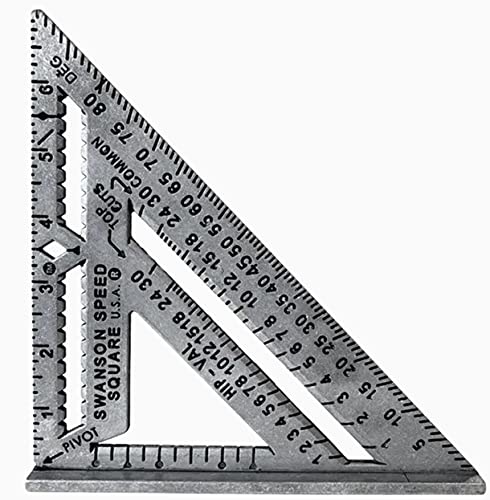
 Swanson Speed Trim Square 4.5-Inch Aluminum Cabinetry Triangle4.5 Inch1 x 6.5 x 6.4 Inches0 PoundsCheck on Amazon
 Johnson Level & Tool 1904-0700V 7-1/4" Johnny Square®7-1/4-inch7.25 x 1 x 7.38 inches0.58 poundsCheck on Amazon

What a Pocket Square Needs to Do
A useful pocket square has a rigid stock, a straight blade and a clear 90-degree relationship between them. The stock should register firmly against the timber edge without rocking. If the square moves while you mark, even a well-machined blade will produce a bad line.
For general carpentry, a blade between 75 mm and 150 mm (3 to 6 inches) is practical. A 75 mm square fits easily in a pouch and works well for checking cut ends and short marks. A 150 mm version reaches farther across a board and is easier to read, but takes more room and is more likely to catch on other tools.
Look for etched or deeply engraved graduations rather than printed markings. Printed scales wear off when covered in dust, glue or pencil marks. A thick aluminum or steel blade usually survives site use better than thin stamped sheet metal, though the cheapest thick-looking squares can still have a poorly set stock.
Types Worth Considering
| Type | Best use | Advantages | Limitations |
|---|---|---|---|
| Small try square | Checking cut ends and marking short shoulders | Rigid, simple and quick to use | Limited reach; no adjustable fence |
| Small combination square | 90-degree and 45-degree marking | Adjustable blade, depth setting and extra functions | More parts to loosen, clog or lose accuracy |
| Pocket framing square | Framing marks and checking larger corners | Longer reach and familiar framing layout | Less convenient in a tool pouch; thin versions can bend |
| Engineer’s square | Precise bench and joinery work | Often very accurate with a solid stock | Usually lacks carpentry graduations and may rust |
For most site carpenters, a small try square is the safest low-maintenance option. If you also mark 45-degree cuts, set short depths or need to scribe parallel lines, a 6-inch combination square is more versatile.
Try Squares for Timber Corners
A try square is ideal for checking whether a timber end has been cut square to its face. Put the stock against the reference face and hold it tight. Check the blade against the end grain, then turn the square over and repeat from the opposite side. If the gap changes sides, the cut or the square may be out.
That two-sided check matters. A square can appear accurate when used one way but reveal an error when reversed. The error may come from a blade that is not square to the stock, a chipped edge, or debris trapped between the stock and timber.
For rough framing, a basic 4-inch carpenter’s try square is often enough. The cheaper option is fine when you are checking stud ends that will be hidden, provided it passes a quick accuracy test. A premium square earns its cost when you mark visible joinery, repeated components or work where a 1 mm error will compound across several parts.
When a Combination Square Is Better
A combination square is the more useful all-round pocket tool. Slide the stock along the blade to mark a shoulder at a repeatable distance, use the 45-degree face for miters, and use the rule to transfer measurements. Some include a level vial or scriber, but these extras should not outweigh the accuracy of the main square.
Check that the locking screw clamps the blade without twisting it. Cheap models often have a loose slider that moves when you push the square against timber. A blade that slips by 1 mm can ruin a row of identical housings or tenon shoulders. For site work, choose a model with a readable 150 mm blade if it still fits your pouch; for cramped work, 100 mm is easier to handle.
Keep the blade and stock clean. Fine sawdust under the slider changes the setting, while grit in the locking mechanism can prevent the blade from seating properly. Do not use the square as a pry bar or a screwdriver. That is a common way to bend the blade or damage the locking screw.
Testing Square Accuracy on Site
You can check a pocket square in under a minute. Place the stock against a straight board edge and draw a line across the board with the blade. Flip the square over, keep the stock on the same edge and place the blade against the first line. If the two lines diverge, the square is not true. A 1 mm gap over 100 mm represents roughly a 0.57-degree error, which is significant for joinery.
Test near the middle of the blade rather than relying on the tip alone. A damaged tip can be out while the rest of the blade remains accurate. Also check the stock for burrs, dents and packed dust. A square that is accurate on a clean workbench may give poor results against rough-sawn timber because the stock bridges high spots.
Buying and Carrying Advice
For a dedicated pocket tool, choose a square with a blade at least 2 mm thick, a stock that does not flex under finger pressure and graduations that remain legible after abrasion. Stainless steel resists rust, while hardened steel can offer a sharper, more durable edge but needs drying after wet work.
A small stainless steel try square suits damp sites and outdoor framing. An aluminum square is lighter and will not rust, but its edges can dent if carried loose with chisels or other steel tools. Store it in a narrow pouch or sleeve, and check it before important marking rather than assuming an expensive square is permanently accurate.
If you regularly check long timber corners, add a 12-inch framing square to the kit. Use the pocket square for fast local checks and the longer square when an error over 300 mm or more would affect the fit. That combination covers most site carpentry without forcing one tool to do jobs it cannot handle.