What's inside
As an Amazon Associate I earn from qualifying purchases. This post may contain affiliate links at no extra cost to you.
A marking knife earns its place when a pencil line is too wide or a gauge line needs to guide a chisel. On hardwood, the knife’s main job is to cut a clean reference edge across the grain without tearing fibers or wandering. The best choice depends less on a fancy handle than on blade shape, control and how easily you can keep the edge sharp.
As an Amazon Associate we earn from qualifying purchases at no extra cost to you.


Sections
Our Top Picks

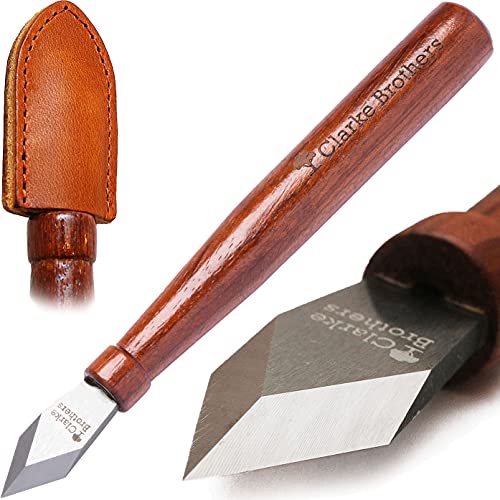


What to look for in a marking knife
For general joinery, choose a knife with a thin, rigid blade and a bevel on one side. The flat side registers against a square, rule or template; the bevel helps the edge cut into the wood. A double-bevel blade can work, but it is harder to keep precisely against a straightedge because the bevel may push the knife away from it.
Blade length is a trade-off. A blade around 25–40 mm (1–1½ in.) offers good control for tenon shoulders, dovetails and short layout marks. A longer blade can reach into a deep mortise or follow a template, but it is easier to twist. A pointed, narrow blade gets into tight corners; a broader blade is more stable for longer cuts. For a first knife, favor control over maximum reach.
Check that the blade is firmly held and has enough steel to sharpen repeatedly. A replaceable-blade knife saves sharpening time, but thin utility-style blades can flex and may not register as steadily against a rule. A fixed blade takes more care to maintain, yet is often the better fit for repeated, accurate joinery work.
Which type suits the work?
| Type | Best use | Trade-off |
|---|---|---|
| Single-bevel marking knife | Shoulder lines, dovetails and knife walls against a rule | Must be oriented correctly; the flat face needs to register against the reference |
| Double-bevel marking knife | General marking when either side may be used | Less convenient for registering one face tightly against a straightedge |
| Replaceable-blade knife | Occasional layout or quick work where sharpening is a nuisance | Blade flex and replacement cost can outweigh the convenience |
| Utility knife | Rough layout, trimming and site work | Usually less precise and less comfortable for controlled, repeated cuts |
A dedicated single-bevel marking knife is the straightforward pick for fine joinery. A double-bevel knife is reasonable if you value ambidextrous use or will mark more than cut to the line. If your work is occasional and you already own a sharp precision utility knife, there is no need to buy another tool until the blade’s flex or handle becomes a real limitation.
Making a clean line in hardwood
Hard maple, oak and similar woods expose poor technique quickly. A heavy first pass can skate along the grain, crush a corner or veer off a square line. Start by holding the knife nearly upright, with its flat face against the rule. Make one light pass to establish the cut, then repeat with slightly more pressure if needed. Two or three controlled passes are safer than one forceful stroke.
For a shoulder line, square the knife across the face and cut just deep enough to create a clear shoulder—often about 0.5–1 mm for typical hand-cut joinery. Keep the line on the waste side of the final dimension. When chopping to it, work from the waste and pare back until the chisel meets the knife wall. Cutting directly on the finished side can leave the joint undersized.
Across figured or open-grained hardwood, the knife may follow a fiber instead of the straightedge. A light scoring pass reduces that risk. If the mark still wanders, stop and reset; pressing harder usually deepens the mistake. On a very hard surface, a sharp knife matters more than extra force.
Edge care and common failure modes
A blunt knife needs pressure, and pressure makes slipping more likely. Hone the bevel on a fine stone or suitable sharpening plate, then remove the burr. Keep the blade thin and keen rather than grinding away metal to make it look polished. If the knife has a single bevel, preserve that geometry and keep the back flat enough to register cleanly.
Watch for three common problems. First, a knife held with the bevel against the rule can drift because the bevel lifts the flat face away from the reference. Second, a loose blade can shift mid-mark; tighten its fastener before layout, not after a bad cut. Third, a very deep knife line can act like a split starter when you pare across the grain. Use a shallow reference cut, then deepen only where the joint requires it.
What to buy for your bench
For regular dovetails, tenons and fitted casework, buy a rigid single-bevel knife that feels steady in your hand and can be sharpened without awkward disassembly. A comfortable handle helps control, but avoid choosing by handle material alone. Blade security and a flat reference face matter more.
For occasional repairs, site layout or rough carpentry, a sharp utility knife is often enough. Its blade is easy to replace, and the lower cost is sensible when marks do not need to guide a fine chisel cut. Just check for blade play and avoid using a flexible blade against a precision rule. A marking knife improves accuracy; it cannot compensate for a moving straightedge, a dull chisel or a line placed on the wrong side of the cut.