What's inside
As an Amazon Associate I earn from qualifying purchases. This post may contain affiliate links at no extra cost to you.
Sections
Our Top Picks
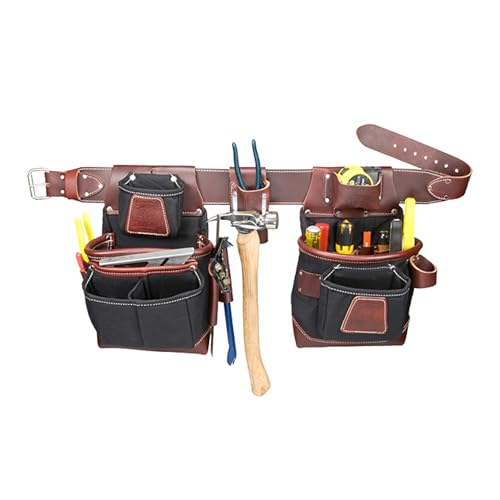
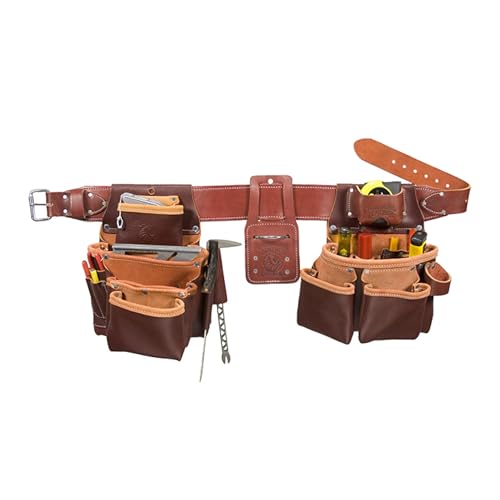
Why leather still matters for hand tool carry
For power tools, nylon and polyester belts are hard to beat – they’re light, cheap, and you can hose them off. For hand tools like chisels and planes, leather has a practical advantage: it doesn’t flex and sag under point loads, it protects you from sharp edges, and it holds its shape so tools don’t shift as you move.
A house carpenter carrying a drill and a speed square can get away with a floppy nylon pouch. A joiner or finish carpenter carrying four to six bench chisels, a block plane, a marking gauge, and a 12-foot tape needs structure. Leather pouches stay open when empty, so you can re-sheath a chisel one-handed without looking down and without cutting the pouch. After six months of daily use, nylon pouches fray where chisel ferrules rub. Leather burnishes instead of fraying.
As an Amazon Associate we earn from qualifying purchases at no extra cost to you.


The downside is weight and break-in. A full leather rig weighs 3.5 to 5.5 pounds empty versus 1.8 to 2.5 pounds for nylon. It will be stiff for the first two to three weeks and needs occasional conditioning if you work outside in rain. If you only carry hand tools occasionally, you don’t need to pay for leather.
What makes a belt comfortable all day
Comfort isn’t about padding. It’s about weight distribution and preventing pressure points. Three details matter more than brand name:
1. Belt width and stiffness. A belt narrower than 2.5 inches will dig into your hips when you load 12 to 18 pounds of hand tools. Look for 2.5 to 3 inches wide, 10 to 12 oz leather (about 4 to 4.8mm thick). It should support weight without rolling over. If you can fold the belt in half lengthwise with one hand, it’s too soft to carry planes comfortably.
2. Suspenders or shoulder yoke. Anything over 10 pounds total should be on suspenders. Without them, you tighten the belt to keep it from slipping, which puts pressure on your lower back and hips. A simple H-back or Y-back set of leather tool belt with suspenders transfers 60-70% of the weight to your shoulders. Padded 2-inch wide suspenders prevent cutting into your traps – avoid 1-inch dress-style suspenders.
3. Pouch placement. For hand tool work you want a low-profile setup, not a bulky framing rig with three deep bags. The classic mistake is hanging a big open pouch on your dominant side and loading it with chisels, a block plane, and a hammer. It swings when you walk and bangs your knee on stairs. Better: a slim chisel pouch or slotted holder tight against the hip, and a separate small pouch for marking tools on the other side. Your front should stay clear so you can bend over a bench without tools jabbing your stomach.
Failure mode to watch for: cheap leather belts use a single snap or roller buckle with holes punched every inch. Under load the holes elongate and the belt slips one notch by lunchtime. A double-prong roller buckle or a grommeted belt with holes every 3/4 inch holds adjustment all day.
Carrying chisels safely
Chisels should never ride loose in an open pouch. An exposed edge will cut the pouch, cut you when you reach in, and roll off a bench if you set the belt down. You have two safe options:
Slotted chisel holder: A leather strip with 4 to 6 vertical slots, usually worn on the belt behind the hip. Each chisel sits edge-down with the handle up, ferrule protected by the leather. Good leather holders have a welted bottom so edges don’t poke through. Capacity is typically four 1/4-inch to 1-inch bench chisels plus a marking knife. Weight is under 8 ounces.
Closed pouch with edge guards: Some makers offer a deep pouch with internal leather sleeves. It’s slower to draw from but better if you move around site a lot or climb ladders. Never carry chisels edge-up.
If you carry more than six chisels, don’t put them on your belt. Use a leather chisel roll in your toolbox and belt-carry only the two or three you are using for the current task. A full set of Stanley Sweetheart or Narex bench chisels weighs 4 to 5 pounds by itself – that weight on your hip will fatigue you and swing awkwardly.
Check stitching around slots. Single-needle stitching with thin thread will pop when a tight chisel is forced in and out. Look for double-stitched or riveted stress points, especially at the top and bottom of each slot.
Carrying planes and other heavy hand tools
No belt comfortably carries a No. 4 or No. 5 bench plane all day. A Stanley No. 4 weighs 4.2 pounds, a WoodRiver No. 5 is over 5 pounds. Hanging that on a belt pulls your whole rig sideways and makes bending impossible.
What you can carry comfortably:
Block planes (12 to 14 oz), small shoulder planes, and trim planes up to about 1.5 pounds will ride in a dedicated plane pocket or a shallow leather holster on the non-dominant side. The pocket should have a flat bottom, not a pointed pouch bottom, so the plane sits sole-down and doesn’t tip.
For anything larger, the belt is for transport between bench and work, not all-day carry. Many joiners use a leather apron with a single plane pocket for short moves – set the plane down when you are actually shooting or paring. If you insist on belt-carrying a bench plane, you need a wide 3-inch belt with a hammer-loop style holster and suspenders, and you should balance it with equal weight on the opposite hip.
The other weight to plan for is marking and measuring tools: a 12-foot tape (8 oz), combination square (9 oz), marking gauge (6 oz), and pencils. Keep these in a separate slim pouch so they don’t rattle against chisel handles and dull edges.
Leather belt types compared
There are four common configurations. The right choice depends on whether you are on site all day or mostly at a bench.
| Configuration | Typical Empty Weight | Best For | Weakness |
|---|---|---|---|
| Leather apron with pockets | 1.5 – 2.2 lb | Bench work, shop joinery, carrying 2-3 chisels + block plane + marking tools | No back support, not ideal for ladders or heavy loads |
| Single leather pouch on belt | 2.5 – 3.5 lb | Minimalist site carry, finish carpentry | Weight unbalanced if you load it heavy |
| Two-pouch leather belt (no suspenders) | 4.0 – 5.0 lb | General carpentry under 10 lb total | Slips without suspenders when loaded over 10 lb |
| Two-pouch belt + suspenders / yoke | 5.0 – 7.0 lb | All-day site work with 12-18 lb of hand tools | Hot in summer, heavier, needs break-in |
For most hand-tool carpenters, the sweet spot is a two-pouch belt with suspenders where you leave one pouch half-empty. It gives you room to add a block plane or extra chisels when needed without being bulky when you don’t.
What to actually buy
You don’t need to spend $300 to get a functional leather rig, but the $40 “genuine leather” belts on Amazon are usually bonded leather or thin 5-6 oz splits that will stretch and tear at rivets within months. Real tool leather will be described as full-grain, 8-12 oz, often vegetable-tanned or oil-tanned.
Budget that works: A plain 2.75-inch full-grain belt ($45-70) plus a separate slotted chisel holder ($35-55) and a small leather apron for bench days ($30-50) will outperform a cheap all-in-one rig. This modular approach also lets you strip down to just the chisel holder and belt when you want to be light.
Mid-range upgrade worth paying for: If you work 6+ hours on your feet, add padded suspenders and a belt with a sewn-in keeper rather than a loop. The keeper prevents tail flap and keeps the buckle centered. Oil-tanned leather needs less maintenance than vegetable-tanned and resists water staining if you work in and out of buildings.
When leather is not the answer: If you work mostly with pine and MDF on install, a nylon belt with a leather chisel sleeve insert is lighter and dries faster. If you sweat heavily, a hybrid – leather holders on a nylon belt – gives you edge protection without a hot leather yoke on your back.
Concrete buying checklist before you order: belt width over 2.5 inches, leather thickness listed in ounces (8 oz minimum), rivets at all pouch-to-belt joints not just stitching, slotted chisel holder with welted bottom, and suspenders that clip or loop to the belt at four points, not two. If a listing doesn’t list leather weight or shows a single snap without rivets, skip it and look at a proper full grain leather carpenter apron or belt from a dedicated leather tool maker instead.
Break-in tip: Wear the belt around the house for two evenings with the tools loaded. Apply a light coat of neatsfoot or leather balm to the flesh side only – not the smooth side where tools slide in and out or you’ll attract sawdust that acts like sandpaper on handles.