What's inside
- Quick comparison: best band saws by shop situation
- Which of the best band saws fits your work?
- Throat capacity, resaw height, and motor power explained
- Blade options matter more than many buyers expect
- Decision matrix for budget, space, and experience
- Ownership realities: footprint, maintenance, and consumables
- A practical resaw setup in six steps
- Final recommendation
- Quick comparison: best band saws by shop situation
- Which of the best band saws fits your work?
- Throat capacity, resaw height, and motor power explained
- Blade options matter more than many buyers expect
- Decision matrix for budget, space, and experience
- Ownership realities: footprint, maintenance, and consumables
- A practical resaw setup in six steps
- Final recommendation
As an Amazon Associate I earn from qualifying purchases. This post may contain affiliate links at no extra cost to you.
The best band saws for most woodworkers are a 14-inch floor-standing saw with at least 12 inches of resaw height, a 1½–2 hp motor, a cast-iron table, and a blade guide system that can hold a sharp ½-inch resaw blade accurately.
As an Amazon Associate we earn from qualifying purchases at no extra cost to you.

Sections
- Quick comparison: best band saws by shop situation
- Which of the best band saws fits your work?
- Throat capacity, resaw height, and motor power explained
- Blade options matter more than many buyers expect
- Decision matrix for budget, space, and experience
- Ownership realities: footprint, maintenance, and consumables
- A practical resaw setup in six steps
- Final recommendation
Quick comparison: best band saws by shop situation
| Best for | Example saw | Throat capacity | Resaw height | Motor | Approximate market range |
|---|---|---|---|---|---|
| Small shops and curved work | Rikon 10-305 | 10 inches | 4⅝ inches | ½ hp | $600–$800 |
| General-purpose value | Rikon 10-326 | 13 inches | 13 inches | 1¾ hp | $1,200–$1,600 |
| Resawing and larger furniture parts | Laguna 14|12 | 13¾ inches | 12 inches | 1¾ hp | $1,700–$2,200 |
| Heavy shop use | Laguna 14BX | 14 inches | 12 inches | 2½ hp | $2,400–$3,000 |
| Large stock and frequent resawing | Grizzly G0513X2B | 16¼ inches | 12 inches | 3 hp | $2,000–$2,700 |
| Portable job-site cutting | DeWalt DWM120 | 5 inches | 5 inches | 10-amp corded motor | $500–$700 |
Specifications can vary by revision, wheel kit, and regional configuration, so confirm the current manufacturer specification before ordering. The figures above are intended for comparing the saw classes and their practical limits.
Which of the best band saws fits your work?
Choose the Rikon 10-305 for curves in limited space
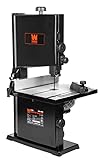
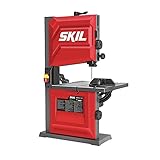
The Rikon 10-305 is a compact 10-inch benchtop band saw aimed at smaller workpieces, scrolling, craft parts, and occasional joinery. Its 10-inch throat gives more usable room than many entry-level saws, while the 4⅝-inch cutting height limits it to thinner boards and small blanks.
Its main advantage is footprint: the saw can fit on a sturdy bench instead of consuming floor space. Its limitations are equally important. A ½ hp motor is suitable for narrow blades and moderate feed rates, but it is not the right choice for repeatedly resawing wide hardwood boards. A 10-inch saw also has less wheel diameter and blade stability than a full-size 14-inch machine.
Choose the Rikon 10-326 for the strongest value balance
The Rikon 10-326 is a 14-inch class saw with a 1¾ hp motor, 13-inch resaw capacity, and a 13-inch throat. That combination covers most furniture-making tasks: cutting curves, ripping tenons, preparing veneers, and resawing boards that are too large for benchtop machines.
It is especially appealing when you need substantial capacity but cannot justify a heavier 2½- or 3-hp machine. Before buying, check whether the included fence, wheel kit, and electrical configuration match your shop. A saw with high capacity still needs a rigid stand and adequate dust collection to perform well.
Choose the Laguna 14|12 for controlled resawing
The Laguna 14|12 combines a 13¾-inch throat, 12-inch resaw height, and 1¾ hp motor in a relatively compact 14-inch floor-standing design. Its blade-guide layout and tracking adjustments make it a strong choice for woodworkers who switch between narrow curve-cutting blades and wider resaw blades.
The 12-inch height is enough for many cabinet panels and bookmatched boards, but the motor is not a substitute for a slow, controlled feed. Dense hardwood, a dull blade, or an overly aggressive cut can overload any saw in this class. If you routinely work at the full height with wide stock, the 14BX or a 3-hp machine provides more reserve.
Choose the Laguna 14BX for demanding regular use
The Laguna 14BX increases motor power to 2½ hp and provides a 14-inch throat with 12 inches of resaw height. The extra power is most useful when cutting dense hardwoods, maintaining a steady feed through thick stock, or running the saw for longer sessions.
It is a substantial investment, and the larger motor does not eliminate the need for the correct blade. The 14BX makes sense for a serious furniture shop, small professional operation, or experienced user who resaws frequently. For occasional curve cutting, its cost and footprint are difficult to justify.
Choose the Grizzly G0513X2B for maximum capacity per dollar
The Grizzly G0513X2B offers a 16¼-inch throat, 12-inch resaw height, and 3 hp motor. Its wider throat is valuable when cutting large curves, wide panels, and substantial bowl blanks. The motor also gives it a comfortable margin for repeated resawing.
The trade-off is space and mass. A large band saw needs room around the table for feeding long boards, not merely enough floor area for the cabinet. It may also require a dedicated electrical circuit depending on the configuration and local wiring. This is a production-oriented choice rather than a compact hobby machine.
Choose the DeWalt DWM120 when portability matters most
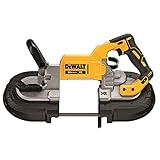
The DeWalt DWM120 is a portable metal-cutting band saw, not a replacement for a stationary woodworking band saw. Its 5-inch capacity and compact frame suit cutting pipe, conduit, angle stock, and other job-site materials. It is useful to contractors who need a portable saw, but its blade speed, table arrangement, and capacity are not intended for furniture curves or board resawing.
Throat capacity, resaw height, and motor power explained
Throat capacity is the distance from the blade to the frame. It determines how far a workpiece can extend to the right of the blade. A 10-inch throat is adequate for many small projects; 13–14 inches is more comfortable for furniture parts; 16 inches or more benefits large curves and wide panels.
Resaw height is the maximum thickness the blade can cut vertically. Do not treat it as a guarantee that the saw will resaw that thickness quickly. The practical limit depends on blade sharpness, stock hardness, fence alignment, dust extraction, and feed rate.
Motor power matters most at high cutting heights and with dense stock. A ½ hp motor works for light work, while 1½–1¾ hp is a versatile middle ground. A 2½–3 hp motor is preferable for frequent thick-board resawing. More power cannot correct a poorly tensioned blade or a fence that is out of alignment.
Blade options matter more than many buyers expect
Plan to own several blades rather than searching for one universal blade:
- ⅛-inch to ¼-inch, 6–10 teeth per inch: tight curves and smaller scroll-style work.
- ⅜-inch, 4–6 teeth per inch: general curves, joinery, and moderate ripping.
- ½-inch to ¾-inch, 2–3 teeth per inch: resawing and straight cuts in thick stock.
- Hook or skip-tooth profiles: faster clearing of sawdust in wood.
- Bi-metal blades: useful for tougher materials, but usually unnecessary for ordinary wood projects.
Blade width must suit the task and the saw’s minimum wheel radius. A wide blade tracks more steadily for resawing but cannot turn as tightly as a narrow blade. Keep a spare blade available: forcing a dull blade increases heat, drift, and motor load.
Decision matrix for budget, space, and experience
| Your situation | Recommended class | Why | What to avoid |
|---|---|---|---|
| Beginner, occasional projects, very limited space | 10-inch benchtop, such as the Rikon 10-305 | Lower cost and compact footprint | Expecting it to resaw thick hardwood |
| Intermediate user, mixed furniture work | 14-inch, 1¾ hp saw | Best balance of capacity and cost | Buying on motor power alone |
| Frequent resawing of hardwood | 14-inch, 2½ hp or larger | More feed-rate reserve and stability | Using a narrow general-purpose blade |
| Large curves, slabs, or production work | 16-inch, 3 hp class | More throat space and sustained power | Ignoring electrical and dust-collection requirements |
| Job-site metal cutting | Portable metal-cutting band saw | Transportable and designed for metal stock | Using it as a woodworking resaw machine |
Ownership realities: footprint, maintenance, and consumables
Measure more than the cabinet. Leave clearance for a board entering the table, a board leaving it, and access to the blade door. A 14-inch saw may occupy roughly 2 by 3 feet, but a long resaw setup can require several times that length in clear space. Add the footprint of an outfeed support if you cut long boards.
The items that wear first are usually blades, tires, guide bearings, thrust bearings, and dust-collection components. Replace a blade when its teeth are dull, missing, or producing excessive burn despite correct setup. Inspect tires for cracking or glazing, and remove packed dust from the wheel rims.
Before each resawing session, clean the table and blade, set the upper guides just above the workpiece, tension the blade according to its width, and verify that it tracks centrally on the wheel. Align the fence to the blade’s actual drift rather than assuming it is perfectly parallel to the table. Feed steadily without pushing harder when the blade begins to wander.
A practical resaw setup in six steps
- Install a sharp wide blade with roughly 2–3 teeth per inch.
- Set the blade tension and tracking while the machine is unplugged, then close the guards.
- Raise the upper guide only high enough to clear the board by a small amount.
- Use a tall, stable fence or resaw point fence to support the stock.
- Make a shallow test cut and adjust the fence for drift before committing valuable lumber.
- Maintain a feed rate that produces continuous chips without forcing the motor or closing the gullets with dust.
For a 12-inch-high board, allow extra stock for setup cuts and possible drift correction. If a blade removes an approximately ⅛-inch kerf, two bookmatched pieces from a 1-inch board will not retain a full ½ inch each; account for the kerf, planing, and surface defects before selecting lumber.
Final recommendation
For most woodworking shops, a 14-inch saw with a 1¾ hp motor and about 12–13 inches of resaw height is the sensible target. Choose the Rikon 10-305 when curves and space matter more than capacity, the Rikon 10-326 or Laguna 14|12 for versatile furniture work, the Laguna 14BX for frequent demanding resawing, and the Grizzly G0513X2B when large stock and maximum capacity justify the larger footprint.