What's inside
As an Amazon Associate I earn from qualifying purchases. This post may contain affiliate links at no extra cost to you.
Sections
Best Airbrush Compressors for Quiet, Reliable Spraying
The best airbrush compressor for most hobbyists is a tank-equipped, oil-free model that delivers roughly 0.5–0.8 CFM at 20–30 PSI, has a regulated moisture trap, and can cycle off while you spray; choose a compact tankless unit only if portability matters more than steady airflow and quieter operation.
Airbrushes need modest pressure, but they still need a consistent supply of air. Match the compressor to your brush, nozzle, paint, and working rhythm—not just its maximum PSI. A small tank smooths pressure pulses and lets the motor rest between cycles, while airflow capacity determines whether the compressor can keep up during longer passes.
As an Amazon Associate we earn from qualifying purchases at no extra cost to you.


Compare the main compressor types
| Setup | Typical airflow | Tank | Typical noise | Best fit |
|---|---|---|---|---|
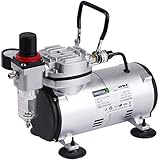
| Compact tankless airbrush compressor | About 0.2–0.4 CFM at airbrush pressures | None | About 40–55 dB | Occasional detail work, small spaces, travel |
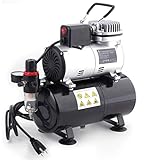
| Airbrush compressor with receiver tank | About 0.4–0.8 CFM | 0.3–1.0 L | About 45–60 dB | Regular hobby use and smoother spray delivery |
| Quiet, larger receiver compressor | About 1–2 CFM at low pressure | 1–6 gal | About 40–60 dB, depending on design | Long sessions, multiple airbrushes, or shared workshop tasks |
These are useful comparison ranges, not guaranteed specifications for every model. Manufacturers may report airflow at different pressures or use theoretical displacement rather than delivered air. For a fair comparison, look for air delivery at a stated pressure and check the compressor’s duty cycle and sound rating under similar conditions. Noise figures also depend on distance, room acoustics, and whether the motor is enclosed.
Choose by your workspace and spraying habits
- Small apartment or shared room: Prioritize a quiet, tank-equipped airbrush compressor, rubber feet, and a flexible hose long enough to place the unit farther from your bench. Avoid assuming “quiet” means inaudible; a motor cycling on can still interrupt calls or sleep.
- Occasional miniatures or touch-ups: A tankless unit can be an economical, compact choice if your sessions are short and your brush has a small nozzle. Expect the motor to run more often and pressure to be less buffered.
- Frequent model painting or larger coverage: Choose a receiver tank of around 0.5–1.0 L and verify adequate delivered airflow. The tank supports smoother bursts, but it does not create extra sustained capacity: the pump must still replenish it.
- Several brushes or mixed workshop use: Consider a larger compressor with a regulator and suitable filters. Confirm it can operate stably at airbrush pressures; some general-purpose shop compressors have regulators that are less precise at the low end.
What to look for before buying
Airflow and pressure control
Most common airbrush work takes place around 15–30 PSI, with the right setting varying by paint, thinning, nozzle size, and technique. A compressor’s maximum PSI is rarely the deciding number. Check that it can provide enough airflow at your working pressure without running continuously. A dual-action brush used for fine lines may consume less air than broader coverage with a larger nozzle, but the brush’s own specification is the best starting point.
Use a regulator with a readable gauge and adjust pressure while air is flowing. Static pressure can look higher than the pressure available during spraying. If the compressor’s airflow is marginal, raising the pressure may make the motor work harder without fixing inconsistent delivery.
Tank capacity and duty cycle
A receiver tank acts as a buffer: the compressor fills it, and the airbrush draws from it. A larger tank generally means fewer motor starts during intermittent spraying, but it adds bulk and takes longer to refill. For airbrushing, a modest tank often provides the useful balance; buying a large tank does not compensate for a weak pump during sustained spraying.
Duty cycle tells you how long the motor is designed to run within a stated period. For example, a 50% duty cycle means about five minutes of operation in a ten-minute period under the manufacturer’s stated conditions, followed by time to cool. Check the exact definition in the manual. A motor that runs continuously beyond its rating can overheat and wear prematurely.
Moisture control and fittings
Compressed air cools as it expands, and moisture can collect in the line or tank. A moisture trap near the compressor is useful, but in humid conditions a second trap closer to the airbrush may help. Drain a receiver tank as the manual directs, especially after a session. Confirm hose threads and adapters before ordering: airbrush and shop-compressor fittings are not always interchangeable.
Three practical buying profiles
| Shopper | Recommended configuration | Trade-off to accept |
|---|---|---|
| Beginner with limited space | Oil-free airbrush compressor, 0.3–0.5 L tank, regulator, moisture trap | Less reserve air than a larger unit; still may be audible indoors |
| Regular hobby painter | Oil-free compressor, 0.5–1.0 L tank, roughly 0.4–0.8 CFM delivered, suitable duty cycle | More weight and cost than a basic tankless model |
| Long sessions or multiple tools | Quiet larger receiver compressor with low-pressure regulation and appropriate filtration | More floor space, plumbing, and maintenance; verify low-pressure control |
These profiles describe configurations, not endorsements of a specific model. Established airbrush and compressor makers such as Iwata, Sparmax, and California Air Tools offer products in this broader category; compare the exact model’s current specifications, warranty, and service support before choosing. Prices vary by capacity and included accessories, so treat broad market ranges as a starting point rather than a prediction of a particular model’s price.
Setup and ownership details that affect reliability
- Place the compressor on a firm, ventilated surface. Soft, unstable furniture can amplify vibration, while blocked vents can trap heat.
- Connect the regulator, trap, and hose in the order specified by the manufacturer. Check seals and fittings for leaks before spraying; a leak can keep the motor cycling even when the brush is idle.
- Set pressure with air flowing. Test on scrap using the same paint and brush setup you plan to use. Adjust in small increments rather than relying on a universal PSI figure.
- Drain moisture and follow the duty-cycle limit. Empty the receiver as instructed, keep the intake clear, and give the motor cooling breaks when required.
Oil-free compressors are convenient for paint work because they avoid oil entering the air stream, but they are not maintenance-free. Dust-clogged intakes, loose fittings, worn seals, and neglected tank drainage are common sources of trouble. If the compressor starts cycling unusually often, check for leaks first. If output pulses or drops during a long pass, the cause may be inadequate airflow, a full moisture trap, a restricted filter, or an undersized hose—not simply low tank capacity.
Bottom line
For steady, quiet airbrushing, start with an oil-free compressor that has a modest receiver tank, a dependable low-pressure regulator, and enough delivered airflow for your brush. Choose tankless for portability and short sessions; step up to a larger receiver only when your work duration or tool demand justifies the extra space. The most useful comparison is not maximum PSI, but airflow at your working pressure, duty cycle, noise in your room, and the effort required to drain and maintain the system.