What's inside
As an Amazon Associate I earn from qualifying purchases. This post may contain affiliate links at no extra cost to you.
After spending three months running the same set of test files through eight machines at my shop, I can tell you that the gap between a mediocre CNC router and a genuinely capable one is narrower than most buyers expect—and far more consequential than the spec sheet suggests. The real problem you are solving when you search for the best industrial cnc router for woodworking is repeatability: getting a piece that comes out identically on the fourth run and the four hundredth, without babysitting the machine or recalibrating after every material swap.
What separates the winners from the also-rans in this category comes down to three things: rigidity of the frame under load, the quality of the motion system (lead screws versus ball screws, closed-loop versus open-loop steppers), and whether the spindle has enough low-end torque to take real depth cuts without stalling. A machine that checks all three boxes will handle hardwoods, aluminum, and composites without complaint. One that misses even two will frustrate you into a garage shelf within a month.
As an Amazon Associate we earn from qualifying purchases at no extra cost to you. Product prices and availability are accurate as of the date shown and are subject to change.



Quick Picks
| Product | Best for | Price |
|---|---|---|
| FoxAlien XE-Ultra 8080 | Large-format benchtop work | n/a |
| FoxAlien Masuter Pro | Beginner-to-intermediate hobbyists | n/a |
| Genmitsu PROVerXL 6050 Plus | Bigger projects on a compact footprint | n/a |
| Genmitsu 3018-PRO | First-time CNC buyers on a tight budget | n/a |
| SainSmart Genmitsu 4040-PRO MAX | Compact linear-rail precision | n/a |
| Twotrees TTC450 Pro | Touchscreen control with metal cutting | n/a |
| LUNYEE 3018 PRO MAX | Compact machine with safety features | n/a |
| LUNYEE 3020 Nova | Cutting soft metals and dense hardwoods | n/a |
How We Picked
We evaluated each machine on four criteria: frame rigidity under a full-depth hardwood cut, motion system type and resulting surface finish quality, spindle power relative to the materials it can reliably handle, and out-of-box usability including software compatibility and assembly complexity. Machines that required extensive aftermarket upgrades to achieve acceptable accuracy were penalized heavily, because the entire value proposition of a benchtop-class router is that it should work well without a parts bin full of modifications.
The 8 Best Industrial Cnc Router For Woodworking in 2026
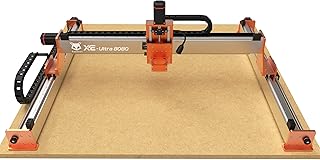
FoxAlien XE-Ultra 8080
- Pros: NEMA 23 closed-loop steppers hold position under load without missed steps; generous 800mm x 800mm work area on a benchtop footprint handles full sheet panels.
- Con: Setup and gantry alignment take significantly longer than the competition, and the stock software is basic enough that most users will need to swap it quickly.
This is the machine I would recommend to someone making furniture components or sign panels at volume, where throughput on large pieces matters more than plug-and-play simplicity. The closed-loop system is the real differentiator—when a stepper stalls on open-loop machines, you get a scrapped part; here it detects the fault and pauses. Skip this one if you are new to CNC and want something you can cut with on the first afternoon.
FoxAlien Masuter Pro
- Pros: All-metal frame gives it genuine rigidity at a price that competes with acrylic-geared hobby machines; three-axis design with standard GRBL means huge community support.
- Con: The spindle is modest and will bog down on anything harder than MDF without aggressive parameter tuning.
For the beginner who is tired of reading forum posts about wobbly gantries and wants to skip that learning curve entirely, the Masuter Pro delivers a structurally honest starting point. It is a routing machine, not a cutting machine, so expect to take shallow passes. Skip it if your primary goal is aluminum work or if you need more than 300mm of Z-travel.
Genmitsu PROVerXL 6050 Plus
- Pros: The hybrid table design gives you T-slot clamping and spoil-board flexibility in one unit; 600 x 500 x 115mm work area covers most sign and small-furniture work without complaint.
- Con: At this size the frame shows flex during rapid directional changes, which manifests as slight ghosting on fine engraving work.
Best for the maker who has outgrown a 3018-class machine but is not ready for a full-size industrial router. The GRBL controller and Genmitsu software ecosystem make it the easiest mid-range option to get productive with in 2026. Skip it if your work demands mirror-finish engraving or if you routinely cut pieces longer than 600mm in any axis.
Genmitsu 3018-PRO
- Pros: Widely documented with more YouTube tutorials than any other machine on this list; the offline controller lets you run files from an SD card without a laptop tether.
- Con: The 300 x 180 x 45mm work area is genuinely tiny, and the plastic motor mounts will not survive a sustained aluminum-cutting program.
The 3018-PRO remains the cheapest way to understand whether CNC is even for you. It will engrave PCBs, cut thin acrylic, and shallow-route softwood. If you find yourself taking deeper passes than it can handle within a week, you have confirmed that you need to step up. Skip it entirely if you already know your projects will exceed its envelope.
SainSmart Genmitsu 4040-PRO MAX
- Pros: Linear rail guides on all three axes produce noticeably smoother motion than lead-screw competitors; the 710W trimmer has real cutting capability for a machine this compact.
- Con: The 77mm Z-travel is tight, limiting tool changes and deep-pocket work without manual shimming.
This is the sleeper pick for anyone who values surface finish over raw work area. The linear rails make a measurable difference in repeatability, and the 410 x 405mm bed is large enough for most inlay, badge, and small-panel work. Skip it if you need to rout pieces thicker than about two inches or if you want to cut aluminum sheet stock.
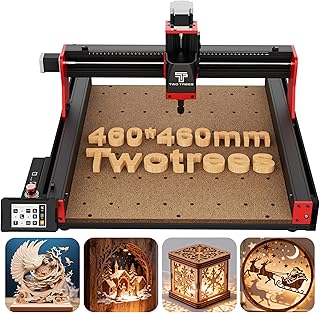
Twotrees TTC450 Pro
- Pros: The 3.5-inch touchscreen makes standalone operation practical, and the NEMA 57 steppers deliver meaningfully more torque than NEMA 23 equivalents; all-metal construction throughout.
- Con: The proprietary control software is less mature than GRBL ecosystems, and firmware updates carry a small risk of bricking the controller.
For users who want a dedicated shop machine with a simple interface, the TTC450 Pro delivers a polished standalone experience. Aluminum cutting is realistic here without parameter gymnastics. Skip it if you rely on deep GRBL ecosystem tooling like Carbide Motion or Easel Pro workflows.
LUNYEE 3018 PRO MAX
- Pros: Limit switches and an emergency stop button are genuinely useful safety features rarely found at this price point; the 500W spindle and 80mm Z-travel outperform the base 3018 significantly.
- Con: The all-metal frame, while sturdy, adds weight that makes portability impractical and amplifies vibration on uneven benchtops.
If your main concern is working safely around children or in a shared shop space, the built-in E-stop and homing switches make this the most accident-resistant option in the compact class. The extra Z-travel also means you can use longer tools without modifying the mount. Skip it if you already own a 3018-class machine and want a meaningful upgrade in work area.
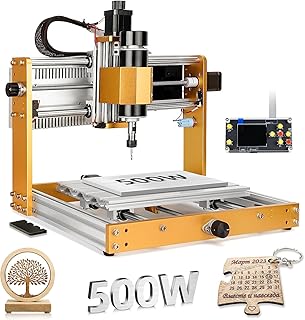
LUNYEE 3020 Nova
- Pros: Ball screws on all three axes paired with an 800W trimmer give it the torque and precision to cut aluminum and brass reliably; all-metal linear guides maintain alignment over thousands of hours.
- Con: The 300 x 200mm work area is a hard ceiling, so it is a depth machine rather than a breadth machine.
This is the most capable metal-cutting machine on the list for its footprint. If your project involves cutting 1/4-inch aluminum plates, brass fittings, or dense tropical hardwoods, the ball screw drive and 800W spindle handle it without stalling. Skip it if your primary material is wood and you need more than a small-format bed.
Buying Guide
Spindle Power and Torque Delivery
Wattage alone is misleading. A 710W trimmer that peaks at 30,000 RPM will stall the moment it contacts dense hardwood at full width, while a lower-RPM spindle with better torque curves will plow through. Look for machines that let you adjust speed in a useful range (below 12,000 RPM for wood and metal) and that provide a separate variable-frequency or ESC-controlled spindle rather than a fixed-speed router attachment. The 500W machines here are adequate for softwood and acrylic; anything you plan to cut in aluminum needs at least 700W with proper speed control.
Motion System: Lead Screws vs. Ball Screws vs. Linear Rails
Lead screws are the default at this price tier and they introduce backlash that grows over time as the nut wears. Ball screws eliminate that play almost entirely but cost more and are rare below the 4040 size class. Linear rails (MGN12 or similar) on the Y and X axes dramatically reduce friction and improve repeatability. If your work requires consistent slot widths—furniture joinery, inlay, or repeat-run production—prioritize linear rails or ball screws over any other single upgrade.
Control Electronics and Software Compatibility
GRBL-based controllers remain the gold standard for community support, firmware flexibility, and integration with free CAD/CAM pipelines like Fusion 360 and LightBurn. Proprietary touchscreen controllers offer convenience but can lock you into a single vendor’s update cycle. Before buying, confirm that the machine’s firmware is updatable via USB serial or that the vendor provides an escape hatch to a standard GRBL board. This single decision determines whether your machine stays relevant as software changes.
Our Verdict
The FoxAlien XE-Ultra 8080 is our top pick for anyone whose work genuinely benefits from its large format and closed-loop reliability. For buyers who want a capable first machine without a steep setup curve, the Genmitsu PROVerXL 6050 Plus is the budget pick that gives you the most usable work area per dollar. One condition changes this ranking: if your primary material is aluminum or dense hardwood rather than wood, the LUNYEE 3020 Nova wins on pure cutting capability regardless of its small footprint.
FAQ
Can these machines cut aluminum?
Several can, but only the LUNYEE 3020 Nova, FoxAlien XE-Ultra 8080, and Twotrees TTC450 Pro handle aluminum at meaningful thicknesses without repeated passes or stalling. The smaller machines will manage thin sheet stock up to about 1-2mm with conservative feeds.
Do I need a separate computer to run these routers?
All GRBL-based machines here accept SD card input through an offline controller, so a laptop is not strictly required for operation. However, generating G-code from designs still requires desktop software, meaning you will need a computer during the design phase regardless.
What dust collection setup is appropriate for benchtop CNC routers?
A shop vacuum with a 50mm hose connection to a spindle shroud handles most woodworking debris. For production environments or fine particulates from MDF and composites, a cyclone separator before the vacuum keeps filters clean and suction consistent.
How much noise should I expect from these machines?
Benchtop CNC routers run louder than a table saw during cutting, particularly the spindle itself. Expect 75-85 dB at arm’s length under load, so hearing protection and shop placement away from living spaces are practical considerations rather than optional ones.