What's inside
As an Amazon Associate I earn from qualifying purchases. This post may contain affiliate links at no extra cost to you.
Sections
Our Top Picks


Why Edge Protection Matters More Than Storage
A sharp chisel edge is fragile. On a bench chisel honed to 25-30 degrees, the very tip is only a few thousandths of an inch thick. Drop it edge-first onto another tool, let it rattle against a plane iron in your bag, or even slide it unprotected across a toolbox drawer and you will roll or chip that edge. You won’t always see the damage, but you’ll feel it on the next cut when the chisel skates instead of pares. Both tool rolls and chisel cases solve this problem, but they do it in completely different ways and with different trade-offs for edge safety, organization, and site use.
What a Tool Roll Actually Does
A tool roll is a flat sheet of fabric or leather with individual pockets, which you roll up and tie or buckle closed. Chisels slide in edge-first or edge-up depending on the design, with a flap that folds over the tops to keep them from sliding out. Most rolls hold 6 to 12 chisels, with pocket widths from 20mm to 32mm for bench chisels. A typical canvas chisel tool roll in 10oz or 12oz waxed canvas weighs 300-400 grams empty, rolls to about 14 inches long and 3-4 inches in diameter, and costs $25 to $55. Leather rolls run $70 to $150 and weigh more.
As an Amazon Associate we earn from qualifying purchases at no extra cost to you.


The roll’s strength is that it keeps edges from touching anything hard. When rolled correctly, each chisel is isolated by two layers of fabric and by air space from the next chisel. The edge itself hangs in the pocket and doesn’t contact the bottom seam if the roll is sized correctly. Good rolls have a separate leather or reinforced patch at the bottom of each pocket to prevent a sharp edge from eventually cutting through. Cheap unreinforced canvas rolls will fail there first. After 6-12 months of daily site use, you’ll see pinholes at the bottom of the pockets where the corners have poked through. That is the primary failure mode to watch for.
Rolls are also soft. You can toss a roll into a tool bag, a site box, or a 5-gallon bucket without worrying that it will dent other tools, and it will absorb impact if the bag is dropped. The downside is zero rigid protection. Step on a roll, trap it under a stack of lumber, or drop a hand plane on it and the cutting edges can be driven through the fabric. They also offer no moisture barrier. Canvas wicks water, and leather needs conditioning. If you work in damp conditions, you still need to oil your chisels before storing them in a roll.
What a Chisel Case Does Differently
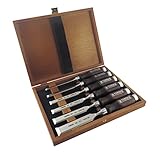
A chisel case is a rigid or semi-rigid box. The classic is a wooden box with a hinged lid and individual slots or a slotted rack inside, often lined with felt or cork. Modern versions are plastic or aluminum cases with molded trays or Kaizen foam cutouts. A wooden case for 8 bench chisels typically measures about 15 x 9 x 3 inches and weighs 1.5 to 2.5 kg empty. A plastic case is lighter but bulkier.
The case protects edges by immobilizing the tool. When the chisel sits in a fitted slot, the edge doesn’t touch anything and can’t rattle side-to-side. Better cases hold the chisel by the handle or ferrule, so the bevel and edge float completely free. This is the best protection against impact. You can drop a wooden case off a tailgate and the edges will usually survive if the lid stays latched. The rigid shell also protects against compression and puncture far better than any roll.
The weaknesses are size, weight, and moisture management. A case takes up 3-4 times the volume of a roll holding the same number of chisels. It doesn’t fit in a tool belt or a crowded site bag. If you only carry 3-4 chisels to a job, a full case is wasted space. Cases also trap moisture. A wooden box with felt lining looks traditional, but felt holds humidity against the steel. Without a light coat of camellia oil or similar and a few ventilation holes, chisels will rust faster in a closed case than in a breathable roll, especially if you bring cold tools into a warm van.
Fitted cases have another failure mode: fit. If you buy a generic case with fixed slots, your 1-1/4 inch slick or your short butt chisels may not fit at all. Foam-insert cases solve this because you cut the pockets yourself, but foam dulls edges if you drag the chisel across it when removing it. You need to lift straight out.
Head-to-Head: Protection, Portability, and Practicality
| Factor | Tool Roll | Chisel Case |
|---|---|---|
| Edge isolation | Good if pockets are reinforced and correctly sized. Edge floats in fabric pocket. | Excellent if chisel is held by handle. Edge touches nothing. |
| Impact resistance | Poor against crushing or point loads. Absorbs light knocks only. | Excellent. Rigid shell prevents deformation and puncture. |
| Protection while carrying | Excellent. Prevents chisels hitting each other. Very compact in a bag. | Excellent, but bulky. Needs separate carry. |
| Weight and size (8 chisels) | ~0.4 kg + tools, rolls to ~14 x 4 in | ~2 kg + tools, ~15 x 9 x 3 in box |
| Moisture / rust risk | Breathable, dries quickly. Still requires oiling. | Traps humidity if lined and sealed. Needs oil and occasional airing. |
| Durability | Fabric wears at pocket bottoms. 2-5 year life on site. | Wood or plastic lasts decades. Foam inserts need replacement every few years. |
| Cost | $25-$55 canvas, $70-$150 leather | $40-$80 plastic, $80-$200 wooden |
| Best for | Site work, mobile kit, mixed hand tool carry | Shop storage, transport in vehicle, long-term protection |
Which Should You Buy for Your Kit?
For most carpenters who carry chisels to site, a roll is the practical choice. It fits in a tote or tool bag alongside a hand plane, marking gauge, and square without adding a separate box to manage. If you do trim or punch work and only need four chisels, an 8-pocket roll with the extra pockets used for a striking knife or 6-inch rule keeps everything in one package. Buy canvas if you want light weight and low cost. It is genuinely fine for protecting edges provided you choose one with reinforced pocket bottoms and a full-length flap. The cheaper option is not a false economy here, especially if you oil your tools. Upgrade to leather only if you want better edge cut-through resistance and don’t mind the extra weight and maintenance.
Choose a case when your chisels live in the shop or travel by vehicle rather than on your person. If you have a set of bench chisels from 1/4 inch to 1-1/2 inch plus mortise chisels that you want to keep as a matched set, a wooden or foam-lined wooden chisel storage case keeps them indexed, visible, and fully protected on a shelf. It is also the better option for premium Japanese chisels or wide paring chisels with delicate, low-angle edges where any contact matters. For site work, some joiners use both: a case stays in the van or shop, and a roll goes to the bench with the 4-5 chisels needed that day.
A third option worth mentioning is individual edge guards. Cheap plastic blade guards at $1-2 each do protect the edge itself from chips when tools are loose in a drawer, but they don’t stop tools from banging together and they fall off in transit. They are a supplement, not a substitute, for a roll or case.
Getting Full Protection From Either System
Whichever you choose, how you put the chisel away matters as much as what you put it in. Put chisels away clean and dry with a thin film of oil. Slide them in edge-first so the bevel faces the reinforced side of the pocket or the open air of the case slot, not against a seam that the corner can cut. Don’t overstuff a roll. If you force a 38mm chisel into a 25mm pocket, the edge will press hard against the stitching and cut it. In a foam case, cut the slot about 2mm wider than the blade and deep enough that the handle holds the tool, not the edge.
Check for wear monthly. On a roll, turn it inside out and look for holes or shiny threads at the pocket bottoms. Patch them early with a scrap of leather. On a case, check that dividers haven’t loosened and that foam hasn’t compressed to the point where edges bottom out. And never use a roll or case as a sharpening decision. If an edge is already chipped, storing it more carefully won’t fix it. Hone it, protect it, and the protection will actually last. For expandable storage that can also hold a block plane and layout tools, a larger tool roll for carpentry hand tools with 12-15 pockets often makes more sense than a dedicated chisel-only case.