What's inside
As an Amazon Associate I earn from qualifying purchases. This post may contain affiliate links at no extra cost to you.
Joinery chisels are easy to damage in storage. The cutting edge can be nicked by a plane iron, screwdriver, or even another chisel. A loose chisel can also punch through a canvas bag, collect grit, or disappear under heavier tools. The choice between a tool roll and a dedicated chisel case comes down to how often you move the chisels, how carefully they are handled, and whether they need to share space with the rest of your kit.
As an Amazon Associate we earn from qualifying purchases at no extra cost to you.


Sections
Our Top Picks


The Main Difference
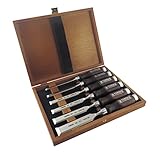
A tool roll is a flexible organiser. It usually has individual pockets sewn into canvas, leather, or synthetic fabric, with a flap and ties or a buckle to hold everything closed. A chisel case is more purpose-built. It may be a rigid box, a fitted plastic holder, or a compact roll with deeper pockets and a protective flap designed specifically for cutting tools.
Neither option automatically protects an edge. The important features are separation, a secure cover over the blades, and enough stiffness that tools cannot press through the material. A roll with shallow pockets and no flap can be worse than a simple wooden box. Conversely, a soft chisel roll can be perfectly adequate if it stays in a clean tool chest and is not thrown into a van.
| Feature | Tool roll | Chisel case |
|---|---|---|
| Capacity | Usually 6 to 20 tools, depending on pocket size | Commonly 4 to 12 chisels in fixed positions |
| Edge protection | Good only if pockets and flap cover the blades fully | Usually better, especially with rigid dividers or blade guards |
| Space efficiency | Rolls flat when empty and pack efficiently | Uses more room, particularly in a crowded tool bag |
| Access | Fast to open and easy to see at a bench | Can be slower if each chisel has a fitted slot or cover |
| Mixed tools | Can carry marking knives, screwdrivers, and small layout tools | Usually limited to chisels and accessories |
| Typical cost | Lower, especially for basic canvas versions | Higher when rigid or custom-fitted |
When a Tool Roll Is the Better Buy
Choose a tool roll if you work between a bench and a job site, carry several sizes, or want one organiser for related hand tools. A good roll can hold a set from about 6 mm (1/4 inch) through 38 mm (1 1/2 inches), plus a marking knife, pencil, and small honing supplies. It is also easier to inspect at a glance than a deep toolbox.
For a general-purpose setup, look for a roll with pockets at least 50 mm (2 inches) deeper than the chisel blades. That extra depth lets the handle sit clear while the blade remains buried. The flap should extend over the entire cutting end when the roll is tied. Heavy cotton canvas is inexpensive and repairable; waxed canvas or leather resists moisture better but adds bulk.
A roll is especially sensible when the chisels are already fitted with individual blade guards. Simple guards made from leather, thick rubber, or split plastic tubing prevent the most common failure: one chisel sliding sideways and striking the edge of another. If the roll costs less than a quality set of guards, buying or making guards may be the better use of money.
See options in canvas tool rolls for chisels if you want a flexible organiser without committing to a bulky case.
When a Chisel Case Earns Its Space
A dedicated case is preferable for expensive, freshly sharpened joinery chisels or for tools that travel regularly in a vehicle. Rigid sides stop other equipment from crushing the blades, and fixed slots prevent the chisels from rubbing together. This matters more with narrow bevel-edge chisels, where a small 1 mm chip can noticeably affect paring work.
Use a case when the chisels are transported in a crowded van, checked as luggage, or stored with heavy planes and power tools. A soft roll can be compressed by 10 or 20 kg of equipment. That pressure may not bend the chisel, but it can force a blade against a pocket seam or exposed fastener. The result is often a bright scratch along the bevel or a ding at the cutting edge.
A case is also useful if you maintain several specialist sets: mortise chisels, paring chisels, or a small set reserved for fine cabinet work. Keeping each set together reduces the temptation to toss loose chisels into a general tool bag. The disadvantage is that fitted cases can waste space when you own only four or five chisels, and replacement slots may be difficult if your collection changes.
For mobile work, compare hard chisel cases with soft cases, checking the internal dimensions rather than relying on the advertised tool count.
Features That Prevent Damage
Separate pockets are only the starting point. The blade must not reach the bottom of a pocket where it can hit a rivet or metal corner. Feel inside each pocket before buying. Any exposed stitching, staple, zipper tooth, or snap near the cutting end is a potential failure point.
Look for a full-width inner flap. A short flap protects the handles but leaves the blade tips exposed when the roll is folded. Individual blade covers are better still, particularly for chisels sharpened below 30 degrees. A lower sharpening angle cuts cleanly in paring work but leaves less metal behind the edge.
Moisture control matters too. Do not wrap damp chisels straight from a cold van into an airtight plastic case. Condensation can form overnight and cause rust along the bevel. Wipe the steel dry, apply a thin rust-preventive film, and let the tools reach room temperature before closing the case. Avoid storing oily chisels in an absorbent leather roll for long periods, as the material can retain dirt against the steel.
The Cheaper Option Is Often Enough
If your chisels live in a workshop drawer and move only from the bench to a nearby project, a basic canvas roll is usually sufficient. Spend the savings on blade guards, a better sharpening stone, or a reliable honing guide. A £15 to £30 equivalent roll with covered pockets can protect a modest set just as well as a costly fitted case under those conditions.
Do not buy a premium case to solve careless packing. Even a rigid case will not protect an edge if chisels are stored wet, forced into slots that are too narrow, or mixed with loose screws. Measure the widest handle and the blade width of every chisel first. For a roll, allow room to close the flap without bending the blades. For a case, leave at least a few millimetres of clearance around each tool so it can be removed without levering against the edge.
If you want one compact organiser for a bench set, a leather chisel roll is a reasonable middle ground. For frequent transport alongside heavy equipment, choose a rigid case or put a guarded roll inside a hard-sided tool box.
A Practical Choice
Choose the tool roll when low weight, low cost, and quick access matter most. Choose the chisel case when the tools are valuable, freshly sharpened, or exposed to rough transport. In either format, insist on individual separation, complete blade coverage, and a closure that cannot open when the organiser is turned upside down.
For most carpenters, the best arrangement is not either-or: a canvas roll for the everyday working set and a rigid case for the chisels kept sharp for fine joinery. That separates routine site wear from precision tools and avoids paying for hard protection every time you carry a basic bench chisel.