What's inside
As an Amazon Associate I earn from qualifying purchases. This post may contain affiliate links at no extra cost to you.
Measuring a timber opening on site is not just a matter of finding the width and writing it down. Openings are often slightly out of square, jambs may be twisted, and finished floors or linings can change the usable size. A folding rule gives you a rigid, repeatable way to check these details without the flex and handling problems of a long tape.
For most carpentry work, an 2m or 2.13m (6ft 6in or 6ft 10in) rule is the useful size. It is long enough for common door openings, folds into a tool-bag-friendly package, and has joints that can be used to transfer measurements into awkward corners. The best choice depends on whether you value compact storage, fine reading, or maximum durability.
As an Amazon Associate we earn from qualifying purchases at no extra cost to you.


Sections
Our Top Picks
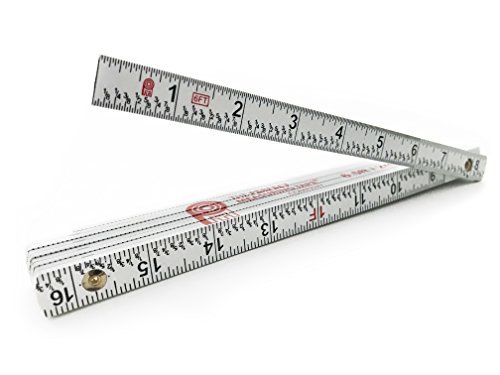 Perfect Measuring Tape Co. FR-72 Carpenter's Folding Rule2 m9.5 x 1.5 x 0.5 inches0.3 poundsCheck on Amazon


Why use a folding rule for timber openings?
A folding rule stays straight when you span a short opening, so it is easier to read accurately than a tape that sags or curls at the end. Its broad, flat sections also sit well against jambs, studs, and thresholds. When checking a door opening, you can use it to measure width at the head, middle, and sill without fighting a loose tape blade.
The joints are useful for inside measurements. Open the rule into an L shape and place one end against the back of the reveal. Read the scale where the second section meets the opposite face. This is slower than using a dedicated inside-measuring tape, but it gives good control in rough or partially finished openings.
A folding rule is especially useful for:
- Checking door and window opening widths at several heights.
- Transferring the depth of a jamb or lining onto a workpiece.
- Measuring short returns, rebates, thresholds, and packer positions.
- Checking whether two opposing faces are parallel.
- Setting out hinge, latch, and strike positions from a fixed edge.
What to look for when buying one
Choose a rule with clear, deeply printed graduations and a finish that will tolerate dust, glue, and occasional wet weather. A white or light-coloured surface is usually easier to read in a dark opening than an unmarked natural-wood scale. If you regularly work in millimetres, buy a metric rule rather than relying on a dual-scale layout with crowded markings.
The joint design matters more than decorative features. Joints should open smoothly, hold a straight line, and have little sideways play. Excess movement at each joint adds up across the full length. On a six-section rule, a small amount of looseness at every hinge can produce a visible error when checking a wide opening.
For general site work, compare metric wooden folding rules with plastic-composite versions before buying. Wooden rules are pleasant to handle and usually easy to mark with a pencil. Composite rules resist moisture better and are less likely to swell, but some have slippery surfaces or scales that wear at the corners.
| Rule type | Best use | Advantages | Limitations |
|---|---|---|---|
| Wooden, 2m or 2.13m | General carpentry and fitting | Rigid, readable, easy to mark | Can swell, split, or loosen after soaking |
| Composite or fibreglass | Wet sites and exterior work | Moisture resistant and hard wearing | Can be slippery; joints vary in quality |
| Inside-reading rule | Reveals, boxes, and cabinet openings | Scale is easier to read from the inside | Usually costs more and may be less versatile |
| Short pocket folding rule | Hinge and hardware set-out | Compact and quick to use | Too short for most complete openings |
How to measure a timber opening properly
Start by removing loose debris, plaster nibs, and temporary packers that could affect the reading. Measure the width in at least three places: near the head, at the middle, and near the sill or floor. Record the smallest measurement if the item must fit into the opening. For a door lining, the smallest width is normally more important than the average width.
Measure the height at the left side, centre, and right side. If the floor is unfinished, measure from the same datum each time and note the expected finished floor build-up. A 12mm difference in floor level can be enough to make a pre-sized door bind at the head.
Check diagonals if the opening needs to be square. Measure from the top-left corner to the bottom-right, then repeat from top-right to bottom-left. The difference between the two readings indicates how far the opening is out of square. A 3mm difference may be manageable with packers and a small trim adjustment; a 10mm difference needs to be allowed for in the frame, lining, or surrounding work.
Do not assume the faces are in the same plane. Hold the rule against the jamb at several points and look for rocking. A twisted jamb can show a correct width at one height while causing a door to catch elsewhere. For deeper openings, use a folding rule with an inside-reading scale or take separate depth readings at the head, sill, and both sides.
Common reading errors and failure modes
The most common mistake is measuring to the wrong surface. Decide whether you need structural opening size, lining size, clear opening, or finished trim size before taking the reading. Write the description beside every number. “Width 890mm” is less useful than “clear width between finished jambs at middle: 890mm.”
Keep the rule fully straight when measuring across a span. A partially folded rule can look aligned while one joint is sitting proud of the jamb. Press it lightly against both faces, but do not force a loose joint flat. If the hinge will not hold position, treat the rule as suspect and confirm the dimension with a tape or straightedge.
Wooden rules should not be left in a wet tool bag or stood against a heater. Moisture can swell the sections and make the joints tight; drying can then leave cracks or looseness. Wipe off water and store the rule flat or closed. A basic rule is cheap enough to replace, so do not rely on one with missing graduations or visibly bent sections. A professional metric folding rule is worthwhile for daily work, but a cheaper rule is fine for occasional repairs if its joints are tight and its scale is accurate.
What to carry with the rule
Pair the folding rule with a sharp pencil, a small level, and a reliable tape for dimensions beyond the rule’s length. A fine mechanical pencil is useful for marking hinge centres and packer lines, while a carpenter’s pencil survives rough timber and dusty site conditions. Keep a small notebook or phone record showing each measurement, its location, and the direction of any out-of-square error.
Before ordering a door, window, or lining, take the measurements twice and compare them. If the opening changes by more than a few millimetres from one point to another, buy or make the frame to suit the actual opening rather than the nominal plan size. That extra check is quicker and cheaper than trimming a fitted door, moving a hinge, or rebuilding a poorly measured jamb.