What's inside
As an Amazon Associate I earn from qualifying purchases. This post may contain affiliate links at no extra cost to you.
For final surface prep before finish, both the No. 4 and No. 4-1/2 will get you there, but they do it differently. The choice is not about quality — a well-tuned example of either will leave a surface ready for oil or shellac without sanding. It is about width, weight, and how much control you want when you are taking 0.001″ to 0.003″ shavings across a finished panel.
If you only buy one smoother for furniture-scale work, most people are better served by the No. 4. If you regularly smooth wide, flat panels, tabletops, or glue-ups wider than 12 inches, the No. 4-1/2 earns its place. Here is how they compare in the hand, not just on paper.
As an Amazon Associate we earn from qualifying purchases at no extra cost to you.



Sections
Our Top Picks
 Stanley 1-12-004 Smooth Plane Bailey No. 4Smooth Plane 2 Inch9.88 x 5.67 x 2.68 inches4.2 poundsCheck on Amazon


What the No. 4 and No. 4-1/2 Actually Are
The Stanley numbering system stuck because it is useful. A No. 4 is the standard smoothing plane: about 9 to 10 inches long (typically 9-3/4″), with a 2-inch wide iron, bedded at 45 degrees. It was designed as the last plane to touch the wood. Short enough to follow slight undulations, wide enough to clean up most boards.
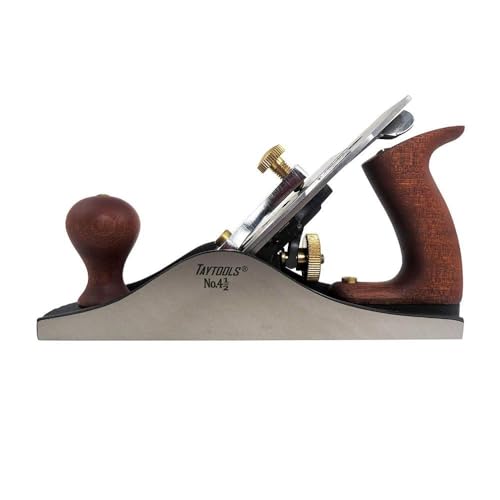
The No. 4-1/2 is not a half-size bigger. It is a distinctly wider and heavier smoother: about 10 to 10-1/2 inches long, with a 2-3/8″ wide iron. Same 45-degree bedding angle in the Bailey pattern, same basic frog and depth adjuster, but the body casting is wider and the iron is 3/8″ broader. In practice it behaves more like a short panel plane than a traditional smoother. Early catalogs listed it for cabinetmakers who wanted a smoother that could also level moderately wide surfaces without tipping into valleys.
Dimensions and Cutting Geometry Compared
On paper the difference looks small. In use it changes balance, cutting resistance, and how accurately you can keep the sole flat to the work.
| Feature | No. 4 Smoothing Plane | No. 4-1/2 Smoothing Plane |
|---|---|---|
| Sole length | 9-3/4″ (248mm) | 10-1/4″ to 10-1/2″ (260-267mm) |
| Iron width | 2″ (50.8mm) | 2-3/8″ (60.3mm) |
| Weight (common ductile iron models) | 3.5 – 4.0 lbs (1.6 – 1.8 kg) | 4.5 – 5.0 lbs (2.0 – 2.3 kg) |
| Sole width | ~2-1/8″ (54mm) | ~2-5/8″ (67mm) |
| Bed angle / Cutting angle | 45 degrees standard | 45 degrees standard |
| Typical shaving on finish pass | 0.001″ – 0.002″ (0.025 – 0.05mm) | 0.001″ – 0.003″ (0.025 – 0.075mm) |
The extra mass of the 4-1/2 helps it hold momentum through hard spots and figured grain, but it also means you push about 20% more iron through the wood on every stroke. With a 2-3/8″ edge engaged, a 0.002″ shaving takes noticeably more effort than the same shaving with a 2″ iron, especially in white oak, hard maple, or hickory. If your sharpening is not dead sharp, the wider iron will tell you immediately with chatter or a stalled cut.
How They Behave on Final Surfaces
Neither plane is a better finisher because of its number. Final finish comes from mouth opening, chipbreaker set, edge sharpness, and how you manage grain direction. Both can leave a glassy, sanding-free surface when set tight.
Where they differ is track coverage and defect tendency. The 4-1/2 covers a wide board in fewer passes. On a 15-inch wide tabletop, that means three well-overlapped strokes instead of four or five. Fewer tracks means fewer chances to leave a visible lap line if your lateral adjustment is slightly off or your iron has a sharp corner.
The No. 4 is more forgiving on boards that are not perfectly flat. Its narrower sole bridges less and will not rock as easily on a panel with a slight cup or twist. It also lets you work around defects — knots, reversals, small patches of tearout — with more localized control. With a 4-1/2, a single speck of tearout on one side of the iron can force you to re-plane the whole width.
Failure modes to watch for with both: if you set the mouth finer than about 1/32″ (0.8mm) for a smoothing cut, any chip buildup will jam and score the surface. If you camber the iron too aggressively (more than about 0.005″ relief at the corners), you will leave scallops that show under a raking light and through clear finish. If the chipbreaker sits more than 1/32″ back from the edge, figured maple and cherry will tear ahead of the cut regardless of which plane you use. On reversing grain, closing the mouth and moving the chipbreaker to within 0.010″ to 0.020″ of the edge matters far more than sole length.
Handling, Pressure and Fatigue
On edge and end grain shooting, the extra width and weight of the 4-1/2 is a disadvantage. It is harder to keep vertical and tires your arms faster during a long smoothing session. For drawer sides, small boxes, and narrow stock under 6 inches, the No. 4 feels nimble. You can drive it with fingertips and keep even pressure front to back without fighting inertia.
On large horizontal surfaces, that weight becomes an advantage. The 4-1/2 registers more stably and needs less downward pressure to keep cutting. You can let the tool do the work and focus on keeping the sole flat and the stroke straight. Carpenters with larger hands also tend to prefer the wider tote and knob spacing on the 4-1/2, while those with smaller hands find the No. 4 more comfortable over a day’s work.
Blade maintenance is the other practical difference. A 2-3/8″ iron takes longer to grind and hone, and it exposes more edge to potential nicks. If you are working on site with limited sharpening stones for plane irons and need to refresh quickly between tasks, the 2″ iron is faster to bring back.
Which One Should You Buy
Buy the No. 4 if you want one all-round smoother for furniture, small joinery, and general site kit. It is cheaper by $30 to $80 in comparable new makes, lighter to carry in a tool bag, easier to sharpen, and easier to learn on. For most boards under 10 inches wide — which is most of what you will smooth — it is every bit as capable. A well-tuned No. 4 smoothing plane with a tight mouth and a sharp iron will finish cherry, walnut, and soft maple without dust-generating sanding.
Buy the No. 4-1/2 if you specifically smooth large panels, glued-up tops, or wide drawer bottoms where you want maximum coverage per stroke. It excels as a final leveler after a jack or No. 5-1/2, when the surface is already flat and you want to remove plane tracks quickly before finish. If you already own a No. 4 and are looking for a second smoother, the 4-1/2 adds a different capability instead of a duplicate. Check a No. 4-1/2 smoothing plane if that wide-panel work is common in your shop.
If budget is tight, do not stretch for the 4-1/2 thinking it is automatically better. Spend the difference on a thicker aftermarket iron or on getting your existing chipbreaker mated perfectly to the blade. A cheap No. 4 that is flat-soled to within 0.0015″ and has a chipbreaker that beds without light leaks will outperform an expensive 4-1/2 that chatters or leaks shavings.
Setup Tips That Matter More Than the Model
Whichever you choose, final prep is won or lost at setup. Lap the sole until it is flat around the mouth and at the toe and heel; a hollow at the mouth guarantees a convex surface. Mate the chipbreaker so it contacts the blade across its full width — polish the leading edge so shavings do not get trapped. Hone with a barely visible camber: about 0.002″ to 0.003″ fall-off at the corners is enough to prevent tracks without leaving hollows. Set the mouth so you can just pass a thin shaving without jamming, and advance the iron until it prints a full-width, translucent shaving on pine, then back off slightly for hardwood. Test on scrap from the same board and read the surface in raking light before you touch the show face.