As an Amazon Associate I earn from qualifying purchases. This post may contain affiliate links at no extra cost to you.
Choosing the right Bostitch nail gun is not a matter of brand loyalty alone. A coil roofing nailer driving 1-3/4-inch ring-shank nails will not seat a finishing brad without splitting the stock, and a 18-gauge brad nailer cannot drive a framing nail into a double top plate. The concrete problem every buyer faces is matching drive range, head type, and nail capacity to the specific fastening task they repeat dozens or hundreds of times per day. A mismatch costs time on the job and money in spoiled material.
What separates the strong performers from the forgettable ones is not raw power but consistency at working air pressure, reload speed between fasteners, and the durability of internal components after thousands of cycles. Bostitch has occupied a durable niche in professional carpentry and exterior trade work, and the current lineup spans roofing, siding, framing, finishing, and metal connector nailing. This roundup compares published specifications, listed prices, and aggregated owner feedback across eight models that represent the breadth of that lineup as of 2026.
As an Amazon Associate we earn from qualifying purchases at no extra cost to you.


Quick Picks
| Product | Best for | Price |
|---|---|---|
| RN46 | Coil roofing fastening | $196.01 |
| BTFP12233 | Trim and molding brad nailing | $126.03 |
| N66C | Coil siding nailing | $234 |
| Strap Shot | Metal connector installation | $239 |
| F21PL | Round-head framing | $219 |
| 16-Gauge Finish Nailer | 16-gauge finish trim | $169 |
| 15° Coil Roofing Nailer | Budget coil roofing | $179 |
| F28WW | Clipped-head framing | n/a |
How We Picked
We filtered these eight models against four criteria that matter most in pneumatic nailers: drive range matched to the intended fastener type, reload capacity relative to cycle time on a typical job, owner-reported jam frequency and durability of the driver blade and piston assembly, and price position against equivalent Bostitch or competitor models in the same class. Models were ranked on how well they solve one specific fastening problem rather than on versatility, because a nailer that does many things acceptably is rarely preferred by tradespeople over one that excels at a single task.
The 8 Best Bostitch Nail Gun in 2026
Bostitch RN46 Coil Roofing Nailer
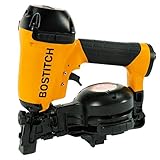
The RN46 is built for roofers who drive hundreds of coil nails per shift into composite or asphalt shingles over plywood or OSB decking. Its 3/4-inch to 1-3/4-inch range covers virtually all common roofing nail lengths, and the coil magazine holds a full load so reload pauses stay infrequent.
- Pro: High nail capacity per reload keeps rhythm during long roof sections.
- Pro: Drive range handles both short shingle nails and longer fan-fold or underlayment fasteners.
- Con: Coil mechanism adds weight compared to stick-driven roofers, causing fatigue on overhead or steep-pitch work.
Skip it if you occasionally roof and do not drive coils daily; a stick nailer will feel lighter and cost less.
Bostitch BTFP12233 Brad Nailer Kit
This 18-gauge pneumatic brad nailer targets finish carpenters and trim installers who need small holes that disappear under paint or wood filler. The Smart Point tip adjusts for flush or below-surface seating on soft millwork, which reduces surface damage on pre-finished stock.
- Pro: 18-gauge holes are nearly invisible, eliminating most putty steps on painted trim.
- Pro: The kit includes accessories, lowering the entry cost for a first pneumatic setup.
- Con: Brad strength is insufficient for baseboards in high-traffic areas where impact loads exceed 18-gauge holding power.
Skip it for heavy baseboard or crown molding on uneven walls; move to a 15- or 16-gauge finisher instead.
Bostitch N66C Coil Siding Nailer
Contractors installing vinyl, wood, or fiber-cement siding at scale benefit from the N66C’s coil magazine and 15-degree collation. The 1-1/4-inch to 2-1/2-inch range handles most lap and panel siding fasteners without switching tools mid-course.
- Pro: Large coil capacity means fewer reloads across long siding courses.
- Pro: 15-degree collation drives nails at an angle that resists pull-out on expanded joints.
- Con: At $234 it carries a premium over stick siding nailers that drive the same fasteners.
Skip it if you only do small siding patches; the reload advantage does not offset the price on short jobs.
Bostitch Strap Shot Metal Connector
The Strap Shot is a specialty tool for installing hurricane ties, joist hangers, and other metal connectors with ring-shank or deformed-head nails. It drives into steel-flange connectors at angles a standard framing nailer struggles to reach.
- Pro: Compact nose profile fits tight connection points between trusses and top plates.
- Pro: Designed specifically for connector nailing, so drive consistency beats repurposed framing tools.
- Con: Narrow application means most carpenters will not need it for anything outside connector installation.
Skip it entirely if you rarely attach metal connectors; a round-head framer with appropriate nails covers most tie-down work.
Bostitch F21PL Framing Nailer
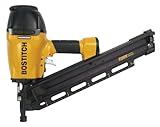
This round-head pneumatic framing nailer drives 1-1/2-inch to 3-1/2-inch nails, making it the workhorse for wall framing, floor systems, and structural sheathing. Round heads provide maximum withdrawal resistance in load-bearing assemblies where code requires them.
- Pro: Full 3-1/2-inch drive capacity handles double top plates and thick built-up beams.
- Pro: Round-head collation meets IBC and IRC requirements for structural connections.
- Con: Heavier and bulkier than clipped-head alternatives, increasing arm fatigue during rapid repetitive nailing.
Skip it if your jurisdiction and project allow clipped heads and you prioritize speed over maximum holding power.
Bostitch 16-Gauge Clip Head Finishing Nailer
Targeting carpenters who install casing, chair rails, and mid-weight trim, this 16-gauge model drives up to 2-1/2-inch finish nails with enough holding force for dense hardwoods that would defeat an 18-gauge brad.
- Pro: 16-gauge diameter provides stronger pull-out resistance on solid wood trim and stair components.
- Pro: Moderate price at $169 sits between brad nailers and full framing rigs.
- Con: Leaves a slightly more visible hole than 18-gauge, requiring minimal filler on painted surfaces.
Skip it if your work is exclusively light millwork or pre-finished MDF where 18-gauge suffices.
Bostitch 15-Degree Coil Roofing Pneumatic Nailer
This model is a lower-cost coil roofing option for crews that still need high fastener capacity but cannot justify the RN46 price. The 15-degree collation and coil magazine suit asphalt and composite shingle work on standard residential roofs.
- Pro: At $179 it undercuts the RN46 by nearly twenty dollars while retaining coil capacity.
- Pro: 15-degree drive angle provides solid withdrawal resistance on shingle tabs.
- Con: Shorter maximum nail length limits use to thinner materials compared to the RN46.
Skip it if you need longer fasteners for underlayment or fan-fold installations that exceed its drive range.
Bostitch F28WW Clipped Head Framing Nailer
The F28WW drives 2-inch to 3-1/2-inch clipped-head framing nails, favoring contractors who work rapidly on wall and floor framing where speed outweighs the marginal holding-power difference between head types.
- Pro: Clipped-head collation packs more nails per strip and fits in tighter magazine housings for a lighter tool.
- Pro: Full 3-1/2-inch capacity handles all standard framing runs without switching tools.
- Con: Clipped heads may not satisfy local inspectors on shear-wall or seismic applications that mandate round heads.
Skip it if your project falls under a code jurisdiction or engineering plan that explicitly requires round-head fasteners.
Buying Guide
Match Drive Range to Fastener Length
The single most common mistake is buying a nailer whose maximum drive length falls short of the fasteners your project requires. A roofing nailer rated to 1-3/4 inches cannot seat a 2-inch underlayment nail, and a framing nailer rated to 3-1/2 inches will not drive a 1-1/2-inch brad without excessive blow-through. Confirm the minimum and maximum lengths before purchasing, and leave at least a quarter-inch buffer on the high end for material compression during firing.
Understand Collation Angle and Magazine Type
Bostitch roofing and siding nailers use coil magazines with 15-degree collation, while framing models use stick or clipped-strip collation at 21 degrees or full round heads. Coil magazines hold more nails per reload, which matters on long uninterrupted runs like siding courses or roof planes. Stick magazines are lighter and cheaper per load but require more frequent reloading. If your workflow involves sustained repetitive fastening, the weight penalty of a coil is worth fewer pauses.
Round Head versus Clipped Head for Structural Work
Round-head framing nails provide the highest withdrawal and shear resistance because the full circumference of the head contacts the wood. Clipped-head nails have a rectangular cutout that slightly reduces bearing surface but allows tighter nail spacing in the collation strip and a slimmer nose for the driver. For most residential framing, both perform within code when correctly specified, but structural engineers and seismic-zone inspectors frequently require round heads. Check your local amendments before defaulting to the lighter clipped option.
Our Verdict
The top pick for most Bostitch buyers is the F21PL. Round-head framing nailers serve the widest range of structural tasks, and the F21PL delivers full 3-1/2-inch capacity without the niche limitations of roofing or brad models. For the budget-conscious carpenter entering the Bostitch ecosystem, the BTFP12233 at $126.03 is the strongest value, offering professional-grade 18-gauge performance with included accessories that would otherwise cost extra. One condition favors a different choice: if you install metal connectors on every job, the Strap Shot at $239 eliminates the fumbling and inconsistent seating that a framing nailer produces in tight flange geometry.
FAQ
Do Bostitch nailers require a specific compressor size?
Most Bostitch pneumatic models operate between 70 and 120 PSI and consume roughly 0.05 to 0.1 SCFM per cycle. A two-gallon, six-SCFM compressor handles brad and finish work comfortably, while coil roofing and framing nailers benefit from a larger tank to avoid pressure sag during sustained nailing.
What gauge nail does the BTFP12233 use?
The BTFP12233 drives 18-gauge brad nails from five-eighths to two inches in length. This gauge leaves the smallest hole in the pneumatic lineup and is ideal for trim, cabinetry, and light molding where visible fasteners are unacceptable.
Can a coil roofing nailer be used for siding?
Technically yes, since drive ranges overlap, but the magazine geometry and nose profile of a dedicated coil siding nailer like the N66C make it easier to place nails at correct spacing on panel edges. Using a roofing coil on siding increases the chance of overdriving through thin vinyl lap.
Is the F28WW available in 2026 and where?
Availability and pricing for the F28WW fluctuate by distributor. Check Bostitch’s current dealer listings for regional stock, as the tool remains in the active product line despite intermittent listing gaps.