What's inside
As an Amazon Associate I earn from qualifying purchases. This post may contain affiliate links at no extra cost to you.
A Makita track saw solves a problem that neither a handheld circular saw nor a table saw handles cleanly: breaking down full sheets of plywood or MDF in place, with factory-grade edge quality and no dust cloud in your living room. The plunge mechanism lets you start a cut anywhere on the panel, while the guide rail locks the saw onto a straight path so the kerf follows your marking line exactly. For cabinet builders, flooring installers, and weekend woodworkers without a 3,000-pound table saw on the floor, this tool changes what is possible with a single setup.
What separates a worthwhile pick from a mediocre one comes down to a handful of concrete factors. The plunge mechanism must engage without play, or your cuts drift. The rail interface must lock tight enough that the saw cannot cant during a long rip. Motor type matters for sustained cutting through dense sheet goods. And the total cost of ownership balloons once you add rails, clamps, and batteries to a bare saw. This roundup for 2026 compares the full Makita ecosystem—corded saws, cordless kits, and every relevant rail accessory—so you can build the configuration that matches your shop without paying for redundant parts.
As an Amazon Associate we earn from qualifying purchases at no extra cost to you.



Sections
Quick Picks
| Product | Best for | Price |
|---|---|---|
| SP6000J | Corded reliability, no battery anxiety | n/a |
| XPS01PTJ Kit | Complete out-of-the-box track saw system | $680.6 |
| XPS01Z Tool Only | Owners who already have LXT batteries | $457.89 |
| XPS01Z Renewed | Lowest entry cost into 36V cordless | $399.99 |
| 194368-5 55″ Rail | Full-sheet breaking on a budget | $109.99 |
| 2x 55″ Rail Set | Joined rail for extended rips | $84.99 |
| 199826-6 Clamp Set | Securing rails to your workpiece | $84 |
| 110″ No-Chip Rail | Longest single-rail reach | $85.49 |
How We Picked
We narrowed the field using four criteria that owners flag most often in long-term feedback. First, plunge-lock repeatability: a saw whose depth setting drifts after a few cuts is useless for precision panels. Second, rail compatibility and interface rigidity, which determines whether the saw tracks straight under side pressure. Third, power delivery—corded saws offer constant torque while brushless cordless models trade a small power deficit for zero-tether convenience. Fourth, total system cost, because a bare saw without a rail and clamps solves nothing. Products that score well on all four made the list.
The 8 Best Makita Track Saw in 2026
1. SP6000J 6-1/2″ Plunge Circular Saw
The corded workhorse for shops where outlet access is never a question. Owners praise its consistent full-depth cuts through hardwood ply and MDF without the power taper you sometimes feel on a fading battery.
- Pro: Uninterrupted torque for long rips and stacked material.
- Pro: Proven plunge assembly with tight depth-stop repeatability over years of use.
- Con: Cord management during full-sheet cuts on a portable table adds friction compared to a cordless model.
Skip it if you routinely break down panels in client homes or job sites where outlet proximity is unreliable. The cordless siblings deliver nearly identical cut quality with zero tether.
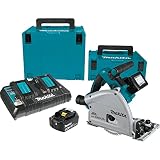
2. XPS01PTJ Kit (36V, 5.0Ah, 39″ Rail)
The complete entry into Makita’s cordless track saw line, bundled with two 5.0Ah batteries and a 39-inch guide rail. For woodworkers who want a working system the same afternoon it arrives, this removes the guesswork of accessory selection.
- Pro: Includes everything needed for crosscuts up to 39 inches without a separate purchase.
- Pro: Brushless motor paired with dual 18V packs matches the SP6000J’s cut speed in owner reports.
- Con: The 39-inch rail is short for full-sheet rips; you will likely add a longer rail quickly.
Skip it if you already own the XPS01Z tool-only saw and separate batteries. You would pay a premium for components you already have.
3. XPS01Z Tool Only
The saw body from the kit above, sold bare for anyone who already runs Makita LXT batteries. Same 36V brushless platform, same plunge geometry, but priced as a component rather than a package.
- Pro: Lowest new-tool-only price for the 36V cordless platform.
- Pro: Cross-compatible with every Makita 18V battery you already own, from compact to 8.0Ah.
- Con: No rail or clamp included, so the total system cost creeps back up once accessories are added.
Skip it if you have no existing LXT inventory. The kit version delivers better per-component value and avoids the risk of mismatched battery sizes.
4. XPS01Z Renewed
A factory-renewed version of the same tool-only saw, typically returned and inspected before resale. For budget-conscious buyers who want cordless 36V power without the new-unit premium, this closes a meaningful gap.
- Pro: Approximately 60 dollars below the new tool-only price for identical function.
- Pro: Same brushless motor, same plunge mechanism, same LXT compatibility as the new unit.
- Con: Cosmetic wear and a shortened warranty window compared to buying new.
Skip it if you need a full manufacturer warranty for commercial use or resale protection. Buy new when downtime cost exceeds the savings.
5. 194368-5 55″ Guide Rail
Makita’s own 55-inch rail, the most common length for breaking down 4-foot sheets with margin. Its aluminum profile and integrated anti-slip strip keep the saw planted during aggressive plunges.
- Pro: Direct-fit clamps and accessories without adapter brackets.
- Pro: Full-sheet width coverage in a single rail for most plywood and MDF panels.
- Con: Priced at roughly double what third-party alternatives cost for similar length.
Skip it if a compatible aftermarket rail meets your tolerance needs and you want to allocate savings elsewhere in the system.
6. 2x 55″ Guide Rail Set for Makita
Two 55-inch rails sold as a pair, joinable for extended rip work. At under 85 dollars for both, this undercuts a single OEM rail in price while giving you reach beyond a standard sheet.
- Pro: Combined length exceeds 110 inches, enabling full-table rips on long panel stock.
- Pro: Two separate rails serve as crosscut and rip guides without repositioning a single long track.
- Con: The joining mechanism is third-party and adds a minor alignment step compared to a continuous rail.
Skip it if your cuts rarely exceed 55 inches and you prefer a single-piece rail without a join point.
7. 199826-6 Quick Release Clamp Set
Makita’s dedicated clamp pair that secures guide rails to the workpiece without marring the rail surface. Owners note the knurled thumbscrew design is faster to deploy than generic bar clamps.
- Pro: Designed to fit the rail profile, so clamping pressure sits below the saw’s running surface.
- Pro: Quick-release action cuts setup time when you reposition rails between multiple cuts.
- Con: Only two clamps included, so wider rails benefit from additional support at the midpoint.
Skip it if you already have parallel clamps that clear the rail height and you see no value in dedicated hardware.
8. 110″ No-Chip & Anti-Slip Guide Rail
A single continuous rail at 110 inches with pre-fitted chip strips along both edges. The anti-slip underside keeps it anchored without clamps for crosscuts, and the no-chip lip protects finished faces.
- Pro: Longest single-rail option listed, spanning two sheets placed end-to-end without a joint.
- Pro: Integrated no-chip strip means finished edges come off cleaner without a sacrificial tape application.
- Con: At 110 inches, storage and transport require a dedicated rack or a shop doorway wide enough to pass it through.
Skip it if your workspace is tight or your longest cuts stay under 55 inches, where a shorter rail is easier to manage.
Buying Guide
Plunge Mechanism and Depth Lock
The defining feature of a Makita track saw versus a standard circular saw is the plunge action: the blade enters the workpiece vertically rather than at an angle. Depth precision determines whether your 3/4-inch plywood cut is actually 3/4-inch or drifts to 11/16. Check that the depth scale has positive detents and that the lock lever is reachable without releasing your grip on the front handle. The SP6000J and both XPS01Z variants share the same plunge geometry, so differences here come down to factory tolerance rather than design.
Rail Compatibility and Length
All listed saws accept Makita-branded rails. The 39-inch rail in the XPS01PTJ kit handles crosscuts and short rips. The 55-inch options cover a full 4-by-4 sheet in one pass. The 110-inch single rail spans two sheets but demands storage space. Aftermarket rails that match the OEM profile can save money, but verify that the tongue-and-groove interface does not introduce lateral play under side pressure during long cuts.
Corded Versus Cordless Power
The 36V brushless platform draws two 18V LXT packs simultaneously, delivering peak output close to the corded SP6000J in owner-reported cuts through MDF and hardwood plywood. Cordless wins on job-site portability and setup speed. Corded wins on sustained throughput when you are ripping dozens of panels back-to-back without swapping batteries. Choose based on whether your cuts happen at a fixed bench or move between locations.
Our Verdict
The XPS01PTJ Kit is the top pick for most buyers because it delivers a functional cordless system in one purchase, eliminating accessory-mismatch risk. The XPS01Z Renewed at 399.99 dollars is the budget pick for anyone already holding LXT batteries and a rail. The 110″ No-Chip Rail wins outright if your primary task is breaking down two or more full sheets in sequence without a rail joint interrupting the cut surface.
FAQ
Can the SP6000J use the same rails as the XPS01Z?
Yes. Both saws share the same rail interface, so any Makita-branded guide rail or compatible aftermarket rail fits either model without adapters or shims.
Do I need the Quick Release Clamp Set if the rail has anti-slip strips?
Anti-slip strips reduce sliding during crosscuts, but a rip cut generates sustained lateral force that can shift a rail over several feet of travel. Clamps are recommended whenever the rail is not mechanically restrained by a fence or stop.
Is 36V (two 18V packs) meaningfully stronger than a single 18V saw?
The dual-pack configuration roughly doubles available voltage to the brushless motor, which translates into higher sustained RPM under load. Owners report fewer stalls in dense MDF and hardwood compared to single-battery circular saws in the same brand family.
What is the shortest rail that still allows a clean plunge entry?
Any rail at or above the saw’s base plate length plus blade reach is workable. The 39-inch rail in the XPS01PTJ kit meets this minimum, but shorter custom rails risk the base plate extending past the rail edge during a plunge, which causes the saw to tilt and produce a tapered cut.