What's inside
As an Amazon Associate I earn from qualifying purchases. This post may contain affiliate links at no extra cost to you.
A scratch awl is a simple marking tool: a pointed steel blade held in a handle, used to make a small indentation in timber. Unlike a pencil line, the mark contains no graphite, will not rub away against a saw fence, and remains visible after a light coat of finish. It is especially useful for starting screws, locating dowels, marking hinge positions, and transferring measurements where a sharp knife line would be excessive.
As an Amazon Associate we earn from qualifying purchases at no extra cost to you.


Sections
Our Top Picks
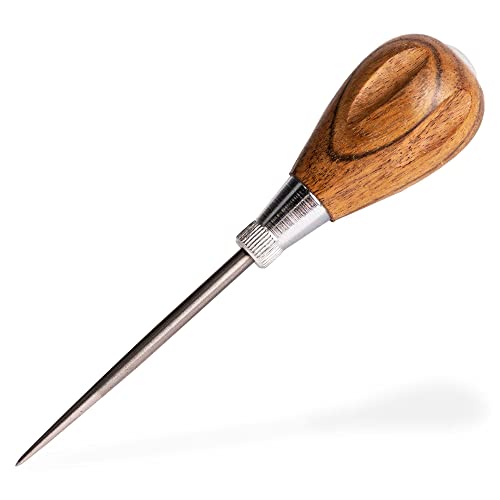 General Tools Scratch Awl Tool with Hardwood Handle8.75 x 3.75 x 3.25 inches0.2 poundsCheck on Amazon
 Klein Tools 650 Scratch Awl with 3-1/2-Inch ShankPack of 112.2 x 4.41 x 1.97 inches0.25 poundsCheck on Amazon


What a scratch awl does well
A scratch awl makes a dot, short groove, or starting hole rather than a wide visible line. Pressing the point straight down creates a clean center mark. Dragging it along a straightedge creates a fine cut, although a marking knife is usually better for long, precise layout lines.
The indentation is useful because drill bits and screws tend to wander on smooth timber. A mark only 1 to 2 mm deep is normally enough to guide a small drill bit. Driving the point deeper can crush soft pine fibers or create a visible divot that remains after sanding.
There is also a practical advantage on a busy site. Pencil graphite can smear onto pale paint, transfer to hands, or disappear when the workpiece is handled repeatedly. An awl mark is permanent enough for the job but still small enough to avoid becoming a cosmetic defect.
Which type of awl to buy
For general carpentry, choose a traditional scratch awl with a rigid, tapered blade and a comfortable handle. A blade around 2.5 to 4 inches long covers most work. A narrow point gives accurate marks and works well for screw starts; a broader, more gradual point makes a slightly larger hole and is less likely to break.
Do not confuse a scratch awl with a stitching awl. Stitching awls often have long, narrow blades designed to pierce leather and may flex under sideways pressure. They are poorly suited to forcing marks into hardwood. A bradawl can work, but its blade is commonly shorter and wider, with a cutting profile intended to open a hole for nails or screws. That is useful when you need a larger pilot hole, not necessarily when you need a fine layout mark.
These woodworking scratch awls are the right starting point for most users. Look for a point that is ground symmetrically, a blade that does not twist in the handle, and a handle large enough to control with one hand.
Features that matter in use
| Feature | What to look for | Why it matters |
|---|---|---|
| Blade length | 2.5 to 4 inches | Long enough for normal marking without excessive flex |
| Point shape | Sharp, even taper; not needle-thin | Starts holes cleanly and resists snapping |
| Handle | Oval or faceted, roughly 4 to 5 inches long | Prevents rolling and gives controlled pressure |
| Blade security | Solid tang or properly fitted ferrule | Stops the blade loosening during repeated pushing |
| Blade material | Hardened tool steel or stainless steel | Holds an edge and resists workshop rust |
A capped awl is worth considering if it will live in a tool belt. The cap prevents the point from puncturing a pouch and reduces the chance of stabbing your hand while searching for another tool. A capped design is slightly slower for repeated work, so an uncapped awl is more convenient at a bench.
Best choices by job
For general site carpentry: buy a medium-point awl with a substantial wood or plastic handle. It should make screw-start marks in softwood, hardwood, plywood, and MDF without requiring excessive force. A bright handle is easier to find in a tool bag.
For fine cabinetmaking: choose a slimmer point and a handle that allows a pencil-like grip. The mark should be just visible, not a large hole. A fine fine-point scratch awl is useful around hinges, drawer hardware, and small dowels, but it is more vulnerable to bending if used as a lever.
For heavy hardwood work: prioritize a thick, rigid blade and a handle designed for pushing from the palm. Hardwood can require considerably more pressure than pine. If the awl point skids, make a shallow starter mark first rather than leaning harder and risking a snapped tip.
For occasional DIY use: the cheaper option is usually fine. A basic awl costing only a few dollars will mark softwood and construction plywood effectively. Spend more for better balance, corrosion resistance, or a replaceable blade—not because an expensive awl makes a more accurate mark by itself.
How to mark timber accurately
Hold the awl vertically for a point mark and brace your wrist against the workpiece. Apply firm, controlled pressure rather than twisting immediately. On softwood, start with roughly 2 to 3 mm of penetration. On hardwood, a shallow dimple may be enough to stop a drill bit.
For a hole location, mark through the center of the measurement line, not beside it. If accuracy matters, make a small knife nick first, then place the awl point in the nick. This avoids the common failure where the awl slides across the surface and leaves a false mark 1 or 2 mm away from the intended position.
When marking across end grain, support the timber on a firm surface. End grain can split if the point is forced in near an edge. Keep at least 5 mm from an edge in softwood unless the design specifically requires closer spacing.
Maintenance and failure modes
Keep the point sharp but not needle-thin. A light touch on a fine file or abrasive stone is enough; grinding away too much steel creates a weak, brittle tip. If the point becomes rounded, it will skate on finished timber and require more pressure.
Inspect the handle and ferrule regularly. Stop using the tool if the blade rotates, the tang is loose, or the handle has split. Never use a scratch awl as a punch, pry bar, or screwdriver. Those jobs can bend the blade or drive it through the handle.
Wipe carbon-steel blades after use, especially in damp tool bags. A drop of light oil prevents surface rust, but remove excess oil before marking light-colored timber. For a compact belt option, compare capped scratch awls with standard bench models and choose based on carry safety rather than appearance.