What's inside
As an Amazon Associate I earn from qualifying purchases. This post may contain affiliate links at no extra cost to you.
Sections
Our Top Picks
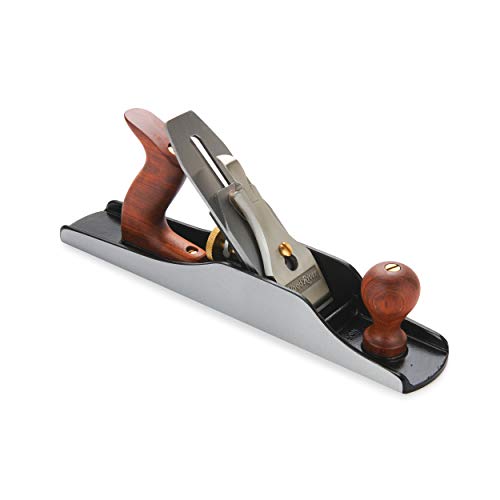

What a No. 5 jack plane does
A No. 5 is a medium-length bench plane, usually about 14 inches long with an iron around 2 inches wide. It is a useful first plane because it can remove saw marks, flatten a board, and bring a workpiece close to final thickness without feeling as cumbersome as a longer jointer plane. The trade-off is that it is not as good as a long plane at showing or correcting a whole-board bow, and it cannot replace a short smoothing plane for fine finishing.
For squaring and sizing timber, the usual sequence is to flatten one face, make an adjacent edge square to it, then use those references to mark and plane the remaining faces. A sharp No. 5 can do much of that work on small and medium stock. “Sizing” with a hand plane is deliberate, however: take thin shavings and check dimensions often. A plane removes material; it does not make an undersized board larger again.
As an Amazon Associate we earn from qualifying purchases at no extra cost to you.

What to look for before buying
Prioritize a flat sole, a securely held iron, and adjusters that move without excessive play. Check the plane on a known-flat surface or with a reliable straightedge. A small gap at the mouth is not by itself proof of a bad plane, but a sole that rocks or has a pronounced hollow can make accurate work frustrating. On a used plane, inspect the iron for enough remaining steel to sharpen and the lever cap and frog for damage or missing parts.
Setup matters as much as the badge. The iron needs a sharp, straight edge for full-width work, and the chipbreaker should sit close to the edge without a gap that packs with shavings. Start with a moderate cut: a shaving roughly 0.05–0.1 mm thick is a useful target for controlled sizing, while a heavier cut is faster for initial stock removal but more likely to tear grain or stall in a knot. These are working ranges, not settings every plane will hold equally well.
No. 5 plane types compared
| Type | What it suits | Main trade-off |
|---|---|---|
| New standard bench plane | Regular use and predictable parts support | Costs more than a basic plane; still needs sharpening and setup |
| Budget new bench plane | Occasional DIY work and learning the basics | May need more tuning; check sole, iron, and adjusters before relying on it |
| Used vintage No. 5 | Buyers comfortable inspecting and restoring tools | Can be excellent value, but rust, a damaged iron, or missing parts can erase the savings |
A well-set-up budget plane can be entirely adequate for a few projects a year. If you want to compare current options, start with a standard No. 5 bench plane. A budget No. 5 plane is a reasonable choice if you are willing to verify the sole and spend time sharpening and adjusting it. Do not assume that a higher price guarantees a better cut, or that an old plane is ready to use straight from the box.
Length, iron, and adjustment
The standard No. 5 is the sensible default for general bench work. A heavier version can feel steadier and carry momentum through difficult grain, but it is more tiring to use and is not automatically more accurate. A No. 5½ has a wider iron and more mass; it can be useful on broad boards, but its added width makes sharpening and pushing more demanding. For furniture parts and ordinary site timber, standard width is usually easier to control.
Look for a plane with an iron that can be sharpened square and a lateral adjuster that holds its position. A cambered edge, with the corners eased back slightly, helps avoid ridges when taking heavier shavings. For a fine, full-width shaving, sharpen the edge nearly straight and use lateral adjustment to make the cut even. One iron can serve both purposes if you are prepared to change the camber and resharpen it; a second iron saves setup time, not money on the first purchase.
How to square and size timber
Secure the board so it cannot rock or slide. Mark the high spots, then plane with the grain where possible. On twisted or cupped stock, remove the high areas first and check progress with winding sticks or a straightedge; simply planing end to end can follow the existing twist instead of correcting it. A No. 5 can flatten modest stock, but a long jointer plane is more efficient when the board is long enough that the shorter sole bridges hollows poorly.
Once one face is flat, mark a reference edge and plane it square to that face. Check with a try square along the length and at both ends. If the edge is out of square, focus on the high side rather than taking a full-width cut. Then gauge the required thickness from the reference face and work down in small passes, checking at several points. If the target is 25 mm, for example, measure at both ends and the middle: a board that reads 25 mm at one end and 26 mm in the middle is not sized consistently.
Common failures are easy to spot. Tear-out usually means the cut is too deep, the iron is dull, or the grain changes direction; reduce the cut, sharpen, and plane from the other direction if needed. A plane that stops cutting may have shavings clogging the mouth or a loose iron assembly. If one side of the board becomes lower, the iron may be set unevenly or you may be leaning on the plane. Recheck the edge across its width before trying to correct the error with another heavy pass.
Useful extras and buying advice
A sharpening setup is essential, not optional. A simple combination waterstone or diamond plate can keep an iron working; add a honing guide if freehand sharpening is not consistent yet. A sharpening stone and honing guide are often a better next purchase than an upgraded plane. Keep a try square, marking gauge, and straightedge close by as well: the plane removes wood, but those tools tell you where and how much.
For occasional work, choose the least expensive plane that passes a careful inspection and can be returned if the sole or mechanism is defective. For frequent furniture making, paying more for consistent machining, reliable adjustment, and available replacement irons can save setup time. Either way, budget for sharpening and practice on scrap. A correctly set No. 5 is a versatile sizing tool; a poorly sharpened premium plane is still a poor sizing tool.