What's inside
As an Amazon Associate I earn from qualifying purchases. This post may contain affiliate links at no extra cost to you.
The best game feeders for most properties are durable, timer-controlled gravity or spin-cast units sized to your feeding frequency: choose a 30-gallon, 6-volt spin feeder for general deer feeding, a 150–350-pound hopper for infrequent visits, or a directional feeder when you need to limit feed to a small area.
As an Amazon Associate we earn from qualifying purchases at no extra cost to you.



Sections
Quick picks by situation
| Situation | Best feeder type | What to prioritize | Typical capacity |
|---|---|---|---|
| Lowest upfront cost | 30-gallon tripod spin feeder | Simple digital timer, standard 6-volt battery, replaceable motor | Approximately 200 lb of corn |
| Weekly property visits | 150–350-pound elevated hopper | Large lid, sealed seams, gravity feed control, strong legs | 150–350 lb |
| Small feeding zone | Directional spin feeder | Adjustable throw pattern and low feed opening | 15–30 gallons |
| Frequent rain or coastal humidity | Powder-coated steel or heavy UV-stabilized polyethylene hopper | Gasketed lid, protected electronics, stainless hardware | 30–350 lb |
| Minimal mechanical maintenance | Gravity feeder | Adjustable ports, anti-bridging design, removable feed tubes | 100–350 lb |
Best game feeders compared
Best all-around: 30-gallon tripod spin feeder
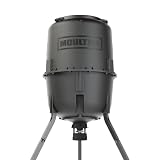
A 30-gallon tripod feeder is the most versatile choice for a typical deer property. Brands such as Moultrie and Wildgame Innovations offer this general format with timed spin-cast motors, programmable feedings, and 6-volt battery systems. A full 30-gallon hopper holds roughly 200 pounds of shelled corn, although the exact weight varies with moisture and feed type.
Look for a timer offering at least four feeding events per day, run times from one to 30 seconds, and a test-feed button. A 6-volt rechargeable battery is usually more economical than disposable cells, while a solar panel can extend operating time when the feeder receives several hours of direct sunlight.
The limitation is exposure. A tripod feeder leaves the motor and lower hopper relatively accessible to rain, rodents, and large animals. The legs also need firm anchoring, especially on soft soil or slopes.
Best for infrequent servicing: large elevated hopper feeder
Large-capacity feeders from manufacturers such as Boss Buck and Texas Hunter are better when you cannot visit every week. Models in the 150- to 350-pound range reduce refilling trips and can use gravity feed, timed spin casting, or both. Their broad hopper lids are easier to seal than small cone lids, and their heavier frames are less likely to shift.
Capacity is not automatically an advantage. More feed sitting in a humid hopper increases the consequences of condensation, leaks, and poor rotation. Choose a large hopper only when the feed can be consumed before it becomes stale or clumped. In warm, wet conditions, a 150-pound hopper may be more practical than a 350-pound model even if the larger unit requires fewer refills.
Best for controlling the feeding area: directional feeder
A directional feeder concentrates feed into a narrower arc rather than broadcasting it evenly around the unit. This can help keep feed away from roads, property boundaries, or areas where you do not want animals gathering. Directional models are also useful when the available clearing is small.
Check the stated throw distance and pattern rather than assuming every motor spreads feed the same way. Wind, corn size, motor height, and spinner speed all change coverage. A short-throw setting may reduce waste, but it can also cause feed to pile under the feeder if the opening is too restricted.
Best for low maintenance: gravity feeder
Gravity feeders have fewer failure points because they do not require a motor, timer, or battery. Adjustable feed ports regulate flow, and a properly designed tube helps prevent excessive discharge. They are suitable for locations where a small amount of feed should remain available throughout the day rather than being released at precise times.
The trade-off is less control. Gravity systems can be vulnerable to bridging, where feed arches over the outlet and stops flowing, particularly when pellets absorb moisture. They also make it harder to establish a precise feeding schedule.
Feature comparison that matters in ownership
| Feature | Entry-level spin feeder | Heavy-duty hopper | What the numbers mean |
|---|---|---|---|
| Capacity | 15–30 gallons | 150–350 lb | One gallon of shelled corn weighs approximately 6.5–7 lb |
| Timer programs | 2–4 feeding times | 4–8 feeding times on advanced controllers | More programs help divide feed into smaller releases |
| Run-time adjustment | 1–30 seconds | 1–60 seconds or adjustable feed ports | Shorter runs reduce waste and battery consumption |
| Battery system | 6-volt rechargeable or lantern battery | 6- or 12-volt rechargeable system | A higher voltage is not automatically more efficient |
| Expected battery interval | Approximately 1–4 months | Approximately 1–6 months | Temperature, run time, battery age, and solar exposure dominate results |
| Hopper material | Polyethylene or light-gauge steel | Thicker polyethylene or powder-coated steel | Polyethylene resists rust; steel can offer better rigidity |
| Mounting | Tripod, hanging kit, or post mount | Four-leg stand, elevated platform, or post mount | Mounting must keep the hopper level and stable |
How to size feed capacity
Use consumption rather than hopper size as the starting point. Suppose a feeder releases 2 pounds per feeding, twice per day. Its daily use is:
2 lb × 2 feedings = 4 lb per day.
A 30-gallon hopper holding approximately 200 pounds would theoretically last 50 days:
200 lb ÷ 4 lb per day = 50 days.
In practice, allow less time because rain, spillage, animals other than deer, and feed settling reduce usable capacity. A reasonable planning figure is 35–40 days for that example. If the feeder is visited every two weeks, the capacity is more than adequate; if it is visited only every two months, a larger hopper or a lower feeding rate is needed.
Timer accuracy and feed control
Timer programming is useful only when the dispenser releases a repeatable amount. Before filling the hopper, run the motor for 10 seconds into a bucket and weigh the output. Repeat the test twice. If the results are 1.6, 1.8, and 1.7 pounds, use approximately 1.7 pounds as the working rate.
To target 2 pounds per feeding, the calculation is:
2 lb ÷ 1.7 lb × 10 seconds = approximately 12 seconds.
Recheck the output after changing feed type. Whole corn, pellets, and mixed feed flow differently, and a spinner can distribute them over different distances. A timer that displays feeding times clearly and retains its settings after a battery change is preferable to a complicated controller with poorly protected buttons.
Weather resistance and mounting
- Lid: Choose an overlapping or gasketed lid that sheds water instead of collecting it around the rim.
- Electronics: The timer and battery compartment should be protected from direct runoff. A waterproof claim does not eliminate the need to inspect seals.
- Hopper: Polyethylene will not rust, while powder-coated steel offers rigidity but eventually needs touch-up where the coating is damaged.
- Legs: Three legs are quick to assemble; four legs generally resist twisting better on uneven ground.
- Anchoring: Use ground stakes, earth anchors, or a secure post mount. Do not rely on the feeder’s weight alone in areas with livestock, bears, or strong wind.
- Height: Elevate the hopper enough to reduce tampering, but keep it accessible for safe refilling and inspection.
Maintenance problems that appear first
The spinner motor and battery terminals are usually the first parts to cause trouble. Dust and feed fragments can enter the spinner plate, while corrosion at a battery connector creates resistance and shortens runtime. Inspect the motor shield, terminal boots, and wiring at every refill.
Moisture is the most damaging long-term problem. Empty the hopper if feed is clumping, clean out fines, and allow the interior to dry fully before refilling. Do not store fresh feed on top of old, damp feed. Check the lid seal after storms and look for pinholes, cracked plastic, loose fasteners, and chewed wiring.
For seasonal upkeep, remove the battery when the feeder will sit unused, lubricate only components specified by the manufacturer, and replace damaged gaskets rather than sealing everything permanently with adhesive. A blocked vent or sealed container can trap condensation just as effectively as a leaking one.
Final buying recommendation
Choose a 30-gallon, 6-volt tripod spin feeder with a four-event timer if you want the best balance of capacity, programming, cost, and easy parts replacement. Select a 150- to 350-pound hopper when reducing refill visits matters more than portability. Choose a directional model for a constrained feeding site, and choose gravity feed when quiet, simple operation outweighs scheduling precision.
Whichever style you buy, prioritize a dependable lid, protected battery compartment, replaceable motor or feed-control parts, and a mounting system you can anchor securely. Those details usually matter more over several seasons than a longer menu of timer features.