What's inside
- Best dive watches in 2026: the three to remember
- Best dive watches by budget tier
- Best dive watches by situation
- What water resistance really means
- Head-to-head: the leading choices
- More of the best dive watches for serious water use
- Bezel, lume, and movement choices
- Dive watch crystal, bezel and lug width: how to read the spec sheet
- Case size and strap comfort
- Best dive watches compared: specs side by side
- Also consider: four more dive watches
- Mechanical dive watch or dive computer?
- How we chose the best dive watches
- Dive watch size guide by wrist and case diameter
- Dive watch care and service by movement type
- Ownership realities and maintenance
- Which dive watch should you buy?
- Best dive watches FAQ
- Final buying recommendation
As an Amazon Associate I earn from qualifying purchases. This post may contain affiliate links at no extra cost to you.
The best dive watches for serious water use are the Tudor Pelagos 39 for a compact modern tool watch, the Seiko Prospex SPB143 for value, the Citizen Promaster Diver BN0150 for a low-maintenance everyday option, the Rolex Submariner for a proven all-round luxury choice, and the Omega Seamaster Diver 300M for a robust mechanical watch with strong technical specifications.
A dive watch should do more than look nautical. For repeated swimming, snorkeling, boat work, and scuba diving, the important questions are whether its stated water resistance is appropriate, whether the bezel can be operated and read reliably, whether the lume remains visible, and whether the case and strap remain comfortable after hours of wear. Movement type, service requirements, and resistance to knocks matter just as much once the watch becomes daily equipment.
As an Amazon Associate we earn from qualifying purchases at no extra cost to you.


Updated October 2026 — The best dive watches for serious water use combine at least 200 m of water resistance, a screw-down crown, a legible unidirectional bezel and strong lume. These are the best dive watches by exact model.
Sections
- Best dive watches in 2026: the three to remember
- Best dive watches by budget tier
- Best dive watches by situation
- What water resistance really means
- Head-to-head: the leading choices
- More of the best dive watches for serious water use
- Bezel, lume, and movement choices
- Dive watch crystal, bezel and lug width: how to read the spec sheet
- Case size and strap comfort
- Best dive watches compared: specs side by side
- Also consider: four more dive watches
- Mechanical dive watch or dive computer?
- How we chose the best dive watches
- Dive watch size guide by wrist and case diameter
- Dive watch care and service by movement type
- Ownership realities and maintenance
- Which dive watch should you buy?
- Best dive watches FAQ
- Final buying recommendation
Our Top Picks
 CITIZEN Men's Eco-Drive Promaster Dive 4 44mm Stainless44 mm4.9 x 4.5 x 4 Inches0.9 poundsCheck on Amazon


Best dive watches in 2026: the three to remember
If you only need a short answer, the best dive watches for most buyers are the Seiko Prospex SPB143 for a first mechanical diver, the Citizen Promaster Diver BN0150 for a low-maintenance quartz tool, and the Tissot Seastar 1000 Powermatic 80 40mm for a Swiss diver with a long power reserve and a 300 m rating. Those three cover the three things most people actually weigh: price tier, maintenance and wrist size.
Best dive watches by budget tier
Each pick below has one spec line. The tiers show how much watch the money buys, not exact prices.
Best dive watches under $400
- Citizen Promaster Diver BN0150 / BN0151: Eco-Drive solar quartz · 200 m · 44 mm · screw-down crown · polyurethane strap
- Casio MDV106-1A: quartz · 200 m · resin strap · simple luminous hands
- Orient Ray II / Mako II: automatic F6922 · 41.5 mm · 200 m · 120-click bezel · mineral crystal
- Orient Kamasu RA-AA0003R39B: automatic F6922 · about 41.9 mm · 200 m · sapphire crystal · 120-click bezel
What to expect at this tier:
- Genuine 200 m ratings and screw-down crowns, but mineral or Hardlex crystals on many models.
- Quartz and solar movements for zero maintenance, or an entry-level in-house automatic from Orient.
- Simple bracelets with basic clasps; plan on a rubber or silicone strap for swimming.
- Few titanium cases, almost no ceramic bezels.
Best dive watches under $1,000
- Seiko Prospex SPB143: automatic · 40.5 mm · 200 m · steel bracelet and straps
- Seiko Prospex Samurai SRPL13: automatic 4R35 · 41.7 mm · 200 m · Hardlex crystal · about 41 hours reserve
- Citizen Promaster Dive BN0200-56E: Eco-Drive · Super Titanium · 44 mm · 200 m · 110 g
- Tissot Seastar 1000 Powermatic 80 40mm: automatic · 40 mm · 300 m · sapphire · 80-hour reserve
- Hamilton Khaki Navy Scuba Auto 40mm: H-10 automatic · 100 m · sapphire · 80-hour reserve
What to expect at this tier:
- Better finishing and longer power reserves (up to 80 hours on the Tissot and Hamilton).
- Sapphire crystals begin to appear, along with ceramic or higher-quality bezel inserts.
- A titanium case from Citizen for lighter wear on long days in the water.
Best dive watches over $1,000
- Victorinox Dive Pro Automatic 43mm: Sellita automatic · 300 m · sapphire · ISO 6425 certified
- Tudor Pelagos 39: titanium · 39 mm · 200 m · COSC-certified movement
- Omega Seamaster Diver 300M: 300 m · helium escape valve · ceramic bezel
- Rolex Submariner: 300 m · 41 mm steel · Oyster bracelet
What to expect at this tier:
- Tool-watch finishing, high-quality bracelet clasps, ceramic bezels and sapphire crystals as standard.
- Service costs that look like a car repair rather than a battery swap.
- Strong resale value, especially for Rolex, Omega and Tudor.
Best for diving technology: a watch-style dive computer
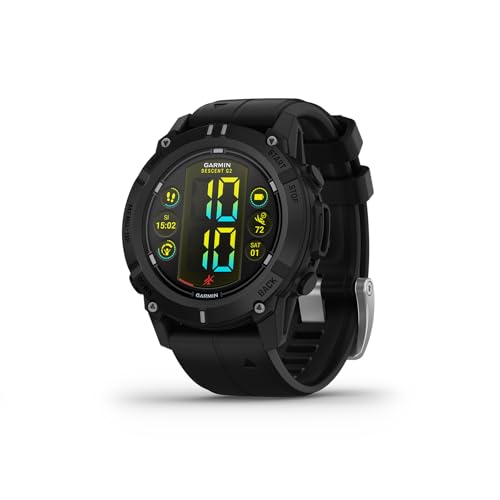
The Garmin Descent G2 is not a traditional dive watch, but it is the practical answer if you actually scuba dive. It logs depth, supports single-gas, multi-gas and gauge modes, and records no-decompression limits. See the comparison below for how it differs from a mechanical diver.
Best dive watches by situation
| Situation | Best choice | Why it fits | Typical market range |
|---|---|---|---|
| Lowest-cost serious option | Citizen Promaster Diver BN0150 | Eco-Drive quartz movement, 200 m rating, strong lume, low maintenance | Varies |
| Best value mechanical watch | Seiko Prospex SPB143 | Compact 40.5 mm case, automatic movement, 200 m rating, replaceable bracelet and straps | Varies |
| Small wrist or daily comfort | Tudor Pelagos 39 | 39 mm titanium case, 200 m rating, excellent clasp adjustment and light weight | Varies |
| Luxury tool-watch durability | Rolex Submariner | 300 m rating, highly secure bracelet, precise automatic movement and ceramic bezel | Varies |
| Technical mechanical alternative | Omega Seamaster Diver 300M | 300 m rating, helium escape valve, ceramic bezel, antimagnetic movement options | Varies |
What water resistance really means
A 200 m or 300 m marking does not mean you should take the watch to that exact depth as a routine practice. Water-resistance ratings are established under controlled test conditions, while real use adds temperature changes, movement, impacts, and crown manipulation. A watch rated to 100 m is generally suitable for swimming and surface water activities, but a 200 m ISO-rated diver gives a more appropriate margin for recreational scuba diving.
For serious diving, look for a watch identified as meeting ISO 6425 or an equivalent diver-watch standard. That standard addresses more than pressure: it includes legibility, shock resistance, magnetic resistance, secure straps, and reliability of the timing system. A screw-down crown and case back are desirable, but they do not replace periodic pressure testing.
Practical rating guide
- 50 m: splash resistance and cautious everyday wear; not a diving choice.
- 100 m: swimming and surface use when the watch is in good condition.
- 200 m: the sensible baseline for a recreational dive watch.
- 300 m or more: additional depth margin and usually a more substantial case and crown system.
Never operate the crown or chronograph pushers underwater. After saltwater use, rinse the watch with fresh water, dry it with a soft cloth, and check that the crown is fully screwed down before entering the water.
Head-to-head: the leading choices
Citizen Promaster Diver BN0150: best low-maintenance tool
The BN0150 uses Citizen’s Eco-Drive quartz movement, which charges from light and can run for months in darkness when fully charged. Its 44 mm case is larger than the nominal dimensions suggest, but the short, curved lugs help it sit securely on many wrists. The 200 m rating, screw-down crown, polyurethane strap, and strong luminous markings make it a practical water watch.
Its main compromise is the strap. Polyurethane can feel stiff when new and may eventually crack, particularly if exposed to sunlight, sunscreen, and salt without rinsing. Replacement straps are inexpensive, and the quartz movement avoids the regular winding and mechanical servicing associated with automatic watches.
Seiko Prospex SPB143: best balance of size and mechanical character
The SPB143 combines a 40.5 mm steel case with a 200 m water-resistance rating and an automatic movement. It is substantially easier to wear every day than many 44 mm dive watches, while still providing a broad enough dial and bezel for underwater reading. Its steel bezel insert is less scratch-resistant than ceramic, but scratches on steel are part of the tool-watch trade-off and can be refinished or accepted without compromising operation.
The automatic movement is convenient when worn frequently, but it is not maintenance-free. Expect eventual servicing, and remember that an automatic watch can stop after several days off the wrist. The bracelet is durable, although many owners prefer a rubber or fabric strap for swimming because it dries faster and conforms better over a wetsuit.
Tudor Pelagos 39: best compact premium diver
The Pelagos 39 is a strong choice when a conventional dive watch feels oversized. Its 39 mm titanium case is light, corrosion-resistant, and rated to 200 m. The ceramic bezel insert resists everyday scratching, while the titanium bracelet includes a clasp with useful extension and adjustment for changing wrist size.
Titanium is lighter than steel but can show surface marks more readily. Its darker gray appearance also develops a different visual character from polished stainless steel. The Pelagos 39’s automatic movement provides a substantial power reserve and chronometer-level certification, but the purchase price and future mechanical servicing are considerably higher than for a quartz Citizen.
Rolex Submariner: best refined all-rounder
The Submariner’s 300 m rating, screw-down crown, Oyster bracelet, and unidirectional ceramic bezel form a durable and highly secure package. The bezel’s 120-click action allows precise elapsed-time setting, and the luminous hour markers remain easy to distinguish in dark conditions. Its 41 mm steel case works for many wrists without the exaggerated height of some oversized divers.
The watch is exceptionally capable for recreational diving, but its price makes it an expensive piece of equipment for rough work. Ceramic is hard to scratch but can chip under a sharp impact, and bracelet links, clasp surfaces, and bezel action can accumulate wear even when the movement remains healthy. Service costs are also part of ownership rather than an occasional surprise.
Omega Seamaster Diver 300M: best technical alternative
The Seamaster Diver 300M offers a 300 m rating, a helium escape valve, a ceramic bezel, and strong lume. Current versions use automatic Co-Axial movements, with many models providing significant resistance to magnetic fields. The helium valve is mainly relevant to professional saturation-diving procedures; it is not a feature that ordinary scuba divers need to operate.
Its scalloped bezel is distinctive and grippy, though some users find a conventional coin-edge bezel easier to turn with thick gloves. The case and bracelet are substantial, so try one on if your wrist is below about 17 cm in circumference. Rubber-strap versions reduce weight and improve comfort in warm water.
More of the best dive watches for serious water use
The five watches above cover the classics. These additional picks fill the gaps competitors list: the entry-level automatic, a titanium quartz, a Swiss mid-range diver and a true dive computer.
Orient Kamasu RA-AA0003R39B — Best value automatic with a sapphire crystal

Spec line: 41.9 mm · 12.8 mm thick · 200 m · sapphire crystal · in-house F6922 automatic · about 40 hours reserve
- Case: about 41.9 mm wide, 47 mm lug-to-lug, 12.8 mm thick
- Water resistance: 200 m with a screw-down crown
- Crystal: sapphire
- Movement: Orient F6922 automatic with hand winding and hacking, about 40 hours
- Bezel: 120-click unidirectional; 22 mm lug width
The Kamasu is the cheapest way into a mechanical diver with a sapphire crystal and a real 120-click bezel. It looks more refined than its price, and the F6922 movement is accurate enough for daily wear. The compromises are the bracelet, which feels light compared with Seiko and Tissot, and a thickness of nearly 13 mm that makes it sit high under a tight cuff.
- Pro: Sapphire crystal at the lowest price in this guide.
- Pro: 120-click bezel with positive action.
- Pro: Hand winding and hacking seconds.
- Con: Standard 40-hour power reserve is short compared with Tissot or Hamilton.
- Con: Bracelet and clasp are basic.
Skip it if you want a ceramic bezel or a power reserve beyond a weekend.
Orient Ray II / Mako II — Best first mechanical dive watch on a strict budget

Spec line: 41.5 mm · about 13 mm thick · 200 m · mineral crystal · F6922 automatic · 120-click bezel
- Case: 41.5 mm wide, about 13 mm thick, 47 mm lug-to-lug
- Water resistance: 200 m, ISO 6425 diver rated, screw-down crown and caseback
- Movement: Orient F6922 automatic, 22 jewels, about 40 hours
- Crystal: mineral
- Variants: Ray II has a smooth bezel, Mako II a coin-edge bezel
The Ray II and Mako II share a case and movement, and for many beginners they are the starting point for automatic divers. The dial is practical and bright, and the movement hacks and hand-winds. A mineral crystal is the tradeoff, so avoid abrasive surfaces on boat decks and docks.
- Pro: Real 200 m rating with an ISO 6425 diver rating.
- Pro: Hacking and hand-winding automatic movement.
- Pro: 22 mm lugs accept a wide range of straps.
- Con: Mineral crystal scratches more easily than sapphire.
- Con: Aluminum bezel insert can fade or scratch.
Skip it if sapphire or a ceramic bezel is non-negotiable.
Seiko Prospex Samurai SRPL13 — Best Seiko Prospex for smaller wrists

Spec line: 41.7 mm · 49.5 mm lug-to-lug · 12.3 mm thick · 200 m · Hardlex crystal · 4R35 about 41 hours
- Case: 41.7 mm wide, 49.5 mm lug-to-lug, 12.3 mm thick, 20 mm lugs
- Water resistance: 200 m, screw-down crown and caseback
- Crystal: Hardlex mineral glass
- Movement: Seiko 4R35 automatic with hand winding and hacking, about 41 hours
- Display: day-date
The redesigned Samurai uses a smaller case than the earlier, larger Samurai, which suits more wrists. It is a sensible alternative to the SPB143 if you prefer a day-date display and a more modern layout. Hardlex crystal is the main compromise, though it resists shattering.
- Pro: 41.7 mm case with a comfortable thickness.
- Pro: Hand-winding and hacking 4R35 movement.
- Pro: Wide range of Seiko aftermarket straps and bracelets.
- Con: Hardlex crystal instead of sapphire.
- Con: Reserve of about 41 hours is shorter than Tissot’s.
Skip it if you prefer a ceramic bezel or sapphire at this price tier.
Citizen Promaster Dive BN0200-56E — Best lightweight titanium quartz diver

Spec line: 44 mm · 11.8 mm thick · 200 m · Super Titanium · Eco-Drive solar · 110 g
- Case: 44 mm wide, 49.4 mm lug-to-lug, 11.8 mm thick
- Water resistance: 200 m, ISO-compliant diver rating, screw-down crown
- Movement: Eco-Drive E168 solar, no battery changes
- Crystal: mineral with anti-reflective coating
- Case and bracelet: Super Titanium, about 110 g
Titanium is lighter and more skin-friendly than steel, and the BN0200 pairs it with Citizen’s light-powered movement. It is the strongest choice for hot-weather boat work where weight and low maintenance matter more than finishing. Titanium shows surface marks more readily than steel, so choose a rubber strap for rougher use.
- Pro: Lightweight titanium at an accessible tier.
- Pro: No battery changes or winding.
- Pro: Five-year manufacturer’s warranty with registration extension.
- Con: Aluminum bezel insert and mineral crystal.
- Con: Titanium shows surface marks.
Skip it if you want a mechanical movement.
Tissot Seastar 1000 Powermatic 80 40mm — Best Swiss entry diver with an 80-hour reserve

Spec line: 40 mm · 46 mm lug-to-lug · about 12.5 mm thick · 300 m · sapphire · Powermatic 80 with 80 hours
- Case: 40 mm wide, 46 mm lug-to-lug, about 12.5 mm thick, 316L steel
- Water resistance: 300 m (30 bar) with a screw-down crown and caseback
- Crystal: sapphire
- Movement: Powermatic 80 automatic, 23 jewels, 80-hour power reserve
- Lug width: 20 mm
The Seastar 1000 40mm is the reference many reviewers recommend as an accessible Swiss diver. It adds sapphire, a deeper 300 m rating and an 80-hour reserve, so it keeps running over a long weekend. The 20 mm lug width opens up an easy range of straps. Verify on the maker’s spec sheet that the specific reference you buy matches the details above.
- Pro: 80-hour power reserve survives three days off the wrist.
- Pro: 300 m rating with a sapphire crystal.
- Pro: 40 mm size suits small and medium wrists.
- Con: Costs more than Orient or Seiko automatics.
- Con: Case is slightly thick for its diameter.
Skip it if you want a titanium case or a larger 43 to 44 mm wrist presence.
Garmin Descent G2 — Best watch-style dive computer for scuba divers

Spec line: 45.5 mm · 15.2 mm thick · 61 g · 1.2 in AMOLED · 100 m depth rating · up to 27 hours in dive mode
- Case: 45.5 mm wide, 15.2 mm thick, 61 g without band
- Display: 1.2 in AMOLED touchscreen, 390 by 390 pixels, sapphire lens
- Water rating: 10 ATM, maximum operating dive depth 100 m
- Dive modes: single-gas, multi-gas, CCR, gauge, apnea and apnea hunt
- Battery: up to 27 hours in dive mode, up to 10 days as a smartwatch
If your question is not which beautiful watch to wear but which watch keeps you safe underwater, the Descent G2 is the answer. It tracks depth and decompression using a Bühlmann ZHL-16c model, supports nitrox and trimix gases, and still works as a daily smartwatch. It is not a traditional dive watch, so the style is different and it needs charging.
- Pro: Real dive computer features, including decompression tracking.
- Pro: AMOLED touchscreen with a sapphire lens.
- Pro: Doubles as an everyday smartwatch.
- Con: Needs charging; no mechanical charm.
- Con: Larger and thicker than a typical dive watch at 15.2 mm.
Skip it if you only snorkel or want a mechanical watch.
Bezel, lume, and movement choices
A proper dive bezel should rotate only counterclockwise. If it moves accidentally, it can indicate less remaining bottom time rather than falsely suggesting that more time is available. A 120-click bezel gives smaller, more precise adjustments than a 60-click design, but click count is not everything: grip, alignment, and resistance to accidental movement matter more.
Lume should be applied to the hands, hour markers, and the bezel’s zero marker. Brightness is useful at the start of a dive, but longevity and contrast are more important after several minutes underwater. Modern watches using proprietary luminous compounds can be very effective; inspect whether the bezel marker remains distinguishable from the dial rather than judging brightness alone.
- Quartz: accurate, shock-tolerant, inexpensive to maintain, and usually the best choice for occasional water use.
- Solar quartz: reduces battery replacement, but still needs seals inspected and may require a rechargeable-cell replacement after many years.
- Automatic mechanical: offers a smooth seconds hand and no conventional battery, but requires periodic service and can stop when unworn.
Dive watch crystal, bezel and lug width: how to read the spec sheet
| Crystal | Scratch resistance | Shatter resistance | Seen on |
|---|---|---|---|
| Sapphire | Highest | Can chip on a hard impact | Orient Kamasu, Tissot Seastar 1000, Hamilton Khaki Navy Scuba, Victorinox Dive Pro |
| Hardlex (Seiko mineral glass) | Moderate | Good | Seiko Prospex Samurai SRPL13 |
| Mineral | Moderate | Good | Orient Ray II / Mako II, Citizen Promaster models |
- Bezel clicks: 120-click bezels (Orient Kamasu, Ray II) allow half-minute settings; 60-click bezels are standard on many others.
- Bezel insert: aluminum is inexpensive and can fade; ceramic resists scratches and fading and is found on higher tiers.
- Lug width: 20 mm (Tissot, Hamilton, Seiko Samurai) and 22 mm (Orient, Citizen BN0200) set which aftermarket straps fit.
- Thickness: a watch above 13 mm tall can catch on a wetsuit cuff; many in this guide sit between 11.8 and 13 mm.
Case size and strap comfort
Measure your wrist circumference and compare it with the lug-to-lug length, not case diameter alone. As a useful guide, wrists under 16 cm often suit 36–40 mm cases, 16–18 cm wrists can usually handle 40–43 mm, and larger wrists may find 44 mm cases proportionate. Case thickness and lug shape can matter more than a 2 mm difference in diameter.
Steel bracelets are the most secure for daily wear and often include a wetsuit extension. Rubber is comfortable in water and easy to rinse, while nylon or fabric straps dry quickly but may retain salt and grit. Replace a strap when the holes elongate, the keeper loosens, or cracks appear near the spring bars. A failed strap can lose the watch even when the case itself remains perfectly sound.
Best dive watches compared: specs side by side
| Watch | Water resistance | Case | Movement | Crystal | Tier |
|---|---|---|---|---|---|
| Casio MDV106-1A | 200 m | Not listed here | Quartz | Mineral | Budget |
| Citizen Promaster Diver BN0150 | 200 m | 44 mm | Eco-Drive solar | Mineral | Budget-mid |
| Orient Ray II / Mako II | 200 m | 41.5 mm | F6922 automatic | Mineral | Budget |
| Orient Kamasu RA-AA0003R39B | 200 m | 41.9 mm | F6922 automatic | Sapphire | Budget |
| Seiko Prospex SPB143 | 200 m | 40.5 mm | Automatic | Not listed here | Mid |
| Seiko Prospex Samurai SRPL13 | 200 m | 41.7 mm | 4R35 automatic | Hardlex | Mid |
| Citizen Promaster Dive BN0200-56E | 200 m | 44 mm titanium | Eco-Drive solar | Mineral | Mid |
| Tissot Seastar 1000 Powermatic 80 40mm | 300 m | 40 mm | Powermatic 80 (80 h) | Sapphire | Upper-mid |
| Hamilton Khaki Navy Scuba Auto 40mm | 100 m | 40 mm | H-10 (80 h) | Sapphire | Upper-mid |
| Victorinox Dive Pro Automatic 43mm | 300 m | 43 mm | Sellita SW 220 | Sapphire | Premium |
| Garmin Descent G2 | 10 ATM (100 m dive depth) | 45.5 mm | Digital | Sapphire lens | Premium |
| Tudor Pelagos 39 | 200 m | 39 mm titanium | Automatic (COSC) | Not listed here | Luxury |
| Omega Seamaster Diver 300M | 300 m | Steel | Co-Axial automatic | Not listed here | Luxury |
| Rolex Submariner | 300 m | 41 mm steel | Automatic | Not listed here | Luxury |
Also consider: four more dive watches
Hamilton Khaki Navy Scuba Auto 40mm — Best Swiss field-diver hybrid

Best for buyers who want a Swiss automatic with a military look and an 80-hour reserve. Key spec: 40 mm case, 100 m water resistance, sapphire crystal, H-10 movement. Trade-off: 100 m is below the 200 m baseline recommended earlier for regular scuba.
Victorinox Dive Pro Automatic 43mm (titanium) — Best titanium Swiss diver in the mid-premium tier

Best for divers who want ISO 6425 certification and a lightweight titanium case. Key spec: 43 mm, 300 m, sapphire crystal, Sellita SW 220 automatic with about 38 hours. Trade-off: shorter reserve than Tissot or Hamilton, and the 14 mm height is chunky.
Ratio FreeDiver Helium-Safe 1000M — Best extreme-depth rating on a budget

Best for buyers who want a large, rugged mechanical diver with a 1,000 m rating and a helium valve. Key spec: sapphire crystal, Seiko NH-series automatic, 45 to 47 mm case depending on reference. Trade-off: it is large and thick at around 15 mm, and the brand has a shorter track record.
Garmin Descent Mk3i 43mm — Best for technical divers who want sonar networking

Best for serious scuba divers who want the Mk3 family of dive computers. Key spec: 43 mm, Subwave sonar networking, multiple dive modes. Trade-off: it costs far more than the Descent G2 and is a computer first, a watch second.
Mechanical dive watch or dive computer?
| Factor | Mechanical or quartz dive watch | Watch-style dive computer |
|---|---|---|
| Tracks depth and decompression | No | Yes |
| Maintenance | Occasional service or battery | Charging, firmware updates |
| Longevity | Decades with service | Depends on battery and software support |
| Style | Classic tool-watch look | Modern smartwatch look |
| Best for | Snorkeling, swimming, backup timer | Recreational and technical scuba |
A diver should not rely on a mechanical watch for decompression planning. Use a dive computer or tables for depth and no-decompression limits, and keep a dive watch as an everyday companion or a bottom timer.
How we chose the best dive watches
This ranking is research-based, with no bench or underwater trials. We used manufacturer specification pages, retailer listings and independent watch publications. We selected watches that: (1) carry a stated water resistance of at least 100 m, with 200 m preferred for scuba; (2) have a screw-down crown; (3) are sold new in the United States; and (4) have clear case size and movement specifications. We included quartz, solar, automatic and computer-based options so each budget and maintenance preference has a pick. Specs differ slightly between sources, so confirm the reference number before you buy.
Dive watch size guide by wrist and case diameter
| Wrist circumference | Comfortable case size | Picks that fit |
|---|---|---|
| Under 6.3 in (16 cm) | 36 to 40 mm | Tudor Pelagos 39, Tissot Seastar 1000 40mm, Hamilton Khaki Navy Scuba 40mm |
| 6.3 to 7.1 in (16 to 18 cm) | 40 to 43 mm | Seiko Prospex SPB143, Seiko Samurai SRPL13, Orient Ray II / Kamasu, Victorinox Dive Pro |
| Over 7.1 in (18 cm) | 43 to 45 mm | Citizen Promaster Diver, Citizen BN0200-56E, Garmin Descent G2 |
Lug-to-lug length matters as much as diameter. Orient and Tissot list 46 to 47 mm lug-to-lug for their 40 to 42 mm cases, while the Citizen BN0200-56E measures about 49.4 mm. If the lugs overhang your wrist, the watch will sit unstable no matter how good the specs are.
Dive watch care and service by movement type
| Movement | Typical care | Best for |
|---|---|---|
| Eco-Drive solar quartz (Citizen) | Expose to light weekly; seal check every 2 to 3 years; rechargeable cell replaced after many years | Set-and-forget wear |
| Quartz with battery (Casio) | Battery change and seal test every few years | Lowest cost |
| Automatic (Seiko, Orient, Tissot, Hamilton) | Service every several years; wind or wear to keep it running | Mechanical enthusiasts |
| Dive computer (Garmin) | Charge and update firmware; replace the strap and seals | Active scuba divers |
Strap choices for the water
- Rubber or silicone: dries quickly, resists salt, and fits over a wetsuit sleeve.
- Steel bracelet: durable, but can corrode at the clasp if you do not rinse it.
- NATO or textile: light and comfortable, but slow to dry.
- Titanium bracelet: light and non-reactive, but marks more easily.
Quick saltwater routine
- Rinse the watch in fresh water after every saltwater dip.
- Do not press buttons or turn the crown while submerged.
- Dry the strap and bracelet before storing.
- Make sure the crown is fully screwed down before getting wet.
Ownership realities and maintenance
The seals are the wear items that matter most. Gaskets age from heat, ultraviolet exposure, chemicals, and repeated compression. Have a frequently submerged watch pressure-tested approximately once a year, and have its seals inspected whenever the case is opened. Mechanical watches commonly need a full service roughly every five to ten years, depending on the manufacturer, use, and timekeeping behavior; quartz and solar watches still need water-resistance checks.
A simple ownership calculation explains why the cheapest purchase is not always the lowest-cost option. The premium watch may offer better finishing and resale value, but the inexpensive tool is often the rational choice for hard, frequent water work.
Which dive watch should you buy?
| If you… | Choose | Why |
|---|---|---|
| Want zero maintenance on a boat or beach | Citizen Promaster Diver BN0150 or BN0200-56E | Solar Eco-Drive, no winding or battery swaps |
| Want your first mechanical diver | Orient Kamasu or Seiko Prospex SPB143 | Real 200 m rating and an automatic movement at an accessible tier |
| Have a small wrist | Tissot Seastar 1000 40mm or Tudor Pelagos 39 | 39 to 40 mm cases |
| Dive with air or nitrox | Garmin Descent G2 | Decompression tracking and multiple gas modes |
| Want one watch for everything | Rolex Submariner or Omega Seamaster Diver 300M | Refined build, resale and 300 m rating |
| Need the lowest cost | Casio MDV106-1A | 200 m quartz tool watch |
Mistakes to avoid
- Choosing by depth marking alone. A 300 m watch with a poor strap is a worse tool than a 200 m watch you trust.
- Ignoring lug-to-lug length. A 44 mm case with short lugs can wear smaller than a 40 mm case with long lugs.
- Skipping pressure tests after a battery swap or servicing.
- Pushing buttons or turning the crown underwater.
- Leaving a rubber strap in sunlight and sunscreen for months without rinsing it.
Best dive watches FAQ
What is the best dive watch for the money?
The Seiko Prospex SPB143 and the Orient Kamasu are the best-value mechanical dive watches, while the Citizen Promaster Diver is the best low-maintenance quartz option. All three offer a 200 m rating and a screw-down crown at an accessible price tier.
How deep can a 200 m dive watch go?
A 200 m dive watch is intended for recreational scuba diving, but the rating comes from controlled testing. Treat the marking as a safety margin, not a target depth, and avoid pressing buttons underwater.
Is a 100 m watch good enough for diving?
A 100 m watch suits swimming and snorkeling, but a 200 m ISO 6425 rating is the sensible baseline for scuba. If you scuba dive, choose a 200 m or 300 m watch and a dive computer for depth tracking.
Do you need a dive watch if you have a dive computer?
No, a dive computer replaces the dive watch for depth and decompression information. Many divers still wear a mechanical dive watch as a backup timer or simply as an everyday tool watch.
Quartz or automatic: which dive watch is better?
Quartz is better for low maintenance, accuracy and shock resistance, while automatic is better for mechanical craft and long-term ownership. Solar quartz reduces battery changes, and automatic watches need periodic service.
What does ISO 6425 mean for a dive watch?
ISO 6425 is the international standard for diver’s watches. It covers pressure resistance, legibility in the dark, shock, magnetism, strap strength and the timing system. The Victorinox Dive Pro and Orient Mako II are among the models marketed as meeting it.
Is titanium better than steel for a dive watch?
Titanium is lighter, corrosion-resistant and warmer on the skin, but it marks more easily than steel. Choose titanium for comfort on long days; choose steel for scratch resistance and a heavier feel.
How often should a dive watch be pressure tested?
Have the seals checked after every battery or crystal service and at least every year or two if you dive regularly. Rinse the watch with fresh water after saltwater use.
Best dive watches by activity
- Snorkeling and swimming: Citizen Promaster Diver BN0150 or Casio MDV106-1A. Quartz and solar movements shrug off knocks and need little care.
- Recreational scuba: Seiko Prospex SPB143, Orient Kamasu or Tissot Seastar 1000, paired with a dive computer or tables for depth and time limits.
- Boat work and fishing: Citizen Promaster Dive BN0200-56E, because titanium is light and the Eco-Drive movement never needs a battery.
- Technical or frequent diving: Garmin Descent G2 as the primary instrument, with a mechanical diver as a backup timer.
- One watch for everything: Omega Seamaster Diver 300M or Rolex Submariner for the widest range of use and the strongest resale.
Final buying recommendation
Choose a 200 m ISO-oriented diver with a unidirectional bezel for regular recreational diving. Pick the Citizen Promaster if reliability and low ownership cost come first, the Seiko SPB143 if you want a moderately sized mechanical watch, or the Tudor Pelagos 39 if comfort and premium construction justify the price. Move to the Rolex Submariner or Omega Seamaster Diver 300M when bracelet security, 300 m capability, finishing, and long-term mechanical ownership are priorities. Whatever the brand, buy the fit first: a readable watch that stays securely on the wrist is more useful underwater than a larger specification sheet.