What's inside
As an Amazon Associate I earn from qualifying purchases. This post may contain affiliate links at no extra cost to you.
A skew chisel is useful when a straight chisel’s broad edge cannot reach cleanly into a corner or work close to a shoulder. Its angled cutting edge lets you pare along a wall of a recess while keeping your hand and handle clear. That helps with dovetail sockets, stopped housings and other timber joints—but only if the edge suits the corner and the tool is sharp.
For occasional cleanup, a standard bevel-edge chisel may be enough. If you regularly pare into acute corners, buy a pair of skew chisels with opposite bevel directions, or a single skew that matches the work you do most. A skew is a specialist, not a replacement for a basic chisel set.
As an Amazon Associate we earn from qualifying purchases at no extra cost to you.


Sections
Our Top Picks
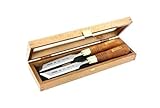
 Narex Set of Skew Chisels in Wooden Box6 mm (0.2 inch)9.92 x 1.34 x 1.34 Inches0.25 poundsCheck on Amazon


What a skew chisel does
The cutting edge runs diagonally across the blade rather than square to its sides. This gives you a narrow leading corner that can reach into a recess without the full width of the blade bearing against the opposite wall. It is particularly handy for trimming the end grain in dovetail sockets, where a square-edged chisel can foul the side of the joint.
Skews are usually made as left- and right-hand versions. The bevel direction determines which way the tool is most comfortable to guide and which corner you can reach. One handedness will not work equally well on both sides of a joint. If you clean both sides of recesses, a matched pair is more versatile than one skew.
Choosing a size and pair
Choose the blade width to suit the recess, not the largest tool you can afford. A 6 mm (1/4-inch) skew can reach tight corners in small dovetails, but it removes little material per pass. A 12 mm (1/2-inch) blade is more useful for general cabinet-sized joints. Wider blades are efficient on larger work but can be awkward in narrow sockets.
If you only need a skew occasionally, start with one in the width you use most and check that its bevel direction reaches the troublesome corner. For regular dovetail work, a left-and-right pair around 6–12 mm wide covers many small and medium joints. Do not assume that a wider blade will reach deeper: the handle, blade thickness and opposite wall can stop it first.
Browse left- and right-hand skew chisel pairs if you often pare both sides of recesses. For one-off work, a suitable straight chisel may be the better-value purchase.
Which option makes sense?
| Tool | Best use | Trade-off |
|---|---|---|
| Single skew chisel | Repeated work on one side or one handedness of corner | Limited access on the opposite side |
| Matched skew pair | Cleaning both sides of dovetail sockets and recesses | Costs more and needs storage for two tools |
| Standard bevel-edge chisel | General paring and occasional accessible corners | May contact the opposite wall before its edge reaches the corner |
| Skewed paring chisel | Long, controlled paring on larger work | Long blade can be cumbersome in a small recess |
What to look for when buying
Prioritise a flat back, a cleanly ground edge and a handle you can control with light pressure. A polished finish is not proof of good geometry. Check that the cutting edge is continuous and that the blade does not have a large hollow or twist. If you can inspect it in person, place the back against a flat surface and look for rocking; a small hollow near the edge can be corrected, but a badly uneven back means extra setup work.
For hand paring, a moderate-length blade gives useful reach without making the tool difficult to steer. A thin blade enters tight spaces more easily, but it is less suited to levering out waste. Do not twist a skew in a corner to pry a chip free: the narrow tip can chip or bend. Use a separate chisel to remove bulk waste, then pare the final sliver with the skew.
Budget tools can be perfectly adequate for occasional bench work. Their common drawback is extra sharpening and flattening before they cut cleanly, not necessarily poor performance once tuned. Pay more if you use the tool often, want a handle that stands up to repeated tapping, or need consistent edge geometry across a pair. Compare standard bevel-edge chisels too; one well-tuned chisel may be more useful than a cheap skew set that rarely leaves the drawer.
Sharpening and using it safely
Sharpen the back flat near the cutting edge, then hone the bevel at the tool’s existing angle. Many bench chisels use a bevel around 25–30 degrees, but follow the blade’s current geometry rather than grinding a new angle without reason. A skew’s diagonal edge makes honing less intuitive: keep the edge flat to the abrasive and avoid rounding its pointed corner. A small secondary bevel is optional; consistency matters more than chasing a particular number.
Secure the work before cutting. Pare in shallow passes, keeping the bevel supported against the surface where that helps control depth. Work from the waste side toward the finished wall, and stop short of the final line until the cut is stable. If the edge chatters, tears the grain or wanders into the wall, stop and sharpen it; pushing harder usually makes the damage worse.
In end grain, take thin cuts and check progress often. A skew can make a clean corner, but its narrow tip is easy to overdrive past the layout line. When the recess is already close to size, a few light hand-pressure strokes are safer than mallet blows. For rough waste removal or a stubborn knot, use a sturdier tool instead.
A practical buying choice
For a first purchase, choose a single skew in the width and handedness that match your most common joint, and spend time getting it sharp. Add its opposite-hand partner if you routinely clean both sides of sockets. If your corners are accessible and the work is occasional, a standard bevel-edge chisel is cheaper and more versatile. The right choice is the one that reaches the corner without forcing you to twist, pry or sacrifice control.