What's inside
- Quick verdict: who should buy the SawStop Jobsite Pro?
- Capacity and key specifications
- Fence setup: good out of the box, but verify before cutting
- Safety system: valuable protection with real ownership costs
- Portability and performance: jobsite versus home shop
- What to budget for and what wears
- Bottom line
- Quick verdict: who should buy the SawStop Jobsite Pro?
- Capacity and key specifications
- Fence setup: good out of the box, but verify before cutting
- Safety system: valuable protection with real ownership costs
- Portability and performance: jobsite versus home shop
- What to budget for and what wears
- Bottom line
As an Amazon Associate I earn from qualifying purchases. This post may contain affiliate links at no extra cost to you.
Sections
- Quick verdict: who should buy the SawStop Jobsite Pro?
- Capacity and key specifications
- Fence setup: good out of the box, but verify before cutting
- Safety system: valuable protection with real ownership costs
- Portability and performance: jobsite versus home shop
- What to budget for and what wears
- Bottom line
Quick verdict: who should buy the SawStop Jobsite Pro?
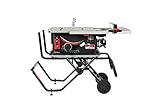
The SawStop Jobsite Pro is a strong choice if you need a portable table saw with a rack-and-pinion fence and SawStop’s brake system, but its weight, setup footprint, and ongoing brake-cartridge costs make it less compelling for frequent hauling or budget-first buyers. It fits a small home shop particularly well when you want a capable 10-inch saw without committing to a contractor or cabinet saw.
Its main trade-off is that “jobsite” describes the rolling stand and transportable design more than effortless portability: this is a substantial machine to load, move, and store. For a stationary home shop, that matters less. For crews carrying a saw up stairs or moving it between sites daily, a lighter saw may be easier to live with.
As an Amazon Associate we earn from qualifying purchases at no extra cost to you.


Capacity and key specifications
The Jobsite Pro is a 10-inch saw with a 15-amp motor, a 25½-inch rip capacity to the right of the blade, and a 12-inch capacity to the left. That is enough for many sheet-goods cuts, but a full 4-by-8-foot sheet is awkward to handle alone on any jobsite table saw. Plan on outfeed support and a helper or panel-cutting method for large panels.
| Specification | SawStop Jobsite Pro | Why it matters |
|---|---|---|
| Blade diameter | 10 inches | Common size with broad blade availability |
| Motor | 15 amps | Standard household-circuit class; avoid sharing a circuit with heavy loads |
| Rip capacity, right | 25½ inches | Handles many cabinet parts and narrower sheet-goods rips |
| Rip capacity, left | 12 inches | Useful for smaller left-side cuts, but not equivalent to right-side capacity |
| Maximum cut depth at 90° | 3⅛ inches | More than enough for typical 2-by lumber, with blade exposure set appropriately |
| Maximum cut depth at 45° | 2¼ inches | Allows common bevel cuts within the saw’s capacity |
| Weight | About 113 lb for the saw; roughly 153 lb with stand | Rolls on its stand, but lifting into a vehicle is a two-person task for many users |
| Brake cartridge | Single-use after activation | Budget for a replacement if the safety system fires |
Specifications can vary slightly by model year or configuration, so verify the exact version and included accessories before buying. The 25½-inch rip limit is the practical constraint to keep in mind: it is not a substitute for a wider-capacity cabinet saw when your work routinely involves broad panels.
Fence setup: good out of the box, but verify before cutting
The rack-and-pinion fence is one of the Jobsite Pro’s strongest day-to-day features. Front and rear adjustments move the fence together, making it quicker to set than a fence that must be aligned manually at both ends. The fence’s scale is useful for repeat settings, but it is still worth confirming the actual blade-to-fence distance with a rule or reliable measuring tool.
For initial setup, assemble the stand on a flat surface and confirm that it locks securely before mounting or unfolding the saw. Check that the blade is parallel to the miter slot, then check the fence against the slot or blade. If the fence is not parallel, follow the manual’s adjustment procedure rather than compensating by steering workpieces. A small alignment error can cause binding, poor cut quality, and increased kickback risk.
Keep the fence faces clean and free of pitch or sawdust, and lock the fence firmly before each cut. For narrow rips, use the appropriate push stick or push block and keep hands out of the blade path. Do not use the fence and miter gauge together to trap a cutoff between the blade and fence; use a safe crosscut setup instead.
Is a SawStop Jobsite Pro fence upgrade worth it?
For most buyers, the included fence is capable enough that an immediate fence upgrade is unnecessary. Consider an aftermarket fence only if you have a specific, verified compatibility need—such as a longer work surface or a particular shop jig—and can confirm that it will not interfere with the saw’s guard, rail, or folding stand. Adding a longer fence does not increase the saw’s supported rip capacity or make large panels safe to handle without proper support.
Safety system: valuable protection with real ownership costs
SawStop’s brake system is designed to stop the blade when its brake detects contact with skin. It is an additional layer of protection, not permission to work without the blade guard, riving knife, push tools, or safe cutting practices. The system can also activate on conductive material or under certain operating conditions, so read the manual’s guidance on bypass mode and materials before using the saw.
The brake cartridge is a consumable if activated, and a damaged blade may need replacement as well. Replacement cartridge and blade costs vary by model and market; allow for a cost in the general range of tens to a few hundred dollars combined, depending on what is damaged and current pricing. Check current local pricing and cartridge compatibility before purchase. That potential expense is part of the ownership calculation, not a reason to disable or bypass the system casually.
For a new user, a shared workshop, or a home shop where several people operate the saw, the safety system may justify its premium. A highly experienced user who already owns a suitable saw may weigh that benefit differently, but the purchase decision should account for both the protection and the cost of a possible activation.
Portability and performance: jobsite versus home shop
| Situation | Fit | Buying advice |
|---|---|---|
| Small home shop, occasional to regular projects | Very good | Good balance of capacity, fence convenience, and safety; measure storage and outfeed space first |
| Remodeler moving between ground-floor sites | Good, with reservations | Wheels help on smooth paths, but the assembled weight and stand footprint make loading a chore |
| Daily transport, stairs, or one-person vehicle loading | Fair to poor | Compare lighter jobsite saws; the Jobsite Pro’s safety system may not outweigh the handling burden |
| Cabinet work with frequent wide rips | Limited | Its 25½-inch right-side capacity may be restrictive; consider a larger saw or a panel-cutting workflow |
| Buyer prioritizing lowest upfront and upkeep cost | Fair | Compare the full purchase price, stand, blades, and potential brake replacement—not just the saw’s headline price |
On site, the saw performs best when it can stay set up on a reasonably level surface with room for infeed and outfeed. Its 15-amp motor is suited to common woodworking cuts with an appropriate sharp blade, but feeding too aggressively, using a dull blade, or running it on an overloaded circuit can slow the cut and worsen results. Use a dust extractor or collection setup where practical; keeping the cabinet and mechanism clear of sawdust also helps the saw operate reliably.
In a home shop, the rolling stand is useful for reclaiming floor space, but the saw still needs a safe working envelope when opened. Measure doorways, storage locations, and the path to your work area before buying. The stand’s mobility is most useful for moving the saw across a shop—not for making a 153-pound assembly feel lightweight.
What to budget for and what wears
Prices vary by retailer, configuration, and year, so compare current market pricing rather than relying on a fixed figure. The Jobsite Pro generally sits in the premium jobsite-saw range. Add the cost of a quality blade suited to your work, dust collection, and any outfeed support. If the saw will be transported often, also consider how you will secure it in the vehicle and protect the fence and controls.
Blades are the routine wear item: resin buildup and dull teeth reduce cut quality and put extra strain on the motor. Clean or replace blades as needed, and use a blade suited to the material. Sawdust accumulation is another preventable issue; unplug the saw before cleaning and follow the manufacturer’s maintenance instructions. Avoid forcing the fence, dragging the saw over rough ground, or storing it where moisture can corrode metal surfaces.
Bottom line
Choose the SawStop Jobsite Pro if you want a portable-format 10-inch saw with a convenient rack-and-pinion fence and value the added protection enough to accept a premium price and possible brake-cartridge replacement. It is especially appealing as a movable home-shop saw or for site work where it can remain set up on one level.
Look elsewhere if you need a genuinely easy one-person carry, routinely rip material wider than 25½ inches, or want the lowest-cost saw to wear out on demanding daily work. Before buying, confirm the exact model’s specifications, test that your shop or vehicle can accommodate its weight and footprint, and include blades, support equipment, and potential safety-system consumables in your budget.