What's inside
- DeWalt Jobsite Table Saws Compared: Compact vs. 10-Inch Models
- Spec Comparison at a Glance
- The Rack-and-Pinion Fence: Why It’s the Selling Point
- Stand Compatibility and Portability
- Corded vs. FlexVolt: The Power Trade-Off
- Which Saw for Which Situation
- Ownership Realities the Listings Don’t Mention
- Bottom Line
- Related Guides
- DeWalt Jobsite Table Saws Compared: Compact vs. 10-Inch Models
- Spec Comparison at a Glance
- The Rack-and-Pinion Fence: Why It’s the Selling Point
- Stand Compatibility and Portability
- Corded vs. FlexVolt: The Power Trade-Off
- Which Saw for Which Situation
- Ownership Realities the Listings Don’t Mention
- Bottom Line
- Related Guides
As an Amazon Associate I earn from qualifying purchases. This post may contain affiliate links at no extra cost to you.
Sections
- DeWalt Jobsite Table Saws Compared: Compact vs. 10-Inch Models
- Spec Comparison at a Glance
- The Rack-and-Pinion Fence: Why It’s the Selling Point
- Stand Compatibility and Portability
- Corded vs. FlexVolt: The Power Trade-Off
- Which Saw for Which Situation
- Ownership Realities the Listings Don’t Mention
- Bottom Line
- Related Guides
DeWalt Jobsite Table Saws Compared: Compact vs. 10-Inch Models
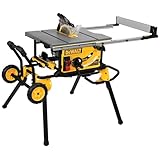
The short version: if you regularly rip full sheets of plywood or 2x material for framing and deck work, the 10-inch DWE7491RS is the right dewalt jobsite table saw — its 32-1/2-inch rip capacity and rolling stand are still the benchmark in 2026. If you’re a remodeler, trim carpenter, or work out of a small van, the 8-1/4-inch DWE7485 compact saw (corded) or DCS7485 (FlexVolt cordless) delivers the same fence system in a package roughly 20 pounds lighter — you just give up the ability to rip a 4×8 sheet in half down the middle.
All three saws share DeWalt’s rack-and-pinion fence, which is the real reason to buy into this lineup. Below is how they actually differ and which situation each one fits.
As an Amazon Associate we earn from qualifying purchases at no extra cost to you.


Spec Comparison at a Glance
| Spec | DWE7491RS (10″ w/ rolling stand) | DWE7485 (8-1/4″ compact, corded) | DCS7485B (8-1/4″ compact, FlexVolt) |
|---|---|---|---|
| Blade diameter | 10 in | 8-1/4 in | 8-1/4 in |
| Rip capacity (right of blade) | 32-1/2 in | 24-1/2 in | 24-1/2 in |
| Rip capacity (left of blade) | 22 in | 12 in | 12 in |
| Max depth of cut at 90° | 3-1/8 in | 2-9/16 in | 2-9/16 in |
| Max depth at 45° | 2-1/4 in | 1-3/4 in | 1-3/4 in |
| Motor / power | 15A corded, 4,800 RPM | 15A corded, 5,800 RPM | 60V FlexVolt, 5,800 RPM |
| Weight (saw only) | ~90 lb with stand | ~46 lb | ~46 lb (battery adds ~4 lb) |
| Dado capable | Yes (up to 13/16 in stack) | No | No |
| Typical street price | $550–$650 (stand included) | $300–$380 | $350–$450 bare tool |
Two numbers in that table do most of the deciding. First, rip capacity: 24-1/2 inches on the compact saws rips a 4×8 sheet to the long dimension but can’t split one down the middle — that takes the DWE7491’s 32-1/2 inches. Second, depth of cut: the 8-1/4-inch blade tops out around 2-9/16 inches, which clears a 2×4 (1-1/2 inches actual) easily but won’t cut a 4×4 (3-1/2 inches) in one pass like the 10-inch saw can.
The Rack-and-Pinion Fence: Why It’s the Selling Point
Every dewalt jobsite table saw in this lineup uses a fence that rides on geared rails front and back, driven by a pinion under the front rail. Turning the adjustment knob moves the fence parallel to the blade by design — there’s no manual squaring step like on clamp-style fences.
In practical terms this means:
- The fence locks parallel to the miter slot within roughly 1/32 inch out of the box, and stays there because both rails are captive.
- Micro-adjustments are repeatable — dial half a turn, get a predictable fraction of an inch of movement.
- The rails telescope, so the fence can sit close to the blade for narrow rips or extend out to full capacity without wobble.
Accuracy is effectively identical across all three saws since they share the mechanism. The 10-inch model’s advantage is purely the longer rail set. One ownership note: sawdust packs into the pinion teeth over time and makes the knob feel gritty. A quick brush-out every few uses keeps it smooth — five minutes with a stiff brush and compressed air is the entire maintenance job.
Stand Compatibility and Portability
This is where the two size classes genuinely split.
10-inch DWE7491RS
The “RS” suffix means it ships with the DW7440RS rolling stand — a folding leg-and-wheel setup that lets you push the saw around like a hand truck and drop it into position in about ten seconds. The saw also accepts the same stand if bought separately. At roughly 90 pounds combined, one person can move it, but you’ll feel it on stairs. The stand is a real workflow advantage if you’re the type who sets up in a driveway or moves between floors; it’s a hindrance if your saw never leaves a shop corner.
Compact saws (DWE7485 and DCS7485)
The compact models mount to DeWalt’s scissor-style and rolling compact stands. They’re light enough (~46 lb) that many users skip a stand entirely and run them on a pair of sawhorses or a workmate-style bench — which is legitimate for occasional use. If you want a stand, budget an extra $100–$200 on top of the saw price. Important: the compact saws do not fit the DW7440RS stand designed for the 7491 — the mounting holes differ, so check stand-to-saw compatibility before buying.
Corded vs. FlexVolt: The Power Trade-Off
The DCS7485 is mechanically the same saw as the corded DWE7485 — same blade, same capacity, same fence. The only question is power delivery.
| Factor | Corded DWE7485 | FlexVolt DCS7485 |
|---|---|---|
| Sustained ripping (wet PT, hardwood) | Unlimited; 15A holds speed | Strong but sags sooner; high drain |
| Runtime (9.0Ah FlexVolt battery) | n/a | Roughly 30–50 linear feet of 3/4″ hardwood ripping per charge; much more in softwood |
| Setup | Needs outlet or generator | True grab-and-go; great for punch-list work |
| Total cost of entry | Lower | Higher — bare tool plus battery/charger unless you own FlexVolt already |
The cordless version makes sense in two situations: you already own FlexVolt batteries from other tools (the battery cost disappears), or your work is genuinely remote — a deck in a backyard, a barn build, punch work where running a cord costs more time than the battery swap. If you’re the second type and don’t own batteries, a realistic worked example: bare tool (~$400) plus a 9.0Ah battery and fast charger (~$300–$350) puts you near $700+ — at which point the corded DWE7491RS with its bigger capacity is the better buy unless cordless is non-negotiable.
Which Saw for Which Situation
| Your situation | Pick | Why |
|---|---|---|
| Framing, decks, plywood sheet work, shop-adjacent use | DWE7491RS | 32-1/2″ rip, cuts 4×4, dado-capable, rolling stand included |
| Remodeling, trim, flooring, van-based work | DWE7485 | 46 lb, stores flat, cheaper, still rips sheet goods to length |
| Remote sites, no power, existing FlexVolt batteries | DCS7485 | Same compact platform without the cord dependency |
| First saw, tight budget, occasional DIY | DWE7485 | Lowest entry cost with the same accurate fence |
| Built-in cabinetry aspirations, dadoes, joinery | DWE7491RS | Only one of the three that accepts a dado stack |
Ownership Realities the Listings Don’t Mention
- What wears first: the blade it ships with. Stock 24-tooth blades are for rough ripping; budget $25–$50 for a 40-tooth combination blade if you want clean plywood edges. Brushes and belts are multi-year items on these direct-drive motors.
- Guard assembly: the modular guard/riving knife is genuinely quick to remove and reinstall — that’s good for safety compliance, but the anti-kickback pawls scuff soft materials. Many users leave pawls off for finished work; keep the riving knife on regardless.
- Dust collection: all three have a 2-1/2-inch port, but a lot of dust exits below the blade on the compact saws since the cabinet is open-bottomed. A shop vac on the port helps; don’t expect cabinet-saw containment.
- Common mistake: ripping stock between the fence and blade with the fence unlocked “just for a second.” The fence can shift mid-cut and cause kickback. Lock it every pass — the rack-and-pinion design makes this a one-hand, half-second habit.
- FlexVolt-specific: cold weather cuts runtime noticeably, and the saw will thermal-protect and pause on long, aggressive rips. Carry a second battery rather than waiting on a charge.
Bottom Line
Buy the DWE7491RS if capacity and the included rolling stand match your work — it covers the widest range of tasks. Buy the DWE7485 if weight and footprint matter more than the last eight inches of rip capacity. Buy the DCS7485 only when cordless freedom justifies the battery investment, ideally because you already own FlexVolt packs. The fence accuracy is a wash across all three, so you’re really buying capacity, portability, and power source — in that order of importance for most buyers.