What's inside
As an Amazon Associate I earn from qualifying purchases. This post may contain affiliate links at no extra cost to you.
Sections
Best DeWalt Cordless Air Compressors: Portability and Runtime Compared
The best DeWalt cordless air compressor depends on the job: choose the 20V MAX inflator for tires and sports gear, the 20V MAX compact compressor for finish nailers, or the 60V MAX compressor when you need a larger tank and more air on site. These are different kinds of tools, not interchangeable versions of one compressor—tank capacity and airflow determine what they can run, while battery size mainly affects how long you can work away from an outlet.
Compare the options by job
| Model | Battery platform | Tank | Maximum pressure | Best fit |
|---|---|---|---|---|
| DeWalt 20V MAX inflator, DCC020IB | 20V MAX; also 12V DC or 110V AC power | Tankless | Up to 160 PSI | Car and bike tires, balls, and other inflation jobs |
| DeWalt 20V MAX compact compressor, DCC2520 | 20V MAX | 2.5 gal | Up to 135 PSI | Finish nailers and portable trim work |
| DeWalt 60V MAX compressor, DCC2560T1 | 60V MAX | 2.5 gal | Up to 135 PSI | More frequent nailing and larger jobs away from power |
| DeWalt 60V MAX compressor, DCCS690 | 60V MAX | 2 gal | Up to 135 PSI | Portable site use where higher air delivery is useful |
Specifications can vary by kit and market; confirm the model number and included battery before buying. DeWalt’s tankless inflator is often described as an air compressor, but it does not store compressed air and cannot run pneumatic tools continuously. The tank models can supply stored air, though their practical output is still limited by the compressor’s recovery rate.
As an Amazon Associate we earn from qualifying purchases at no extra cost to you.


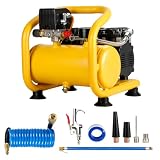

Choose by situation
- Mostly tires, balls, and inflatables: Pick the DCC020IB. Its tankless design keeps it compact, and it can run from a compatible 20V MAX battery, a 12V vehicle outlet, or household AC power. It has separate high-pressure and high-volume modes, so it can handle tires as well as larger inflatables more appropriately than a tire-only pump.
- Trim carpentry with a brad or finish nailer: The DCC2520 is the practical starting point if you already own 20V MAX batteries. Its 2.5-gallon tank provides a useful reserve for intermittent nailing without requiring a cord or a large shop compressor.
- More frequent fastening away from an outlet: Consider a 60V MAX model if you already use that battery platform or need more sustained site capacity. The larger battery system is not automatically the best value: a 20V MAX compressor may be the better buy for occasional trim jobs when its airflow meets the nailer’s requirements.
- Spray finishing, sanding, or continuous air demand: Choose a properly rated corded compressor instead. These cordless models are designed around portability and intermittent work, not long, steady air consumption.
Battery compatibility and realistic runtime
A 20V MAX battery does not fit a 60V MAX tool, and a 60V MAX battery should not be assumed to work in a 20V-only compressor. DeWalt’s FLEXVOLT batteries can serve as 20V MAX batteries in compatible 20V tools and as 60V MAX batteries in compatible 60V tools, but check the exact model’s compatibility before relying on that flexibility. If you already own batteries, matching the compressor to your platform can save more than choosing a slightly larger tool.
There is no dependable single runtime figure for a cordless compressor. Nailing uses short bursts followed by recovery; inflation time depends on the object’s starting pressure, target pressure, volume, temperature, and battery condition. A larger battery usually gives more work between charges, but it also adds weight. For a trim crew, carrying a spare charged battery may matter more than buying the highest-capacity pack.
Inflation time versus tank recovery
For the DCC020IB, inflation time is determined by the item and the selected mode, not by tank recovery: there is no tank to refill. Set the target pressure, secure the hose, and let the automatic shutoff stop the pump. For tires, use the vehicle’s recommended cold pressure rather than the maximum pressure printed on the tire sidewall.
On tank models, distinguish time to fill the tank from time to complete a job. A tank can briefly supply more air than the pump produces at that instant, but after repeated nailer shots the motor must rebuild pressure. For an air tool, check its required pressure and air consumption in SCFM, then compare those figures with the compressor’s delivered airflow—not just its maximum PSI. PSI describes pressure; it does not tell you how long the tool can run.
What a 2.5-gallon tank can—and cannot—do
A 2.5-gallon tank is a portable reserve, not a promise of continuous tool operation. It is well suited to intermittent fastening with compatible brad and finish nailers. The exact pace depends on the nailer’s consumption, how often you fire, and how quickly the compressor restores pressure. Expect more pauses when fastening continuously or using an air-hungry tool.
Before purchasing, compare the nailer’s stated SCFM at its operating pressure with the compressor’s published airflow. If the tool demands more air than the compressor can deliver over time, the tank only delays the pressure drop; it does not solve it. Impact wrenches, spray guns, and sanders commonly need more sustained airflow than a compact cordless tank can provide.
Ownership details that affect the choice
- Drain tank compressors: Moisture collects inside a tank during use. After the compressor cools and is depressurized as directed in the manual, open the drain valve and let condensate escape. Leaving water inside encourages corrosion.
- Keep the intake clear: Sawdust and job-site debris can restrict cooling or enter the pump. Store the compressor clean and dry, and follow the manual’s instructions for inspection and service.
- Protect hoses and fittings: A small air leak makes a compressor cycle more often, wasting battery and adding wear. Check couplers and hose connections if the tank loses pressure while idle.
- Mind the trade-off: Tank models are heavier than an inflator, and a large battery adds more carry weight. If the compressor stays in a truck, capacity may be worth it; if you carry it up ladders, compactness matters more.
Bottom line
For a general-purpose DeWalt cordless air compressor purchase, start with the work rather than the PSI headline. Buy the DCC020IB for inflation; choose the 20V MAX DCC2520 for portable, intermittent finish-nailing if you already own compatible batteries; step up to a 60V MAX tank model when its battery platform and airflow better match frequent site work. For continuous air tools, a larger corded compressor is usually the more capable choice.