What's inside
As an Amazon Associate I earn from qualifying purchases. This post may contain affiliate links at no extra cost to you.
Sections
Best Portable Air Compressors for Car Tires and Roadside Use
For most drivers, the best portable air compressor for car tires is a 12-volt, direct-to-battery inflator rated for at least 1.0 CFM at 30 PSI, with a hose long enough to reach all four wheels and an auto-stop setting; choose a battery-powered model if you need to inflate away from the vehicle. Among established options, the VIAIR 88P suits drivers who want a compact, vehicle-powered compressor, while the AstroAI Cordless Tire Inflator is a better fit for occasional top-ups without a power cord.
Quick comparison
Inflation times below are practical estimates, not guaranteed manufacturer results. Tire size, starting pressure, temperature, and the compressor’s duty cycle can change them substantially. Published airflow figures are not always measured at the same pressure, so compare them as rough indicators rather than direct performance guarantees.
As an Amazon Associate we earn from qualifying purchases at no extra cost to you.


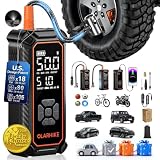

| Type or example | Power source | Published performance or capacity | Hose / reach | Vehicle storage fit | Best for |
|---|---|---|---|---|---|
| VIAIR 88P | 12V battery clamps | 1.47 CFM at 0 PSI; 120 PSI maximum | 16 ft air hose; power lead about 10 ft | Small compressor, but store clamps and hose together | Frequent use and larger tires |
| AstroAI Cordless Tire Inflator, 20V | Rechargeable battery; some versions also accept 12V input | Up to 160 PSI maximum; actual airflow varies by version | Short attached hose, typically around 1.5–2 ft | Compact kit; reserve space for battery and charger | Occasional top-ups and cord-free use |
| Slime 12V tire inflator (compact models) | 12V accessory socket | Model-dependent; generally intended for passenger-car tires | Typically several feet of hose and a long power cord | Often easy to stow under a seat or in a trunk bin | Low-cost emergency backup |
| Heavy-duty 12V compressor, roughly 1.5–2.0 CFM at 30 PSI | Battery clamps | Often 100–150 PSI maximum; check duty-cycle limit | Usually 16–30 ft hose options | Bulkier; may need a dedicated cargo-space spot | Frequent inflation or SUVs and light trucks |
Figures for named products can vary by model year, kit, and market. Confirm the exact version’s manual before buying, particularly its airflow, hose length, power connection, and continuous-run limit. Maximum PSI alone does not tell you how quickly a unit will inflate a tire.
Choose by your roadside situation
| Your situation | Best fit | Trade-off to accept |
|---|---|---|
| One or two slow leaks or seasonal pressure checks | Compact 12V inflator with auto-stop and a digital gauge | Small units can be slow when adding many PSI to all four tires. |
| Regular use, SUV tires, or remote travel | Battery-clamp compressor with at least 1.0 CFM at working pressure | It needs a safe battery connection and usually more storage room. |
| No accessible 12V outlet or frequent use away from the car | Rechargeable cordless inflator | Battery charge and capacity limit how many tires it can handle. |
| Tight trunk or under-seat storage | Small accessory-socket unit with an integrated or tidy cord wrap | Short hoses may force you to reposition the compressor at each wheel. |
| Large tires or repeated inflation in one session | Higher-airflow compressor with a stated duty cycle | More capable models are heavier, louder, and more expensive. |
What matters more than the maximum PSI
Inflation time and duty cycle
For roadside use, useful airflow at tire pressure matters more than a headline maximum-pressure number. A compact inflator may add a few PSI quickly but take several minutes to raise a low passenger-car tire substantially. For a rough planning estimate, a unit that delivers about 0.5 CFM at working pressure moves 0.5 cubic feet of free air per minute; tire pressure and compressor losses make real inflation slower than a simple volume calculation suggests. Check the maker’s stated time for a comparable tire, if available, and its duty cycle—the required rest period after running.
If the compressor must cool after ten minutes, do not assume it can inflate four nearly flat tires in one uninterrupted session. Let it cool as directed. Repeated overheating is hard on the motor, seals, and wiring.
Power source and vehicle compatibility
An accessory-socket inflator is convenient, but some vehicle outlets have a low amperage limit or only work with the ignition on. Check the car manual and compressor’s current draw before connecting it. If a unit draws more current than the outlet allows, use a model designed for direct battery clamps rather than an improvised adapter. Keep the engine running only where it is safe and legal, and never run it in an enclosed space.
Cordless models avoid cables and can be handy for bicycles or sports equipment, but their batteries need charging and may lose capacity over time. For a long trip, a 12V-capable backup or a separate tire-pressure gauge reduces dependence on a fully charged battery.
Hose reach, gauge accuracy, and storage
Measure from the likely power connection to the farthest tire, allowing extra length to route the hose without pulling it tight. A compressor with a long air hose but a short power lead may still need to sit near the wheel. Avoid stretching a hose across traffic or under a moving vehicle.
Auto-stop is convenient, but verify the pressure with a separate, reliable tire gauge, especially if a reading is near the vehicle’s recommended pressure. Digital displays can differ from a standalone gauge, and heat from driving raises tire pressure. Set pressures when tires are cold, following the label on the driver’s door jamb—not the maximum pressure molded into the tire sidewall.
Before purchasing, check that the compressor, hose, power lead, adapters, and battery all fit in the storage space you actually have. A soft case helps keep dust off the kit and prevents the hose fitting from scratching other cargo.
How to use one safely at the roadside
- Park securely. Move as far from traffic as possible, use hazard lights, and avoid working on the traffic-facing side when you can. If the location is unsafe, prioritize getting people to safety and call for roadside assistance.
- Check the tire. Do not inflate a tire with a visible sidewall bulge, exposed cords, or severe damage. Inflation is not a repair for structural damage or a puncture that will not hold air.
- Connect correctly. Place the compressor on stable ground, route the hose away from hot or moving parts, and connect to the valve stem. Follow the unit’s instructions for the socket or battery clamps.
- Set pressure and inflate. Use the cold-pressure target from the vehicle placard. Stay within the compressor’s run-time limit and let it cool as directed.
- Recheck and stow. Confirm pressure with a separate gauge, replace the valve cap, and check the tire again after driving. A tire that loses pressure needs inspection, not repeated top-ups.
Ownership costs and common wear points
Basic 12V inflators are commonly in the general $20–$50 range, cordless kits around $40–$100, and heavier-duty compressors often $100–$300 or more. These are broad market ranges, not quotes; included batteries, hose quality, and output affect the price. A budget unit can be sensible for rare use, but frequent users should weigh replacement cost against slower inflation and limited duty cycle.
The parts most likely to cause trouble are the valve connector, hose, power plug, fuse, and battery. Keep the hose loosely coiled, avoid kinking it, and protect fittings from dirt. Let the motor cool before packing it away. For battery-clamp models, check the cable insulation and clamps periodically; for cordless models, store and recharge the battery according to its manual. A blown fuse should be replaced only with the specified rating—never bypass it.
Bottom line: Choose a compact socket-powered compressor for occasional top-ups and minimal storage space; step up to a battery-clamp model when speed, larger tires, or repeated use matter. For true cord-free convenience, a cordless inflator is practical, provided you keep its battery charged and confirm its output suits your tires.