
Our Short List of 3
All 3 Picks at a Glance
| Product | Specs | Action |
|---|---|---|
 WoodRiver Taper Jig With Aluminum Guide Bars | Check price on Amazon | |
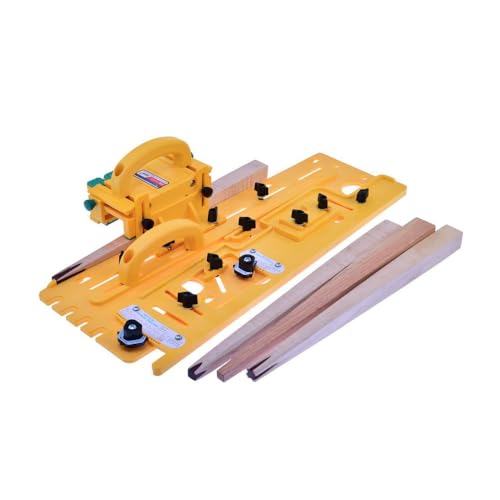 MICROJIG Microdial Tapering Jig TJ-5000 in the GRR-RIPPER Bundle | Check price on Amazon | |
 POWERTEC 71875 Small Parts Tapering Jig for Short Stock | Check price on Amazon |
Key takeaways
- Compare the best taper jigs for table saw legs, with indexed stops, aluminum rails, hold-down clamps, micro-adjust dials and compact small-parts models.
What's inside
- Quick answer
- Rockler Taper Jig for Indexed, Repeatable Leg Tapers
- WoodRiver Taper Jig With Aluminum Guide Bars
- POWERTEC 71395 Taper and Straight Line Jig With Hold-Down Clamps
- MICROJIG Microdial Tapering Jig TJ-5000 in the GRR-RIPPER Bundle
- POWERTEC 71875 Small Parts Tapering Jig for Short Stock
- How to choose
- Who should skip
- Frequently Asked Questions
- Final verdict
- Product and ASIN Reference
As an Amazon Associate I earn from qualifying purchases. This post may contain affiliate links at no extra cost to you.
A tapered leg looks simple on a finished table, but cutting four identical tapers freehand is anything but simple. A taper jig holds the workpiece at a fixed, repeatable angle while it passes the blade, so the second, third and fourth legs match the first instead of drifting further off with every pass. Designs differ more than the shared name suggests: some are full sleds riding in the miter slot on a long bar, some are hinged fence-riding frames, and some are dial-driven gauges trading a sled base for finer angle control.
This guide compares five taper jigs across the main buying classes, from an indexed sled with positive stops to a compact small-parts model. Every specification below comes from the product listing or maker documentation for that model, including angle ranges, base and rail dimensions, miter bar sizes and included hardware. Where a listing leaves a figure unstated, the section says so rather than guessing.
As an Amazon Associate, we earn from qualifying purchases.
Sections
- Quick answer
- Rockler Taper Jig for Indexed, Repeatable Leg Tapers
- WoodRiver Taper Jig With Aluminum Guide Bars
- POWERTEC 71395 Taper and Straight Line Jig With Hold-Down Clamps
- MICROJIG Microdial Tapering Jig TJ-5000 in the GRR-RIPPER Bundle
- POWERTEC 71875 Small Parts Tapering Jig for Short Stock
- How to choose
- Who should skip
- Frequently Asked Questions
- Final verdict
- Product and ASIN Reference
Quick answer
The Rockler Taper Jig is the top pick for most furniture work: its indexing holes set the fence in one-degree steps, its end stop registers each leg the same way, and the included 36-inch miter bar tracks straight. Choose the POWERTEC 71395 for hold-down clamps on a longer sled, and the MICROJIG Microdial bundle for the finest angle adjustment.
Rockler Taper Jig for Indexed, Repeatable Leg Tapers
The Rockler Taper Jig takes the top spot because it removes the two most common sources of error in taper cutting: setting the angle and registering the workpiece. The base is MDF covered with a low-friction laminate, riding on an adjustable miter bar that mounts in two positions to suit different saws. If a saw’s slot places the base too close to the blade, the listing notes the base edge can be trimmed to create a zero-clearance edge for that saw.
Angle setting is the headline feature. Small indexing holes at each end of the jig act as positive stops, and each mark represents one degree of taper. You set one end of the fence at the widest point of the taper and the other end at the mark for the angle you want, which makes returning to the same setting on a later project far easier than re-measuring a plain hinged jig. For dimensioned tapers, measuring tapes at each end let you set up from the actual leg dimensions instead.
Workholding is covered as well. The jig includes two wide hold-downs with non-marring rubber caps, three abrasive strips on the base to resist slipping, a large handle for control, and an end stop that keeps shorter workpieces from sliding backward. The listing states the jig cuts tapers on boards up to 6 inches wide, and removing the miter bar converts it to a straight-line ripping jig for a clean edge on rough-sawn boards of any width.
The trade-offs are capacity and format. Six inches of board width covers most table and chair legs but not wide panels, and the sled takes more storage room than a folding hinged jig. The indexing also works in whole-degree steps, so a taper between degrees still needs the tape-based setup.
WoodRiver Taper Jig With Aluminum Guide Bars
The WoodRiver Taper Jig is the aluminum pick, built around aluminum guide bars with a push handle rather than a sled base. It is made for Woodcraft Supply under model number 03R22W, and the listing title describes the format plainly: two aluminum guide bars and a push handle. In this hinged, fence-riding layout, the bars open to the taper angle and the assembly runs against the rip fence, so there is no miter bar to fit and no slot position to check before the first cut.
That simplicity is the appeal. Aluminum bars do not swell or warp the way a shop-made wooden jig can, the tool folds flat and hangs on a wall hook, and setup is a matter of setting the angle between the bars and locking it. For occasional tapering on legs and rails, a light hinged jig like this is often all a small shop needs.
The honest limitations follow from the format. The listing does not publish a maximum taper angle, a bar length or a stock capacity figure, so buyers who need a documented angle range should compare the sled models here, which state theirs. A fence-riding jig also depends on your rip fence being parallel and locked down, and without hold-down clamps the workpiece is kept in place by hand pressure against the bars, which argues for push blocks on narrow stock.
Availability deserves a note: this is an older listing, and current offers may come from third-party sellers. Check model 03R22W on the listing at purchase time.
POWERTEC 71395 Taper and Straight Line Jig With Hold-Down Clamps
The POWERTEC 71395 is the pick for buyers who want the workpiece clamped down rather than held by hand. The listing’s package contents are specific: a base measuring 32 by 7-7/8 inches of half-inch MDF with melamine coating on both sides, an adjustable fence 32 inches long with a pre-assembled stop plate, an aluminum miter bar measuring 3/4 by 3/8 by 36 inches, two hold-down clamps 5-1/2 inches long, two self-adhesive tape measures, three abrasive grip strips, and the T-bolts and hardware to assemble it.
The two hold-down clamps are the reason to choose this model. They pin the leg blank to the base so both hands stay on the jig and push knob through the cut, which matters most on the second and third faces of a four-sided taper, where the cut face sits against the fence at an angle. The fence’s stop plate registers the end of each blank, and the tape measures support dimensioned setups.
Fit is the main thing to verify before ordering. The listing frames the jig around a 3/4 inch wide by 3/8 inch deep miter slot, and POWERTEC publishes acceptable ranges for the distance from the slot’s inside edge to the blade; saws outside those ranges will not place the base correctly, so measure first. Assembly is also part of the deal: this is a kit of parts, and the melamine-coated MDF base, while flat and slick, will not shrug off a dropped corner like an aluminum frame.
Within those limits, the 71395 is the most complete sled package here: long base, long bar, clamps, tapes and grip strips in one box, sized for full-length table legs.
MICROJIG Microdial Tapering Jig TJ-5000 in the GRR-RIPPER Bundle
The micro-adjust pick is the MICROJIG Microdial Tapering Jig, model TJ-5000, sold on Amazon in a bundle with the GRR-RIPPER GR-100 3D Pushblock. Where other jigs here set an angle with holes, tapes or an etched scale, the Microdial uses two ColorMatch dials: a degree scale adjusting from 0 to 10 degrees in increments as fine as 1/8 of a degree, and a rise-over-run dial setting taper from 0 to 2 inches in 1/16 inch intervals. For legs specified by how much narrower the foot is than the top, the rise-over-run dial skips the angle conversion entirely.
Two independent MemoryLock stops store settings so you can switch between two tapers on the same workpiece, which suits six- and eight-sided legs where faces alternate. The maker lists the jig for table saws, router tables and band saws, states a weight of 3 pounds 4 ounces, and notes it is designed and made in the USA. It is built to work with the GRR-RIPPER pushblock system, and the bundle includes the GR-100 block, so the hand-protection half of the setup arrives in the same box.
The trade-offs are range and approach. Ten degrees is the ceiling, covering furniture legs comfortably but not the steeper tapers 15-degree sled and rail jigs can reach. There is no sled base or miter bar carrying the workpiece; control comes from the pushblock, so the technique differs from the sled models and rewards a careful read of the included guide. The bundle also means buying the pushblock whether or not you already own one.
POWERTEC 71875 Small Parts Tapering Jig for Short Stock
The compact pick is the POWERTEC 71875, a small-parts tapering jig sized for short legs, wedges and trim pieces that would be lost on a 32-inch sled. The maker manual lists the base at 11-1/2 by 7-5/16 by 1/2 inches in MDF, an adjustable fence with a stop plate at 11-1/2 inches, and an aluminum miter bar measuring 12 by 3/4 by 3/8 inches. Two hold-down clamps, two clamp blocks and a 4-1/2 inch handle are included, and the manual states the jig is intended for table saws with a standard 3/8 by 3/4 inch miter slot.
That short footprint is the point. On small parts, a full-size sled puts the operator’s hands far from the work and wastes most of its length; the 71875 keeps clamps, stop plate and handle close together, and stores in a drawer. It also converts to straight-line ripping on short stock by removing the miter bar, following its larger sibling’s pattern.
Capacity is the obvious limit: an 11-1/2 inch base cannot support a full-length table leg safely, and the manual cautions that the jig may not suit many benchtop and jobsite saws, so check slot dimensions first. Within that small-parts role, though, the 71875 is a complete package: clamps, stop plate, handle and bar sized to the work instead of scaled down from a full sled.
How to choose
Begin with how your saw will guide the jig. Sled models ride on a miter bar, so confirm your slot is 3/4 by 3/8 inches and check any published slot-to-blade ranges against your saw. Fence-riding models like the WoodRiver depend on the rip fence instead, suiting saws with nonstandard slots.
Next, match the setting method to how you work. Indexed holes and positive stops are fastest for repeated common angles. Etched scales and tapes suit dimensioned tapers taken from a drawing. A micro-adjust dial earns its keep when a design calls for a fraction of a degree or a rise-over-run figure, and when two settings must alternate on one workpiece.
Then check capacity honestly: the longest and widest blank you plan to taper, the steepest angle, and whether the jig’s stated range covers both. Finally, decide how the work will be held. Hold-down clamps add control on multi-face tapers and small parts; if the jig you like has none, plan on push blocks.
Who should skip
Skip taper jigs entirely if you taper one leg a year; a shop-made hinged jig from scrap covers that pace. Skip the compact 71875 for full-length table legs, and skip the long sleds if you only cut short parts and storage is tight. Skip the Microdial bundle if you already own pushblocks and need more than 10 degrees of taper. Anyone whose saw has a nonstandard miter slot should skip bar-guided sleds until the slot is measured and matched.
Frequently Asked Questions
What taper angle do most table legs need?
Most furniture legs fall in a shallow range, roughly one to three degrees per face, which every jig here can reach. Differences appear at the extremes: the Microdial stops at 10 degrees, while sled and rail designs that publish a range commonly reach 15 degrees.
Can a taper jig also straighten a rough board edge?
Yes, several models here double as straight-line ripping jigs. The Rockler and both POWERTEC models convert by removing the miter bar and setting the fence parallel to the blade, letting the jig carry a rough edge past the blade safely.
Do I need hold-down clamps on a taper jig?
They are not required, but they help most on repeat faces and small parts, where the workpiece wants to shift against the fence. If your jig has no clamps, keep firm pressure with a push block and stop if the blank moves.
Will these jigs fit a benchtop table saw?
Only after measuring. Most sled jigs here are built around a 3/4 by 3/8 inch miter slot, and some publish slot-to-blade ranges. The 71875 manual warns it may not suit many benchtop saws, so compare your slot against the listing first.
Final verdict
For most shops, the Rockler Taper Jig is the right first taper jig: indexed one-degree settings, a proper end stop, real hold-downs and a 36-inch miter bar cover the full run of chair and table leg work. The POWERTEC 71395 matches it for buyers who want the clamp package on a longer sled, the WoodRiver keeps things light and simple in aluminum, the MICROJIG Microdial bundle is the precision option, and the POWERTEC 71875 fills the small-parts corner.
Product and ASIN Reference
| Product | ASIN |
|---|---|
| Rockler Taper Jig / Straight Line Jig | B002MMKMDE |
| WoodRiver Taper Jig Aluminum Guide Bars and Push Handle | B0035Y25LU |
| POWERTEC 71395 Taper/Straight Line Jig | B09HX9SP5Z |
| MICROJIG GRR-RIPPER GR-100 and TJ-5000 Microdial Tapering Jig Bundle | B0B4PL8V1D |
| POWERTEC 71875 Small Parts Tapering Jig | B0D923BX34 |
Related guides
More from Amazon
Programs that pair well with the guide above. Offers and eligibility are set by Amazon and may change.
A free business account with business pricing and bulk-buying tools for work, shop or home office.
Create a business accountFree shipping on eligible items, Prime Video and more. Eligible new members can start with a free trial.
Start a Prime free trialAudiobooks and podcasts to listen to on the go. Eligible new members can start with a free trial.
Try Audible freeAd-free music streaming. Eligible new subscribers can start with a free trial.
Try Music Unlimited freeAs an Amazon Associate we earn from qualifying purchases.
Write Your Review
No reviews yet. Be the first to share your experience!