
Key takeaways
- Find the best protractors for woodworking, from steel square-head models to magnetic and bevel protractors that mark and measure angles with confidence.
What's inside
As an Amazon Associate I earn from qualifying purchases. This post may contain affiliate links at no extra cost to you.
A good protractor turns guesswork into a mark you can trust. Whether you are setting a miter angle, checking a bevel on a board edge, or laying out a chair leg that meets a seat at an odd angle, an analog protractor gives you a direct reading with no battery, no screen, and no calibration routine. It is also one of the easiest to buy badly, because a loose pivot or a hard-to-read scale can quietly push every cut that follows off true.
This guide covers analog protractors only. Digital angle finders are a different tool class, and they already have their own roundup on this site. Every pick below reads angles from a printed or etched scale.
As an Amazon Associate, we earn from qualifying purchases.
Sections
Quick Answer
For most woodworkers, the General Tools Angle Protractor Number 17 is the best starting point, thanks to its stainless steel body, square head, and clear 0 to 180 degree scale. For finer layout work, add the Incra ProTrac 06 marking protractor, and choose the Mitutoyo 187-907 bevel protractor when precision fitting matters most.
Table of Contents
- Our Top Picks
- How to Choose
- Who Should Skip
- Frequently Asked Questions
- Final Verdict
- Product and ASIN Reference
Our Top Picks
General Tools Angle Protractor Number 17

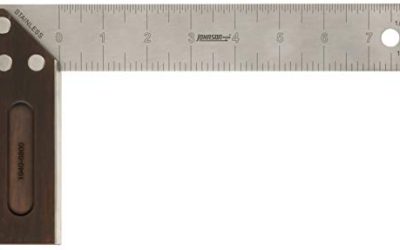
The General Tools Angle Protractor Number 17 is a classic square-head protractor that has earned its place in woodworking shops by doing one job well. Its stainless steel body resists rust in a damp shop, and the square head gives you a flat reference face to register against a board edge. Pressed against a square edge, it stays put and the reading stays honest.
The scale runs from 0 to 180 degrees, which covers every miter and bevel angle a woodworker normally needs. Graduations are etched into the steel rather than printed on top of it, so they do not wear away in a tool roll or apron pocket. The locking arm carries an angle to the workpiece without drifting.
Specs
- Material: Stainless steel body with a square head
- Scale range: 0 to 180 degrees
- Graduations: Etched into the steel surface
- Arm: Adjustable locking arm for transferring angles
- Best for: Everyday marking, miter angles, and general shop layout
- Tier: Budget
- ASIN: B00004T7TB
Empire Level 36 Magnetic Polycast Protractor
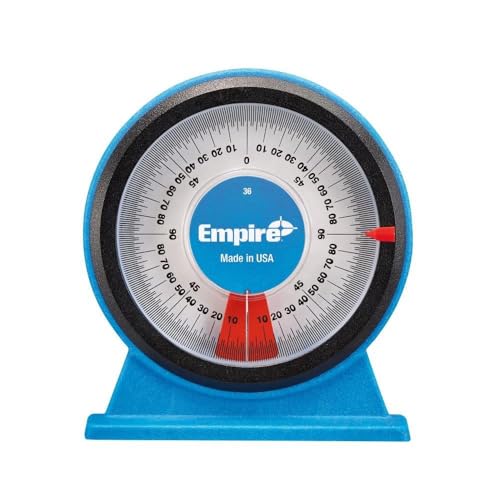
The Empire Level 36 Magnetic Polycast Protractor takes a different approach. Its body is made from polycast material, which keeps the tool light in the hand while resisting chips and cracks if it gets knocked off the bench. A magnetic base lets it sit flat against a steel surface, such as a saw table or a steel straight edge, without sliding around while you read the angle.
That magnetic hold is useful during setup work. When you are checking the angle of a blade or a fence, a protractor that stays where you put it leaves both hands free to adjust the machine. The markings are large enough to read at arm’s length, with no electronics to fail and no display to wash out in bright light. For roof pitch checks, stair layout, and machine setup, this is exactly what you want.
Specs
- Material: Polycast body with a magnetic base
- Scale range: Full angle range for carpentry and layout work
- Graduations: Large, easy-to-read printed scale
- Base: Magnetic for holding position on steel surfaces
- Best for: Machine setup, roof pitch checks, and job site use
- Tier: Budget
- ASIN: B00004YYG4
Starrett 193 Steel Protractor

Starrett has built precision measuring tools for generations, and the 193 Steel Protractor shows why the brand keeps its reputation. This is a solid steel protractor with a 0 to 180 degree range, made for woodworkers who want a scale they can read precisely and a pivot that stays smooth without developing play.
The steel body gives the tool a reassuring weight in the hand, and the scale is cleanly marked so that half-degree readings are practical. The arm moves smoothly and locks firmly, which matters when you are transferring an angle from a drawing to a workpiece. Use it to set out angled tenons, to check the angle of a chair back, or to confirm that a cut matches your plan before glue-up.
Specs
- Material: Steel body and arm
- Scale range: 0 to 180 degrees
- Graduations: Cleanly marked scale for precise reading
- Arm: Smooth-moving locking arm for angle transfer
- Best for: Furniture layout, joinery angles, and checking cut angles
- Tier: Mid-range
- ASIN: B000VDRUDQ
Incra ProTrac 06 Precision Marking Protractor

The Incra ProTrac 06 is a six-inch precision marking protractor built specifically for woodworkers who lay out angles on the workpiece itself. Unlike a general-purpose protractor, it is designed to sit flat on a board and guide a pencil or a marking knife along its edge, so the angle you read is the angle you mark.
At six inches long, it is compact enough for small parts, where angled layout often goes wrong. Marking a short tenon shoulder at an angle is harder than marking a long board, because there is less edge to register against. The ProTrac 06 handles this well, with a stable base and a clear scale. It excels at setting out miter angles for picture frames and boxes, and at marking joinery where the angle matters as much as the length.
Specs
- Material: Precision marking protractor for woodworking layout
- Length: 6-inch body for use on small parts
- Scale range: Full marking range for miter and joinery angles
- Use: Direct marking on the workpiece with pencil or marking knife
- Best for: Boxes, frames, small furniture parts, and angled joinery layout
- Tier: Mid-range
- ASIN: B00002255K
Mitutoyo 187-907 Bevel Protractor
The Mitutoyo 187-907 is a universal bevel protractor, and it is the most precise tool in this roundup. It combines a protractor head with a 150 mm blade, and it reads angles across a full circle, which makes it suitable for measuring angles that a 0 to 180 degree protractor cannot reach in a single setup. For fitting work where two parts must meet at an exact angle, that range and precision matter.
Bevel protractors are built for measuring existing angles as much as for marking new ones. Hold the blade against one face of a joint and the body against the other, and the scale tells you the angle between them. That makes the 187-907 useful for checking installed trim, for measuring an existing piece you want to copy, and for verifying that a sawn angle is true. It is the premium pick here, best suited to a shop where precision fitting is regular work.
Specs
- Material: Precision bevel protractor with a steel blade
- Blade length: 150 mm
- Scale range: Full-circle universal bevel protractor reading
- Function: Measures existing angles and marks new angles
- Best for: Precision fitting, copying existing angles, and angled joinery
- Tier: Premium
- ASIN: B000VB7BSM
How to Choose
Start with the job, not the tool. If you mostly mark miter angles on trim and furniture parts, a square-head protractor like the General Tools Number 17 covers nearly everything.
Think about how you read angles. A protractor with large, clear graduations is easier to use in a dusty shop or in poor light than one with fine, crowded markings. If you work on machine setup, a magnetic base, like the one on the Empire Level 36, keeps the tool in place while your hands are busy elsewhere. If you mark small parts, a compact six-inch protractor such as the Incra ProTrac 06 is easier to control than a long one.
Material matters for longevity. Stainless steel resists rust and holds etched graduations well. Polycast bodies are lighter and tougher against drops, which suits job site use.
Check the pivot and the lock before you commit to a protractor for precision work. The arm should move smoothly without sticking, and the lock should hold the setting firmly. A loose pivot introduces error that no careful reading can fix, which is the main reason to step up to a Starrett or Mitutoyo when your work demands tight fits. Most woodworking angles fall inside 0 to 180 degrees. A full-circle bevel protractor is worth the extra cost only when you regularly measure angles on installed work or copy angles from existing pieces.
Who Should Skip
If you already own a digital angle finder and you use it for every setup, an analog protractor may add little to your shop. Digital tools read quickly and suit machine setup well, and there is no need to duplicate a tool that already serves you. An analog protractor earns its place when you want a marking tool that needs no battery and reads directly from a scale.
Woodworkers who only ever cut at right angles can also skip this purchase for now. A good square covers square work, and a protractor only helps once angles enter the picture. If your projects are limited to boxes and shelves with square joints, spend the money on a better square instead.
Beginners who are still learning basic measuring may want to start with a combination square and a sliding bevel before adding a protractor. Those two tools teach the habits of registering against an edge and transferring an angle. Finally, skip the premium bevel protractor if your work is rough carpentry or outdoor building. A precision instrument will not make rough cuts more accurate, and a budget steel or polycast protractor is the better match there.
Frequently Asked Questions
What is the difference between a protractor and a sliding bevel?
A protractor measures an angle in degrees from a printed or etched scale, so it tells you the exact number. A sliding bevel copies an angle from one surface to another without telling you the number. Many woodworkers own both, using the protractor to find the number and the bevel to carry it.
Do I need a digital angle finder instead of an analog protractor?
Not necessarily. A digital angle finder reads quickly and suits machine setup, while an analog protractor needs no battery and works well for marking angles directly on wood.
What size protractor is best for woodworking?
A six-inch protractor suits small parts, boxes, and frames, where a long tool is awkward to control. A larger protractor is better for big boards and for checking angles across a wide surface. Most woodworkers start with a standard square-head protractor and add a compact marking protractor later.
Can a protractor measure angles on installed trim?
Yes, if the protractor can sit flat against both faces of the joint. A bevel protractor with a long blade works best here, because it spans the joint faces and reads the angle between them. For tight corners, a sliding bevel is often the easier way to capture the angle first.
Final Verdict
The best protractor for most woodworkers is the General Tools Angle Protractor Number 17. It is simple, durable, and easy to read, and it covers the marking and measuring jobs that come up most often in the shop.
Add the Incra ProTrac 06 if you build boxes, frames, and small furniture. Add the Empire Level 36 if you set up machines or work on site, where its magnetic base and tough polycast body earn their keep. Step up to the Starrett 193 for tighter furniture layout, and choose the Mitutoyo 187-907 bevel protractor when precision fitting is regular work. Register the tool firmly against a true edge, read the scale at eye level, and lock the arm before you carry the angle to the saw.
Product and ASIN Reference
| Product | ASIN |
|---|---|
| General Tools Angle Protractor Number 17 | B00004T7TB |
| Empire Level 36 Magnetic Polycast Protractor | B00004YYG4 |
| Starrett 193 Steel Protractor | B000VDRUDQ |
| Incra ProTrac 06 Precision Marking Protractor | B00002255K |
| Mitutoyo 187-907 Bevel Protractor | B000VB7BSM |
Related guides
More from Amazon
Programs that pair well with the guide above. Offers and eligibility are set by Amazon and may change.
A free business account with business pricing and bulk-buying tools for work, shop or home office.
Create a business accountFree shipping on eligible items, Prime Video and more. Eligible new members can start with a free trial.
Start a Prime free trialAudiobooks and podcasts to listen to on the go. Eligible new members can start with a free trial.
Try Audible freeAd-free music streaming. Eligible new subscribers can start with a free trial.
Try Music Unlimited freeAs an Amazon Associate we earn from qualifying purchases.
Write Your Review
No reviews yet. Be the first to share your experience!