
Key takeaways
- Compare the best chainsaw sharpeners: five electric bench grinders and bar-mounted jigs ranked by speed, accuracy, chain fit, and ease of use.
What's inside
- Quick Answer
- Table of Contents
- 1. Oregon 410-120 Bench Grinder
- 2. Oregon 520-120 Bench Grinder
- 3. Buffalo Tools ECSS Electric Chainsaw Sharpener
- 4. Granberg G1012XT Precision Grinder
- 5. Timberline Chainsaw Sharpener 7/32 Inch
- How to Choose
- Who Should Skip
- Frequently Asked Questions
- Final Verdict
- Product and ASIN Reference
As an Amazon Associate I earn from qualifying purchases. This post may contain affiliate links at no extra cost to you.
A dull chain turns a chainsaw into a workout: the saw pushes hard, throws dust instead of chips, and drifts sideways through the cut. A good sharpener fixes that in minutes, and the right one depends on how often you cut and where you sharpen.


This guide covers electric sharpeners and sharpening jigs only. Hand files have their place, and a companion guide on saw files covers them in full, but the tools below use a powered grinding wheel or a guided carbide cutter to shape each tooth the same way, every time. The Oregon 410-120 bench grinder is the best all-round pick for most home shops, and the Granberg bar-mounted grinder suits owners who sharpen in the field.
As an Amazon Associate, we earn from qualifying purchases.
Sections
- Quick Answer
- Table of Contents
- 1. Oregon 410-120 Bench Grinder
- 2. Oregon 520-120 Bench Grinder
- 3. Buffalo Tools ECSS Electric Chainsaw Sharpener
- 4. Granberg G1012XT Precision Grinder
- 5. Timberline Chainsaw Sharpener 7/32 Inch
- How to Choose
- Who Should Skip
- Frequently Asked Questions
- Final Verdict
- Product and ASIN Reference
Quick Answer
Buy the Oregon 410-120 bench grinder for most home shops: it mounts to a bench or a wall and sharpens every common chain pitch. Choose the Oregon 520-120 for heavy use, the Buffalo Tools ECSS for a first bench sharpener, the Granberg G1012XT for field sharpening, and the Timberline jig for precise hand-cranked sharpening on the bar.
Table of Contents
- Quick Answer
- 1. Oregon 410-120 Bench Grinder
- 2. Oregon 520-120 Bench Grinder
- 3. Buffalo Tools ECSS Electric Chainsaw Sharpener
- 4. Granberg G1012XT Precision Grinder
- 5. Timberline Chainsaw Sharpener 7/32 Inch
- How to Choose
- Who Should Skip
- Frequently Asked Questions
- Final Verdict
- Product and ASIN Reference
1. Oregon 410-120 Bench Grinder
The Oregon 410-120 is the bench grinder most home shops should start with. It mounts to a bench or a wall with two bolts, and the motor turns the wheel at 3,150 RPM, fast enough to reshape a dulled cutter in a few light passes.
Three grinding wheels come in the box: a 3.2 mm wheel, a 4.7 mm wheel, and a 6.0 mm flat profile disc for depth gauge work. That spread covers chains from 1/4 in pitch up to .404 in pitch, so one grinder handles the pruning saw, the firewood saw, and the larger felling saw.
One-way motor rotation adds a margin of safety, since the wheel turns away from the operator. A dressing brick and a quick-check grinding template keep the wheel shaped and the angles consistent.
Specs
- Type: Electric bench or wall mount chain grinder
- Power: 120 volt corded, 220 watts
- Wheel speed: 3,150 RPM
- Grinding wheels: 3.2 mm, 4.7 mm, and 6.0 mm flat profile disc
- Chain fit: 1/4 in, 3/8 in low profile, .325 in, 3/8 in, and .404 in pitch
- Best for: Home shops that sharpen several chains a month
2. Oregon 520-120 Bench Grinder
The Oregon 520-120 is the step up for owners who sharpen chains every day or run a small fleet of saws. Its headline feature is hydraulic-assist clamping: lowering the grinding head tightens the chain vise on its own, so each cutter locks in place without a separate hand operation and every tooth is ground at the same angle.
The motor is rated at 300 watts and turns the wheel at 3,400 RPM, a notch stronger and faster than the compact bench grinder above. It ships with two grinding wheels plus a 6.0 mm flat profile disc for depth gauge maintenance, and it sharpens the same full range of pitches, from 1/4 in up to .404 in.
This is a heavier, shop-bound machine, and it earns its bench space only if the volume justifies it. For a firewood cutter who sharpens two or three chains a week, the hydraulic assist and the stronger motor pay for themselves in time saved. Occasional users will get the same sharp chain from the smaller grinder.
Specs
- Type: Electric bench chain grinder with hydraulic-assist clamping
- Power: 120 volt corded, 300 watts
- Wheel speed: 3,400 RPM
- Grinding wheels: 3.2 mm and 4.7 mm, plus 6.0 mm flat profile disc
- Chain fit: 1/4 in, 3/8 in low profile, .325 in, 3/8 in, and .404 in pitch
- Best for: Daily sharpening and owners with several chainsaws
3. Buffalo Tools ECSS Electric Chainsaw Sharpener
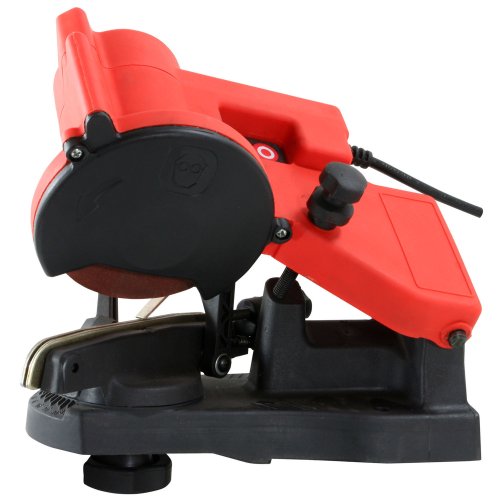
The Buffalo Tools ECSS is the sensible first bench sharpener. It is a compact electric grinder that mounts to a bench, a wall, or a vise, so it fits shops where a full-size grinder would crowd the bench. The 85 watt motor spins the grinding wheel at 4,200 RPM, and the light frame suits gentle, controlled passes rather than heavy reshaping of a badly damaged chain.
The grinder uses a 4.25 in diameter wheel and handles the common chain pitches found on homeowner saws. Angle and depth adjustments are set by hand before each pass, and the see-through safety shield keeps filings away while the cutter stays visible.
What this sharpener gives up against the Oregon bench grinders is heft and clamping force: the vise is simpler, and a chain with rock damage takes longer to bring back. For a homeowner who sharpens one or two chains a few times a season, that trade is fair: it restores a working edge quickly and takes little bench space.
Specs
- Type: Compact electric bench, wall, or vise mount sharpener
- Power: 120 volt corded, 85 watts
- Wheel speed: 4,200 RPM
- Grinding wheel: 4.25 in diameter
- Chain fit: Common homeowner chain pitches
- Mounting: Bench, wall, or vise
- Best for: First bench sharpener and occasional home use
4. Granberg G1012XT Precision Grinder
The Granberg G1012XT takes a different approach: instead of bringing the chain to a bench grinder, it brings the grinder to the chain. The unit clamps directly onto the chainsaw bar, and a 12 volt motor spinning at 24,000 RPM drives a small grinding stone across each cutter while the chain stays mounted. That makes it the pick for cutting away from the shop, where a dull chain would otherwise end the day early.
Setup is the heart of this tool. The jig sets the sharpening angle, the stone height, and the depth gauge in one fixture, so every cutter comes out the same length and shape. It sharpens crosscut, ripping, and skip-tooth chains, and three grinding stones are included.
The trade is speed: a bar-mounted grinder works one cutter at a time with a small stone, so a full chain takes longer than on a bench grinder. What it returns is consistency in the field with no need to remove the chain afterward.
Specs
- Type: 12 volt bar-mounted electric precision grinder
- Power: 12 volt, 24,000 RPM motor
- Mounting: Clamps directly to the chainsaw bar
- Chain fit: Crosscut, ripping, and skip-tooth chains
- Adjustment: Sets sharpening angle, stone height, and depth gauge
- Included: 3 grinding stones
- Best for: Cutting away from the shop and remote work
5. Timberline Chainsaw Sharpener 7/32 Inch
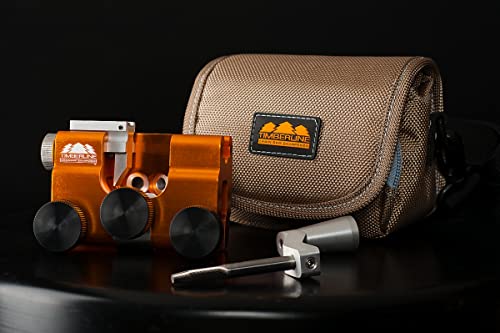
The Timberline is a hand-cranked sharpening jig, and it earns its place here by doing one thing with unusual precision. The machined aluminum body clamps onto the bar, a tungsten carbide cutter sits over the tooth, and a few turns of the crank shave the cutter to a fixed 30 degree angle. Every tooth ends up the same length because the jig indexes off the chain itself, which keeps the chain cutting straight.
The 7/32 in cutter suits 3/8 in and .404 in pitch chains, the sizes most full-size homeowner and farm saws run. No power is needed, and the carbide cutter lasts far longer than a file. The whole tool packs into a soft carry case with room for spare cutters.
Hand cranking is slower than a powered wheel, and a chain with heavy rock damage still belongs on a bench grinder first. But for a working chain that needs a touch-up between tanks of fuel, the Timberline is hard to beat: it is quiet, and it holds the angle steady for hands that have never learned freehand filing.
Specs
- Type: Hand-cranked bar-mounted sharpening jig with carbide cutter
- Cutter: 7/32 in tungsten carbide cutter
- Sharpening angle: Fixed 30 degree angle
- Chain fit: 3/8 in and .404 in pitch chains
- Body: Machined aluminum, made and assembled in the USA
- Power: None, hand cranked
- Best for: Precise field touch-ups and even cutter length
How to Choose
Start with the chain, not the sharpener. Find the pitch stamped on the chain or listed in the saw manual: common homeowner pitches run from 1/4 in up to .404 in, and every sharpener in this guide lists the pitches it handles. Check the pitch before ordering, because the wrong fit sharpens nothing.
Next, decide where sharpening happens. A bench grinder belongs in the shop, needs an outlet and a solid mount, and restores badly worn chains fastest. A bar-mounted grinder or jig travels to the woodpile and keeps a working chain keen without removing it.
Then weigh volume against precision. High-volume sharpening rewards hydraulic-assist clamping and a stronger motor, since the machine does the holding. Low-volume sharpening rewards a compact grinder or a jig, since setup is quick and the tool stores small. In every case, favor clear angle and depth settings: consistent angles matter more than motor speed.
Finally, plan for consumables. Grinding wheels wear and need dressing, carbide cutters eventually dull, and depth gauges need lowering as cutters shrink.
Who Should Skip
Skip a bench grinder if there is no solid bench or wall to mount it on: a grinder that flexes during a pass grinds uneven edges. A bar-mounted sharpener or a hand-cranked jig is the better buy without a fixed workstation.
Skip a high-volume grinder if only one saw sees occasional use. The extra clamping power and motor size add bulk that a light-duty grinder or a jig covers for a fraction of the footprint. Match the machine to the cutting load.
Skip any sharpener that does not list your chain pitch. A grinder built for smaller pitches cannot reach a large cutter correctly, and a jig sized for one pitch family will not index on another.
Skip sharpening a chain with cracked, missing, or badly bent cutters, and skip a chain with stretched links that no longer sit tight on the bar. Those chains need replacement, not sharpening.
Frequently Asked Questions
How often should I sharpen my chainsaw chain?
Sharpen when the saw starts pushing hard, throwing fine dust instead of chips, or drifting sideways in the cut. For firewood cutting, that often means a touch-up every few tanks of fuel.
Do I need to remove the chain to sharpen it?
No. Bar-mounted grinders and jigs sharpen the chain while it stays on the saw, which suits field work. Bench grinders need the chain off the saw, which suits shop work and badly worn chains.
What chain pitch do I need to match?
Match the pitch stamped on the chain or listed in the saw manual, commonly 1/4 in, 3/8 in low profile, .325 in, 3/8 in, or .404 in. The pitch sets the wheel size on a grinder and the cutter size on a jig.
Can a bench grinder damage a chain?
Yes, if the wheel dwells on one cutter too long. Heavy pressure and long passes overheat the steel and soften the edge. Use light passes, let the wheel do the work, and dress the wheel so it cuts cool.
Final Verdict
The Oregon 410-120 bench grinder is the best chainsaw sharpener for most home shops: it mounts to a bench or a wall, covers every common pitch, and restores a dull chain quickly with repeatable angles. Owners who sharpen daily should step up to the Oregon 520-120 for its hydraulic-assist clamping and stronger motor, while first-time buyers will find the Buffalo Tools ECSS an easy way into bench sharpening. For work away from the shop, the Granberg G1012XT sharpens on the bar from a 12 volt source, and the Timberline jig delivers the most even hand-cranked edge of the group.
Product and ASIN Reference
| Product | ASIN |
|---|---|
| Oregon 410-120 Bench Grinder | B00Y0S88Y8 |
| Oregon 520-120 Bench Grinder | B00ULDRULS |
| Buffalo Tools ECSS Electric Chainsaw Sharpener | B000N4L2LO |
| Granberg G1012XT Precision Grinder | B002GCZC3A |
| Timberline Chainsaw Sharpener 7/32 Inch | B0FHZ65XG3 |
Related guides
More from Amazon
Programs that pair well with the guide above. Offers and eligibility are set by Amazon and may change.
A free business account with business pricing and bulk-buying tools for work, shop or home office.
Create a business accountFree shipping on eligible items, Prime Video and more. Eligible new members can start with a free trial.
Start a Prime free trialAudiobooks and podcasts to listen to on the go. Eligible new members can start with a free trial.
Try Audible freeAd-free music streaming. Eligible new subscribers can start with a free trial.
Try Music Unlimited freeAs an Amazon Associate we earn from qualifying purchases.
Write Your Review
No reviews yet. Be the first to share your experience!