
Key takeaways
- Johnson 1940-0800 try square by its listing facts: 8 in stainless blade, carbonized bamboo stock, etched graduations, for true 90 degree work.
What's inside
As an Amazon Associate I earn from qualifying purchases. This post may contain affiliate links at no extra cost to you.
A workshop can survive many mediocre tools, but a mediocre square is a saboteur: every joint it marks inherits its error, and the error is invisible until assembly. Choosing a try square is therefore an accuracy purchase, decided by blade material, graduation quality and whether the stock will stay true through seasons of workshop humidity and knocks.
This guide is for woodworkers and carpenters choosing an 8-inch try square for furniture, cabinet and general bench work. The product below is presented from its product name and the specifications on its Amazon page: Johnson Level & Tool’s professional model 1940-0800, with a stainless steel blade, carbonized bamboo stock and etched graduations, the combination that the listing offers for a tool whose entire value is trustworthiness.
Sections
Quick Picks
As an Amazon Associate we earn from qualifying purchases.
| Product | Best for | Key spec from title |
|---|---|---|
| Johnson Level & Tool 1940-0800 Professional Carbonized Bamboo Try Square, 8 Inch | A stainless-bladed 8-inch square with a bamboo stock and lifetime warranty | 8 in try square, carbonized bamboo handle, stainless steel blade, etched 1/8 and 1/16 in graduations |
How to Choose
Accuracy is the only specification that cannot be compromised
A try square exists to answer one question, is this exactly ninety degrees, and to mark that answer on wood. Everything else about the tool serves that answer. When this or any square arrives, test it: draw a line along the blade against a straight board edge, flip the square, and draw again beside the first line; parallel lines mean a true square, a wedge means a return. A professional-branded square like this Johnson, with a limited lifetime warranty as listed, is built and warranted to pass that test for years. The test still costs two minutes and converts faith into knowledge, which is the correct relationship between a woodworker and a reference tool.
Blade material decides the square’s old age
The blade here is heavy-duty stainless steel, listed as rust and corrosion proof, with graduations permanently etched in 1/8 and 1/16 inch increments. Etching matters more than it sounds: printed graduations wear off a working tool, while etched ones remain legible for the tool’s life, filled with grime and wiped clean a thousand times. Stainless removes the rust anxiety of carbon steel blades in damp workshops and site work. An 8-inch blade is the furniture-worker’s size, long enough to mark across boards and check cabinet parts, short enough to live in an apron pocket or bench drawer without ceremony.
The stock is a material choice with consequences
This square’s stock is carbonized bamboo with stainless gauging edges and a routed hand grip. Traditional stocks are rosewood or brass-faced timber; bamboo is the modern answer, dimensionally stable, light and resistant to the swelling that can push a wooden stock out of truth, with carbonizing hardening its surface against bench knocks. The stainless gauging edges protect the reference faces where the stock meets the work, which are the surfaces whose wear would silently corrupt the square’s accuracy. The routed grip is a small ergonomic truth: a square is picked up hundreds of times a week, and the one that sits comfortably in the hand is the one that gets used correctly.
Fit the square into a system of checking
One square is a tool; a square with habits is a system. Use this 8-inch for bench marking and assembly checks, keep it off the floor and out of the toolbox’s metal pile, and re-verify it after any drop onto concrete, because a fall is the one event that can retire a square without visible damage. Many woodworkers keep the good square for joinery and a beater for site work, which is a defensible economy: reference tools earn their keep by being trusted, and trust is preserved by protecting them from the jobs that do not need it.
Consider also what the square teaches. A beginner working with a verified square learns what a true right angle feels like, the way a joint closes, the way a carcase sits flat, and that physical calibration stays in their hands for every later project. Working with an untrue square teaches the opposite lesson, that assemblies fight and gaps are normal, which is a harder unlearning. The price difference between a tested square and a doubtful one is trivial against the education either one delivers, which is why experienced woodworkers are unreasonably fond of their good squares.
The Best Option
Johnson Level & Tool 1940-0800 Professional Carbonized Bamboo Try Square, 8 Inch

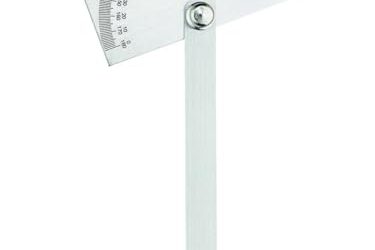
A try square has one job, to be exactly ninety degrees and stay that way, and this Johnson professional model builds that job out of reassuring materials: a heavy-duty stainless steel blade that cannot rust, permanently etched graduations in eighths and sixteenths, and a carbonized bamboo stock with stainless gauging edges and a routed grip. Bamboo is a thoughtful stock material, light, stable and warm in the hand, and carbonizing it hardens the surface for workshop life. At 6.1 ounces the square is present without being cumbersome, and the limited lifetime warranty states the manufacturer’s own expectation of its lifespan.
Specs
- Model 1940-0800; 8-inch try square
- Handle: carbonized bamboo with stainless gauging edges and routed hand grip
- Blade: heavy-duty stainless steel, will not rust or corrode as listed
- Graduations permanently etched in 1/8 inch and 1/16 inch increments
- For checking and marking 90-degree angles in carpentry and woodworking
- Limited lifetime warranty as listed; weight 6.1 ounces
Best for: Checking and marking right angles in furniture and cabinet work
Watch out for: Verify any square against a known-straight edge when it arrives, the draw-a-line, flip, draw-again test, because a square’s value is its accuracy, not its appearance.
Which One Fits Your Situation
You are setting up a furniture or cabinet bench
This is your square: 8 inches is the bench size, stainless and bamboo answer the workshop’s humidity and knocks, and the etched graduations serve both marking and measuring in one tool. Verify it on arrival with the flip test, then hang it at the bench where it will be reached for daily, because a square’s value compounds with every joint it keeps honest.
You do site carpentry as well as shop work
The stainless blade and stable bamboo stock suit a tool that travels, and the limited lifetime warranty suits a tool that works for a living. Consider dedicating this one to the shop and carrying a cheaper square on site, not because it is fragile, but because reference accuracy is worth protecting from ladders, concrete and the backs of vans.
You are replacing a square you no longer trust
Replace it with a verifiable upgrade: this Johnson’s materials and warranty are the upgrade, but the flip test on arrival is what actually restores your confidence. A workshop that has been burned by a bad square does not need a more expensive one so much as a tested one, and this model is built to pass and keep passing.
You mostly do rough framing and construction
An 8-inch try square will serve for studs and small work, but framing squares and speed squares cover construction’s larger geometry more naturally. Buy this Johnson for the bench and the fine work, where its size and accuracy are the point, and let the big squares handle the big timber.
There is a middle path worth knowing: many carpenters keep one trusted 8-inch square, like this Johnson, as the reference against which every other square in the shop is checked. The framing square, the speed squares, the combination square, all of them get verified against the reference, so the whole geometry of the workshop traces back to one tested tool. Bought once and verified on arrival, this model is built to be that reference.
Storage completes the reference system: hang the square by the bench or lay it in a drawer alone, never under a pile of steel. Bamboo and stainless forgive humidity, but no square forgives being the anvil for other tools. A reference tool’s environment is part of its calibration, and the two minutes spent housing it properly are repaid by every line it marks true.
Common Mistakes
- Trusting a square for years without ever running the two-minute flip test.
- Storing the good square loose in a metal toolbox where its edges take the knocks.
- Using etched graduations as a ruler for precision measuring they were not designed for.
- Continuing to use a dropped square on joinery without re-verifying it first.
Frequently Asked Questions
What is a try square used for?
For checking and marking 90-degree angles: the stock registers against a board’s edge and the blade shows or marks the true right angle across it. It is a core tool for furniture, cabinets and joinery, where square parts are the difference between assemblies that close and assemblies that fight. This model is 8 inches, the standard bench size.
Why a bamboo stock instead of wood or metal?
The listing’s carbonized bamboo stock is light, dimensionally stable and hardened by carbonizing, with stainless gauging edges protecting its reference faces. Traditional wooden stocks can swell with humidity; bamboo resists that movement, which helps the square stay true. The routed hand grip adds comfort for a tool picked up constantly through the day.
How do I know the square is accurate?
Use the flip test: against a board with one known-straight edge, draw a line along the blade, flip the square over, and draw a second line from the same point. If the lines are parallel, the square is true; if they form a wedge, it is not. Test on arrival and after any hard drop, whatever the brand or warranty.
Are the graduations useful for measuring?
The blade’s etched 1/8 and 1/16 inch graduations serve for quick marking and approximate measuring at the bench, which is their intended role on a try square. For precision measurement, use a rule or tape designed for it. The etching’s real virtue is permanence: unlike printed marks, etched graduations survive a lifetime of workshop wear.
Related guides
More from Amazon
Programs that pair well with the guide above. Offers and eligibility are set by Amazon and may change.
A free business account with business pricing and bulk-buying tools for work, shop or home office.
Create a business accountFree shipping on eligible items, Prime Video and more. Eligible new members can start with a free trial.
Start a Prime free trialAudiobooks and podcasts to listen to on the go. Eligible new members can start with a free trial.
Try Audible freeAd-free music streaming. Eligible new subscribers can start with a free trial.
Try Music Unlimited freeAs an Amazon Associate we earn from qualifying purchases.
Write Your Review
No reviews yet. Be the first to share your experience!