What's inside
- Top 3 Picks
- Quick Comparison
- How We Chose
- 1. HUNTER Leather Speed Bag — Best for All-Round Home Training
- 2. Redipo Boxing Speed Bag — Best for Entry-Level Reflex Work
- 3. Meister SpeedKills Leather Speed Bag — Best for Fast Rebound in Tight Spaces
- 4. Everlast Elite Speed Bag — Best for Casual Home Rhythm Work
- 5. Ringside Medium Leather Speed Bag 7″ × 10″ — Best for Boxing Reflex Training
- 6. SAEEPABUL Professional Boxing Speed Bag — Best for a Budget Starter Kit
- 7. Everlast Powerlock Speed Punching Bag — Best for Durable Mid-Tier Training
- 8. MaxxMMA Heavy Duty Adjustable Speed Bag Platform Kit 24″ + Ball 10″ × 7″ — Best for a Complete Home Gym Build
- 9. Garvee Speed Bag Platform Kit — Best Turnkey Mounting Solution
- 10. Ringside Apex Boxing Training Platform Speed Bag — Best for a Compact All-in-One Platform
- 11. HUNTER SpeedKills PU Leather Speed Bag — Best Cheap Spare or Second Bag
- 12. TITLE Boxing Gyro Balanced Leather Speed Bag — Best for Fastest, Most Consistent Rebound
- How to Choose
- Frequently Asked Questions
- Which One to Buy
- Top 3 Picks
- Quick Comparison
- How We Chose
- 1. HUNTER Leather Speed Bag — Best for All-Round Home Training
- 2. Redipo Boxing Speed Bag — Best for Entry-Level Reflex Work
- 3. Meister SpeedKills Leather Speed Bag — Best for Fast Rebound in Tight Spaces
- 4. Everlast Elite Speed Bag — Best for Casual Home Rhythm Work
- 5. Ringside Medium Leather Speed Bag 7″ × 10″ — Best for Boxing Reflex Training
- 6. SAEEPABUL Professional Boxing Speed Bag — Best for a Budget Starter Kit
- 7. Everlast Powerlock Speed Punching Bag — Best for Durable Mid-Tier Training
- 8. MaxxMMA Heavy Duty Adjustable Speed Bag Platform Kit 24″ + Ball 10″ × 7″ — Best for a Complete Home Gym Build
- 9. Garvee Speed Bag Platform Kit — Best Turnkey Mounting Solution
- 10. Ringside Apex Boxing Training Platform Speed Bag — Best for a Compact All-in-One Platform
- 11. HUNTER SpeedKills PU Leather Speed Bag — Best Cheap Spare or Second Bag
- 12. TITLE Boxing Gyro Balanced Leather Speed Bag — Best for Fastest, Most Consistent Rebound
- How to Choose
- Frequently Asked Questions
- Which One to Buy
As an Amazon Associate I earn from qualifying purchases. This post may contain affiliate links at no extra cost to you.
Sections
- Top 3 Picks
- Quick Comparison
- How We Chose
- 1. HUNTER Leather Speed Bag — Best for All-Round Home Training
- 2. Redipo Boxing Speed Bag — Best for Entry-Level Reflex Work
- 3. Meister SpeedKills Leather Speed Bag — Best for Fast Rebound in Tight Spaces
- 4. Everlast Elite Speed Bag — Best for Casual Home Rhythm Work
- 5. Ringside Medium Leather Speed Bag 7″ × 10″ — Best for Boxing Reflex Training
- 6. SAEEPABUL Professional Boxing Speed Bag — Best for a Budget Starter Kit
- 7. Everlast Powerlock Speed Punching Bag — Best for Durable Mid-Tier Training
- 8. MaxxMMA Heavy Duty Adjustable Speed Bag Platform Kit 24″ + Ball 10″ × 7″ — Best for a Complete Home Gym Build
- 9. Garvee Speed Bag Platform Kit — Best Turnkey Mounting Solution
- 10. Ringside Apex Boxing Training Platform Speed Bag — Best for a Compact All-in-One Platform
- 11. HUNTER SpeedKills PU Leather Speed Bag — Best Cheap Spare or Second Bag
- 12. TITLE Boxing Gyro Balanced Leather Speed Bag — Best for Fastest, Most Consistent Rebound
- How to Choose
- Frequently Asked Questions
- Which One to Buy
Top 3 Picks
Best overall: HUNTER Leather Speed Bag for Boxing — a premium cowhide bag with a lightweight bladder and supplied swivel, and the most balanced choice for a home setup that will see daily use.
Best budget: Redipo Boxing Speed Bag — a PU leather reflex bag at the lowest practical outlay, ideal for rhythm and coordination work rather than heavy striking.
Best premium: TITLE Boxing Gyro Balanced Leather Speed Bag — a gyro-balanced leather bag built for the fastest, most predictable rebound at high speed, aimed at experienced strikers.
Quick Comparison
Every bag and platform kit below is compared on the four things that actually decide whether a speed bag works in your space: bag size, shell material, rebound character, and mounting requirement.
| Product | Best for | Key specs | Price tier |
|---|---|---|---|
| HUNTER Leather Speed Bag (cowhide, swivel included) | All-round home training | Premium cowhide shell; lightweight bladder; swivel supplied; medium-weight feel | Mid-range |
| Redipo Boxing Speed Bag | Entry-level reflex work | PU leather shell; compact reflex-ball format; lightweight; swivel not usually included | Budget |
| Meister SpeedKills Leather Speed Bag — Small (7.5″ × 5″) | Fast rebound in tight spaces | Small 7.5″ × 5″ (19 cm × 12.7 cm); leather shell; lightweight latex bladder | Mid-range |
| Everlast Elite Speed Bag | Casual home rhythm work | Compact synthetic or leather-class shell; standard bladder; hangs from most platforms | Budget |
| Ringside Medium Leather Speed Bag 7″ × 10″ | Boxing reflex training | Medium 7″ × 10″ leather bag; slower, heavier rebound; gym-grade construction | Premium |
| SAEEPABUL Professional Boxing Speed Bag | Budget starter kit | Synthetic leather shell; standard-size teardrop; lightweight; swivel often bundled | Budget |
| Everlast Powerlock Speed Punching Bag | Durable mid-tier training | Premium leather shell; lock-style bladder retention; medium teardrop | Mid-range |
| MaxxMMA Heavy Duty Adjustable Speed Bag Platform Kit 24″ + ball (10″ × 7″) | Complete home gym build | 24″ adjustable platform; 10″ × 7″ bag included; wall or ceiling mount; hardware included | Premium |
| Garvee Speed Bag Platform Kit with 360° swivel | Turnkey mounting solution | Adjustable mount; 360° swivel; bag and air pump included | Premium |
| Ringside Apex Boxing Training Platform Speed Bag — Small, Red/Black | Compact all-in-one platform | Small red/black bag; platform included; compact footprint for limited wall space | Mid-range |
| HUNTER SpeedKills PU Leather Speed Bag | Cheap spare or second bag | PU leather shell; lightweight latex bladder; fast rebound; bag only | Budget |
| TITLE Boxing Gyro Balanced Leather Speed Bag | Fastest, most consistent rebound | Gyro-balanced leather shell; tournament-class construction; medium teardrop | Premium |
How We Chose
This roundup is built from published specifications, manufacturer descriptions, and long-established conventions in boxing equipment — not from a physical testing program. The selection criteria were narrow and practical.
First, category fit: every item here is either a speed bag or a speed bag platform kit, so nothing is padded in from unrelated boxing gear. Second, specification clarity: bags with published dimensions, stated shell materials, and named bladder types rank higher than listings that only describe a product in vague marketing terms, because those are the numbers a buyer needs to match a bag to a swivel and a platform.
Third, use case coverage: the list deliberately spans budget reflex work, mid-range daily training, premium speed-focused bags, and full mounting kits, because the most common buying mistake is choosing a bag without accounting for the platform it must attach to. Fourth, upgrade path: a bag should make sense as a first purchase and still be useful later, and platform kits were included because they remove the single biggest obstacle for home buyers.
Finally, brand durability signals: we favored makers with a documented presence in boxing equipment and consistent material descriptions across their ranges. We did not benchmark, time, or measure any of these products ourselves, and any figures below come from published specs or standard industry sizing.
1. HUNTER Leather Speed Bag — Best for All-Round Home Training
As an Amazon Associate we earn from qualifying purchases at no extra cost to you.

The HUNTER Leather Speed Bag is the pick for the widest range of home setups: it is a premium cowhide bag with a lightweight bladder and a swivel supplied in the box, which means the two most common compatibility questions — “will this rebound fast enough for a beginner?” and “do I need to buy a swivel separately?” — are both effectively answered before you order.
Cowhide is the traditional shell material for speed bags, and for good reason. Leather holds its shape through repeated impact far better than synthetic shells, and it develops a slightly faster return as it breaks in. That break-in period matters: a brand-new leather bag is often slower than the same bag after a few weeks of steady use, because the shell softens and the bladder seats itself properly against the inside of the teardrop.
Key specs
- Shell material: premium cowhide leather
- Bladder: lightweight, described as fast-return
- Swivel: included with the bag
- Size class: medium teardrop, the standard size for adult home and gym use
- Mounting: any standard platform with a swivel boss or a swivel-mount eyelet
Strengths
The single biggest advantage here is the bundled swivel. A swivel that is designed together with the bag tends to hang the bag at the right height and let it rotate freely, which is exactly what produces a predictable, rhythmic rebound. Buying a bag and a swivel separately is the most common source of “my speed bag doesn’t come back straight” complaints, and it is a compatibility problem rather than a bag-quality problem.
Second, the leather shell makes this a long-life purchase. Synthetic bags are perfectly serviceable, but they tend to crack along the seam where the top of the teardrop meets the neck, and that is usually where a cheap bag dies. Leather resists that failure mode considerably better, particularly if the bag is stored indoors and not left hanging in a cold garage.
Third, the lightweight bladder suits the way most people actually train at home. A lighter bladder rebounds more quickly, so you can work on speed and rhythm without having to hit hard to keep the bag moving. That is a real training benefit: speed bag work is about timing and hand-eye coordination, not power, and a bag that returns lazily forces you to strike harder than you should.
Pros
- Swivel included removes the biggest setup headache
- Premium cowhide shell should outlast synthetic alternatives by a wide margin
- Lightweight bladder gives a fast, beginner-friendly rebound
- Standard teardrop size fits virtually every platform
Cons
- Mid-range price is more than most buyers need to spend on a first bag
- Leather needs a break-in period before it reaches its fastest rebound
- Requires a properly installed platform — the bag alone is not a free-standing solution
- Needs occasional leather conditioning to avoid drying out
How it compares
Against the Everlast Powerlock, the HUNTER is the more straightforward purchase: you get the swivel, you get cowhide, and you do not have to think about matching parts. The Powerlock counters with a lock-style bladder retention system and a broader brand support network, which matters if you want to walk into a store and buy a replacement bladder off the shelf. Against the TITLE Boxing Gyro Balanced bag, the HUNTER is slower and more forgiving — which, for anyone below an intermediate level, is a feature rather than a shortcoming. The TITLE bag rewards clean technique; the HUNTER teaches it.
2. Redipo Boxing Speed Bag — Best for Entry-Level Reflex Work

The Redipo Boxing Speed Bag is the lowest-cost way into speed bag training, built around a PU leather shell and a compact reflex-oriented format. It suits someone who wants to find out whether speed bag work sticks before committing a meaningful amount of money to a platform and a leather bag.
PU leather — polyurethane-coated synthetic — is the standard shell material at the budget end of this category. It is consistent, it does not need conditioning, and it is inexpensive to manufacture, which is why nearly every entry-level bag uses it. The trade-off is durability: PU shells tend to harden over time and eventually crack at high-stress points, particularly the neck.
Key specs
- Shell material: PU leather (synthetic)
- Format: compact speed and reflex punching bag
- Weight class: lightweight
- Swivel: usually not included — check before ordering
- Mounting: standard platform or a swivel loop on a wall bracket
Strengths
The obvious strength is price. At budget tier, this is a bag you can buy alongside a cheap swivel and a wall bracket and still be well under what a single premium leather bag costs on its own. For a first foray into the discipline, that is a sensible allocation of money — you learn whether you enjoy the rhythm work before you learn whether you enjoy maintaining leather.
Second, the synthetic shell is maintenance-free in the short term. No conditioning, no worries about humidity, no break-in. You inflate it, hang it, and hit it. For a bag that lives in an apartment or a shared space, that simplicity has genuine value.
Third, the lightweight construction makes it easy to keep moving. A beginner’s most common frustration is a bag that feels dead and requires too much force to keep returning. A light PU bag avoids that entirely, and the faster cycle actually makes rhythm drills easier to learn.
Pros
- Very low entry cost — the cheapest way to try the discipline
- Zero break-in and no conditioning required
- Light weight gives an easy, quick rebound for beginners
- Compact enough for small home setups
Cons
- PU leather is the least durable shell option and will crack first at the neck
- Swivel is typically sold separately, adding to the true setup cost
- Rebound consistency is noticeably below leather bags once speed increases
- Not intended for heavy striking — a coordination tool rather than a power tool
How it compares
Compared with the HUNTER SpeedKills PU Leather bag, which sits at the same budget tier, the Redipo is the more compact and reflex-focused option while the HUNTER SpeedKills is closer to a conventional teardrop with a latex bladder and a faster stated rebound. If your goal is pure hand-speed drills in a tight space, the Redipo format works; if you want a bag that behaves like a standard gym speed bag at a budget price, the HUNTER SpeedKills is the better fit. Either way, budget both for the bag and the swivel — the bag alone does not create a training station.
3. Meister SpeedKills Leather Speed Bag — Best for Fast Rebound in Tight Spaces

The Meister SpeedKills in its small size — 7.5″ × 5″, or roughly 19 cm × 12.7 cm — is the choice when ceiling height, wall space, or a low platform make a full-size bag impractical, and when rebound speed matters more than striking surface.
Size is the most misunderstood variable in speed bag selection. A smaller bag has less internal volume, so the same amount of air creates higher pressure and a faster return. The trade-off is a smaller striking area, which demands more precision. The SpeedKills small is therefore a bag for someone whose technique is already reasonable and who wants to work at speed.
Key specs
- Dimensions: 7.5″ × 5″ (19 cm × 12.7 cm) — small class
- Shell material: leather
- Bladder: lightweight latex
- Rebound character: fast, high-cycle
- Mounting: standard swivel and platform
Strengths
The latex bladder is the standout component. Latex holds air pressure more consistently than cheaper rubber bladders and returns to shape faster between impacts, which translates directly into a more repeatable rhythm. If you have ever hit a bag that seemed to return at a slightly different angle each time, that inconsistency usually traces back to the bladder rather than the shell.
Second, the small dimensions make this genuinely usable in constrained spaces. A smaller bag swings through a smaller arc, so it needs less clearance from the wall and less distance from the platform to the floor. In a basement with a low joist or a garage with shelving on one side, that margin is often the difference between a bag that works and a bag you have to return.
Third, the leather shell keeps the longevity advantages of the material without the size penalty. You get the break-in behavior and crack resistance of leather in a compact package.
Pros
- Small footprint suits low ceilings and tight wall clearance
- Latex bladder gives consistent pressure and a fast, repeatable rebound
- Leather shell resists the neck cracking that kills budget bags
- Excellent for speed and rhythm drills once basic timing is established
Cons
- Small striking surface punishes sloppy technique — not a beginner’s first bag
- Faster rebound can feel frantic if you are still learning the basic rhythm
- Needs a swivel and platform purchased separately
- Over-inflation makes it unpleasantly harsh; pressure control matters more on small bags
How it compares
Against the Ringside Medium Leather bag at 7″ × 10″, this is the faster but less forgiving option. The Ringside medium presents a bigger target and a heavier, more deliberate rebound that is easier to read — a better training bag for someone building fundamentals. The Meister small is what you graduate to when the medium feels slow. Against the HUNTER cowhide bag, the Meister is smaller and quicker but lacks the bundled swivel, so the true out-of-box cost is higher unless you already own a swivel you like.
4. Everlast Elite Speed Bag — Best for Casual Home Rhythm Work

The Everlast Elite Speed Bag is the familiar name-brand option at the budget tier, aimed at casual home users who want a recognizable brand and a bag that hangs from any standard platform without fuss.
Everlast is one of the oldest and most widely distributed names in boxing equipment, and the practical benefit of that is availability: replacement bladders, swivels, and platforms are easy to find, and any gym or sporting goods store will recognize the product. For a beginner, that ubiquity is worth more than it sounds.
Key specs
- Shell material: synthetic to leather-class, depending on variant
- Size class: compact teardrop
- Bladder: standard replaceable type
- Mounting: compatible with standard swivels and platforms
- Intended use: general fitness and coordination
Strengths
The main strength is accessibility. Because Everlast is distributed so broadly, you can replace a worn bladder or a broken swivel quickly and cheaply, and you are unlikely to end up with a bag that nothing else fits. That matters more than most buyers expect: a speed bag is a consumable-adjacent product, and the bladder will need replacing long before the shell gives out.
Second, the compact size and moderate weight make it forgiving. It returns at a readable pace, which is exactly what a beginner needs to build the basic three-count rhythm before chasing speed.
Third, the price tier keeps the total cost of a first setup low. Combined with a modest wall-mounted platform, this is one of the cheapest complete routes into speed bag training.
Pros
- Widely available brand with easy parts replacement
- Low cost keeps total first-setup spend down
- Forgiving, readable rebound suits beginners
- Fits standard swivels and platforms without adapters
Cons
- Budget-tier materials mean a shorter service life than leather bags
- Rebound consistency falls off at high speed
- Bladder quality varies and is often the first component to fail
- Not a serious training bag for anyone past the beginner stage
How it compares
Next to the HUNTER cowhide bag, the Elite is the cheaper, less durable, less consistent choice — and that is a fair summary of the trade. Next to the Redipo PU bag, the Elite has the advantage of brand support and parts availability, while the Redipo is often the cheaper of the two. If you are buying blind and want the lowest-risk budget purchase, Everlast’s distribution network tips the decision; if you want the best rebound for the money at budget tier, the HUNTER SpeedKills PU bag with its latex bladder is the stronger spec.
5. Ringside Medium Leather Speed Bag 7″ × 10″ — Best for Boxing Reflex Training

The Ringside Medium Leather Speed Bag at 7″ × 10″ is the classic gym-size bag: a heavier, more deliberate teardrop that presents a larger striking surface and a rebound you can read and time. It suits boxers and martial artists doing structured reflex work rather than pure speed drills.
Ringside has a long-established presence in combat sports equipment, and the medium leather bag is squarely in the traditional training tradition. The 7″ × 10″ proportions are close to the industry-standard medium — big enough for consistent clean contact, small enough to require actual accuracy.
Key specs
- Dimensions: 7″ × 10″ (medium class)
- Shell material: leather
- Rebound character: heavier, slower, highly predictable
- Mounting: standard swivel and platform
- Intended use: boxing reflex and combination training
Strengths
The larger size is the point. A bigger bag gives you more margin for error on contact, which means you can keep a rhythm going for longer without a miss breaking your sequence. If your goal is to build a sustained pattern — the classic alternating-hand rhythm that underpins speed bag work — a medium bag lets you practice it for minutes rather than seconds.
Second, the heavier rebound is more informative. Because the bag returns more slowly, you have slightly more time to observe where it is going and adjust your next strike. That feedback loop is how timing improves, and it is the reason coaches traditionally start boxers on medium bags rather than small ones.
Third, the leather shell is built for gym conditions. If this bag lives on a platform that gets shared use, the shell will hold up to more cumulative impact than any synthetic option.
Pros
- Larger striking surface makes sustained rhythm easier to achieve
- Slower, predictable rebound is ideal for learning combinations
- Leather shell suited to shared and high-volume use
- Genuine gym-grade construction and traditional sizing
Cons
- Premium tier price is high for a single bag
- Slower rebound limits top-end speed work compared with small bags
- Larger bag needs more wall and floor clearance
- Requires a sturdier platform because of the extra mass
How it compares
Against the Meister SpeedKills small, this is the slower, more forgiving bag and the better learning tool; the Meister is the upgrade once the medium feels sluggish. Against the TITLE Gyro Balanced bag, which also sits at premium tier, the Ringside is bigger and slower while the TITLE is faster and more demanding. If you can only own one bag and you are still refining technique, the Ringside medium is the safer purchase. If you already have clean timing and want maximum cycles per second, the TITLE bag is the sharper instrument.
6. SAEEPABUL Professional Boxing Speed Bag — Best for a Budget Starter Kit

The SAEEPABUL Professional Boxing Speed Bag is a synthetic leather bag at the budget tier, typically bundled in a way that makes it a convenient starter purchase alongside a swivel. It suits buyers who want a complete, low-cost entry into the sport.
Synthetic leather shells dominate this price point for good reason: they are cheap, consistent, and require no care. The trade-off is the same one you see across the budget segment — a service life measured in months of regular use rather than years.
Key specs
- Shell material: synthetic leather
- Size class: standard teardrop
- Weight: lightweight
- Swivel: frequently bundled — confirm before purchase
- Mounting: standard platform or wall bracket
Strengths
The strength is convenience at a low price. Budget kits that pair a bag with a swivel remove the compatibility guesswork that trips up most first-time buyers, and they let you start training the day the package arrives, assuming you already have a platform or bracket.
Second, the lightweight construction is beginner-appropriate. It moves easily, it does not require force, and it lets you concentrate on the rhythm instead of on generating power.
Third, the synthetic shell means no maintenance. No conditioning, no storage humidity concerns, no break-in. For a bag in a garage or an unheated room, that is a practical advantage leather does not have.
Pros
- Low total cost, often including a swivel
- Light weight makes basic rhythm work approachable
- No conditioning or break-in period
- Standard sizing fits common platforms
Cons
- Synthetic leather will crack at stress points well before a leather bag would
- Rebound consistency is adequate rather than precise
- Bundled swivels vary in quality and may need replacing early
- Not a long-term training investment
How it compares
Against the Everlast Elite, the SAEEPABUL is typically the cheaper and more fully bundled option, while the Elite wins on brand recognition and parts availability. Against the HUNTER SpeedKills PU bag, the SAEEPABUL is generally the more complete package, but the HUNTER bag’s latex bladder is the better rebound component. As a first purchase that you expect to outgrow, the SAEEPABUL is a reasonable place to start; as a bag you intend to keep for years, none of the budget synthetic options compete with the leather entries further up this list.
7. Everlast Powerlock Speed Punching Bag — Best for Durable Mid-Tier Training
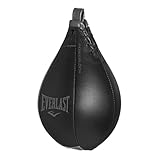
The Everlast Powerlock Speed Punching Bag sits in the middle of the range with a premium leather shell and a bladder retention design intended to keep the bladder seated where it belongs. It suits a home trainer who has outgrown a budget bag and wants something that will last through regular use.
The “Powerlock” name refers to the bag’s bladder retention approach. Bladders shifting inside the shell is a genuinely common failure mode — a bag that has been hit thousands of times can develop a bladder that slides toward one end, which changes the rebound and eventually causes an uneven strike. A retention design that holds the bladder in position addresses that directly.
Key specs
- Shell material: premium leather
- Bladder retention: lock-style system to keep the bladder seated
- Size class: medium teardrop
- Mounting: standard swivel and platform
- Intended use: regular home and light gym training
Strengths
The leather shell is the primary reason to buy here. It resists cracking far better than any PU or synthetic leather option, and it holds its teardrop shape over time, which is what keeps rebound consistent across the life of the bag rather than degrading steadily.
Second, the Powerlock retention system targets the failure mode that most often ends a speed bag’s useful life short of shell failure. If the bladder stays put, the rebound stays predictable, and you get more usable months out of the same bag.
Third, the Everlast name keeps parts easy to source. A replacement bladder or swivel is a simple purchase, and the standard medium size means it will fit platforms you already own or buy later.
Pros
- Premium leather shell for a long service life
- Bladder retention design addresses the most common mid-life failure
- Standard medium size fits common platforms and swivels
- Broad brand support makes replacement parts easy to find
Cons
- Mid-range price is substantially more than budget synthetics
- Leather requires occasional conditioning to stay supple
- Medium size needs more clearance than small bags
- Rebound is predictable rather than exceptionally fast
How it compares
Against the HUNTER cowhide bag, both are mid-range leather options. The HUNTER includes a swivel and uses a lightweight fast-return bladder; the Powerlock counters with its retention system and Everlast’s broader parts availability. If you already own a good swivel, the Powerlock is the more surgical choice; if you are starting from nothing, the bundled swivel on the HUNTER saves a step. Against the TITLE Gyro Balanced bag, the Powerlock is slower and more forgiving, which is the right trade for anyone who is still working on consistency rather than top-end speed.
8. MaxxMMA Heavy Duty Adjustable Speed Bag Platform Kit 24″ + Ball 10″ × 7″ — Best for a Complete Home Gym Build

The MaxxMMA kit is the answer to the real problem most home buyers hit: a speed bag is useless without a platform, and mounting a platform properly is a bigger project than choosing the bag. This kit bundles a 24″ adjustable platform with a 10″ × 7″ speed bag and the mounting hardware, so a single purchase creates a complete training station.
The 24″ platform diameter is a standard size for home installations — large enough to provide a stable base with good rebound, small enough to mount on a garage wall or a solid ceiling joist without a major carpentry project.
Key specs
- Platform diameter: 24″
- Height adjustment: adjustable mount for different user heights
- Included bag: 10″ × 7″ speed bag
- Mounting: wall or ceiling, hardware included
- Intended use: complete home gym installation
Strengths
The height adjustment is more important than it sounds. A speed bag should hang so that its midpoint sits roughly at eye level when you stand in your stance. A platform with no adjustment forces you to compromise — or to train at the wrong height, which throws off your rhythm and your shoulders. An adjustable mount lets you set the correct height and change it if another person uses the same setup.
Second, the kit removes the compatibility risk entirely. The platform, the swivel mounting point, and the bag all come from the same supplier, so everything fits together and the rebound behaviour is predictable from day one. For a first-time buyer, that certainty is worth a meaningful premium.
Third, the included 10″ × 7″ bag is a sensible medium-size starting point: forgiving enough for beginners, capable enough to keep for a long time.
Pros
- Complete setup in one purchase — platform, bag, and hardware
- Adjustable height accommodates different users and corrects hanging position
- 24″ platform is a proven, stable standard size
- Eliminates compatibility guesswork between bag, swivel, and platform
Cons
- Premium price reflects buying a system rather than a bag
- Requires solid mounting into a stud or joist — not suitable for drywall alone
- Included bag may be the first component you want to upgrade
- Installation is a real project, not a five-minute assembly
How it compares
Against the Garvee platform kit, both are premium all-in-one solutions. The MaxxMMA specifies a 24″ platform and includes a 10″ × 7″ bag; the Garvee emphasizes a 360-degree swivel, an adjustable mount, and includes an air pump. The pump is a small but genuinely useful inclusion — you will need to adjust bag pressure regularly, and having the right tool from the start saves a trip. Against buying a platform and a bag separately, both kits cost more up front but avoid the sizing and fitting errors that make a home setup frustrating. Against the Ringside Apex small platform, this is the larger, more height-flexible option.
9. Garvee Speed Bag Platform Kit — Best Turnkey Mounting Solution

The Garvee kit is built around convenience: an adjustable mount, a 360-degree swivel, and a speed bag with an air pump included. It suits buyers who want one box that contains everything needed to go from an empty wall to a working speed bag station.
The 360-degree swivel is the headline component. A swivel that rotates freely in all directions lets the bag return on a consistent path rather than fighting the hardware, and it is the single component most responsible for whether a speed bag feels smooth or erratic.
Key specs
- Swivel: 360-degree rotation
- Mount: adjustable for height
- Included accessories: speed bag and air pump
- Mounting: wall or ceiling installation
- Intended use: turnkey home setup
Strengths
The air pump inclusion solves a problem most beginners do not anticipate. Speed bag performance is heavily pressure-dependent: under-inflate and the bag feels dead and slow, over-inflate and it becomes harsh and unpredictable. Being able to add or release air precisely, from day one, means you can tune the rebound to your level rather than accepting whatever pressure the bag arrived with.
Second, the adjustable mount and free-rotating swivel together produce a smoother cycle. If the swivel binds, every strike transfers a little rotational resistance into the bag’s path, and the rhythm degrades. A freely rotating swivel keeps the bag’s motion clean.
Third, everything arrives together. There is no compatibility research, no second order, and no risk that the swivel you bought does not match the platform’s mounting plate.
Pros
- Includes an air pump — essential for tuning rebound pressure
- 360-degree swivel promotes a smooth, consistent return path
- Adjustable height suits multiple users
- Complete kit removes all compatibility risk
Cons
- Premium price for a setup that includes a mid-tier bag
- Requires secure structural mounting
- Kit bags are rarely the strongest component — expect to upgrade eventually
- Adjustment mechanisms add hardware that must be checked periodically for tightness
How it compares
Against the MaxxMMA kit, the Garvee’s advantages are the explicitly 360-degree swivel and the included pump; the MaxxMMA’s advantage is a specified 24″ platform diameter, which gives a larger, more stable mounting surface. Both are premium-tier complete solutions and both solve the same core problem. Against the Ringside Apex small platform, the Garvee is the more feature-complete package while the Apex is the more compact, less expensive option for tight spaces. If you have a solid wall and limited room, the Apex may fit better; if you have proper structural mounting points available, either full kit is the more capable choice.
10. Ringside Apex Boxing Training Platform Speed Bag — Best for a Compact All-in-One Platform

The Ringside Apex is a small red-and-black speed bag supplied with its own platform — a compact all-in-one aimed at home users who want a real training station without dedicating a large section of wall to it.
The small bag size is deliberate. A smaller bag on a smaller platform takes up less room, swings through a tighter arc, and returns faster than a medium. The trade-off is the same as with any small bag: less margin for error on contact.
Key specs
- Bag size class: small
- Colour: red/black
- Platform: included
- Footprint: compact — suited to limited wall space
- Intended use: home boxing training and coordination
Strengths
The compact footprint is the main advantage. Full 24″ platforms demand a clear wall area and adequate floor clearance, which many apartments and shared rooms simply do not have. A smaller platform-and-bag combination can fit into a corner or a narrow strip of wall and still deliver a genuine speed bag session.
Second, the small bag produces a faster rebound, so the session is more speed-oriented than a medium bag allows. For a user focused on hand speed and reflex rather than sustained rhythm, that is the right characteristic.
Third, the Ringside brand carries genuine combat-sports pedigree, and an all-in-one package removes the mismatched-parts risk that affects buyers assembling a setup from separate purchases.
Pros
- Compact platform and bag suit limited space
- Small bag delivers a fast, speed-oriented rebound
- All-in-one purchase avoids compatibility problems
- Established boxing brand with real category experience
Cons
- Small bag is less forgiving for absolute beginners
- Smaller platform offers less stability under heavy use than a 24″ platform
- Still requires secure structural mounting
- Smaller striking area makes long unbroken sequences harder
How it compares
Against the MaxxMMA and Garvee full kits, the Apex is the space-saving choice with a smaller bag and a smaller platform, while the larger kits suit a dedicated training area and a user who wants a medium bag. Against buying a Meister SpeedKills small bag plus a separate platform, the Apex is the simpler route at the cost of flexibility — you cannot easily swap to a bigger bag if you later want a medium. For a first setup in a tight room, that simplification is often worth accepting.
11. HUNTER SpeedKills PU Leather Speed Bag — Best Cheap Spare or Second Bag

The HUNTER SpeedKills PU bag is a lightweight latex-bladder bag at the budget tier. It suits two specific buyers: someone who wants a low-cost first bag, and someone who already has a leather bag and wants a cheap, fast alternative for speed-focused sessions without wearing out the good one.
The combination of a synthetic shell and a latex bladder is interesting at this price point. Latex bladders are normally found on more expensive bags because they hold pressure more consistently, so pairing one with a PU shell gives you better rebound than the shell material alone would suggest.
Key specs
- Shell material: PU leather (synthetic)
- Bladder: lightweight latex
- Rebound character: fast
- Size class: standard teardrop
- Supplied as: bag only — swivel and platform separate
Strengths
The latex bladder is the reason to pick this over other budget bags. Consistent air pressure means a consistent rebound path, and consistency is what lets you build a rhythm instead of constantly correcting. At this price tier, that is a genuinely above-average component choice.
Second, the lightweight build makes for an easy, quick cycle. If your goal is hand speed and timing drills, a light bag that returns fast is the correct tool, and it costs very little.
Third, as a second bag it makes real sense. Keeping a cheap fast bag for speed sessions preserves the leather bag for longer, more varied work, and spreads wear across two products instead of concentrating it on one expensive item.
Pros
- Latex bladder gives better rebound consistency than most budget bags
- Very low cost makes it an easy second bag or spare
- Light weight suits speed and timing drills
- Standard teardrop size fits common swivels and platforms
Cons
- PU leather shell is the limiting factor on lifespan
- Swivel and platform sold separately
- Not durable enough to be your only bag if you train daily
- Fast rebound is less forgiving while you are learning basics
How it compares
Against the Redipo, this is the more conventional teardrop shape with a better bladder, and the better choice for general rhythm work; the Redipo is the more compact reflex-focused format. Against the HUNTER cowhide bag from the same brand, the two are the budget and mid-range ends of the same design philosophy — the PU version gets you the fast lightweight rebound for less money, while the cowhide version gets you years of service. If budget is the binding constraint, the PU bag plus a modest swivel is a perfectly workable starting point; upgrade the shell later and keep the swivel.
12. TITLE Boxing Gyro Balanced Leather Speed Bag — Best for Fastest, Most Consistent Rebound

The TITLE Boxing Gyro Balanced Leather Speed Bag is the top-of-list choice for rebound quality. Its gyro-balanced construction is intended to keep the bag rotating evenly so that its return path stays true even at high speed, and it suits experienced users chasing faster cycles and cleaner timing.
“Gyro balanced” describes a construction approach that distributes weight so the bag spins and returns without wobble. In practice, a balanced bag means fewer corrections: you strike, it comes back where you expect, and you can chain strikes together without adjusting. At slow speeds this is a nice-to-have. At high speeds it is the difference between a rhythm and a mess.
Key specs
- Shell material: leather
- Construction: gyro balanced for even rotation
- Size class: medium teardrop
- Rebound character: fast and highly consistent
- Mounting: standard swivel and platform
Strengths
Rebound consistency is the whole proposition here, and it is the hardest attribute to find in cheap bags. An unbalanced bag returns on a slightly different path each time, which forces constant micro-adjustments and makes sustained fast sequences nearly impossible. Balanced construction removes that variability, so the bag becomes a predictable partner rather than an unpredictable one.
Second, the leather shell supports long-term use. Combined with a balanced core, a leather TITLE bag should hold both its shape and its rebound character for a long service life, which is what justifies the premium tier over several years of ownership rather than one season.
Third, the medium teardrop size is the most versatile format: enough surface area for sustained work, small enough to reward accuracy. It is the size most experienced speed bag users settle on.
Pros
- Gyro-balanced construction delivers an unusually consistent return path
- Leather shell supports years of regular training
- Fast rebound suits speed and combination drills
- Medium size balances striking surface against precision demands
Cons
- Premium tier price is the highest on this list for a single bag
- Rewards good technique and exposes poor technique — not a beginner’s bag
- Requires a swivel and a solid platform purchased separately
- Leather needs occasional conditioning to maintain suppleness
How it compares
Against the Ringside Medium Leather bag, both are premium leather mediums. The Ringside is the heavier, slower, more forgiving option and the better learning tool; the TITLE is the faster, more precise instrument and the better choice once your timing is solid. Against the Everlast Powerlock, the TITLE wins on rebound consistency while the Powerlock wins on parts availability and bladder retention. If you are choosing one premium bag and your technique is already clean, the TITLE is the pick; if you are still building consistency, buy the Ringside medium and move to the TITLE later.
How to Choose
Speed bag selection comes down to four variables that interact with each other: size, shell material, bladder type, and mounting. Get the order of decisions right and the choice becomes straightforward.
Start with mounting, not the bag
This is the step most buyers skip, and it causes the most wasted money. A speed bag cannot be used without a platform, a swivel, and a structurally sound mounting point. Before comparing bags, answer three questions:
- Where will it hang? You need either a ceiling joist, a wall stud, or a purpose-built bracket fixed into solid structure. Drywall anchors alone will not survive the repeated load of a swinging bag.
- What is the clearance? Measure the distance from the mounting surface to the floor, and the distance to the nearest wall or obstruction. A medium bag on a 24″ platform needs roughly a metre of clear space in front of it and enough ceiling height to hang the bag at eye level.
- Do you already own a swivel? If yes, buy a bag only and match its size to your platform. If no, a bundled kit or a bag with an included swivel saves both money and a compatibility headache.
If the answer to the mounting question is “nowhere obvious,” a complete platform kit is the correct purchase, because it includes the mounting hardware and removes the risk of buying a bag that cannot be hung. That is the single strongest argument for the MaxxMMA and Garvee kits and, in a smaller space, the Ringside Apex.
Size: the biggest single influence on how a bag feels
Speed bag sizes are usually quoted as two numbers — the diameter and the height of the teardrop — and they fall into three practical classes.
| Size class | Typical dimensions | Rebound speed | Striking surface | Best suited to |
|---|---|---|---|---|
| Small | Roughly 7.5″ × 5″ (19 cm × 12.7 cm) | Fastest | Smallest — punishes misses | Experienced users, speed drills, tight spaces |
| Medium | Roughly 10″ × 7″ or 7″ × 10″ teardrop | Moderate | Generous — forgiving on contact | Most home and gym training, learning combinations |
| Large | Larger teardrops and heavy training bags | Slowest | Largest — most forgiving | Beginners building basic rhythm, heavier conditioning work |
The relationship between size and speed is straightforward physics. A smaller bag holds less air, so at the same pressure its shell is relatively stiffer and it returns to shape faster. A larger bag holds more air and has more surface to deform, so the return is slower and heavier.
The practical rule: choose the size above your current level. If you are a beginner, a medium or large bag will let you sustain a rhythm long enough to actually learn. If you are intermediate and comfortable with a medium, a small bag will push your hand speed. Buying a small bag as your first purchase is the most common mistake in this category — it is technically the “fast” option, but it is fast in a way that punishes the imprecision every beginner has.
Shell material: leather versus synthetic
Three materials dominate the market, and the differences show up almost entirely in lifespan rather than in how the bag feels on day one.
| Material | Upfront cost | Expected lifespan (regular home use) | Maintenance | Typical failure point |
|---|---|---|---|---|
| Premium cowhide / leather | Mid to premium | Multiple years | Occasional conditioning; keep dry | Stitching eventually, rarely the shell itself |
| PU / synthetic leather | Budget | Months to a couple of years | None | Surface cracking at the neck and stress folds |
| Vinyl / basic synthetic | Lowest | Under a year under regular use | None | Cracking and seam separation |
Leather’s advantage is not that it feels different immediately — a new leather bag can actually feel slower than a synthetic one because it is stiffer. Its advantage is that it stays usable. The teardrop shape holds, the rebound stays consistent, and the shell survives the repetitive flexing that eventually splits a synthetic bag at the neck.
Leather does need minimal care: keep the bag out of damp cold, and condition the shell occasionally with a leather treatment to stop it drying out and cracking. A dried-out leather bag fails the same way a synthetic one does; it just takes longer to get there.
The economics are worth running. A budget synthetic bag at a low price that lasts one year of light use, versus a mid-range leather bag at three to five times the price that lasts four or five years, works out roughly comparable per year — but the leather bag performs consistently throughout, while the synthetic bag’s rebound degrades steadily as it ages. You are buying consistency as much as durability.
Bladder type: the component that actually governs rebound
Inside every speed bag is a bladder — the inflatable rubber or latex core. It is the cheapest component and the one that most affects how the bag behaves.
- Standard rubber bladders are common at budget tier. They are functional but hold pressure less consistently, and they are typically the first part to fail.
- Latex bladders return to shape more quickly and hold pressure better, producing a more repeatable rebound. They are common on mid-range and premium bags and are the clearest indicator of quality in a product listing.
- Bladder retention systems — such as the design used on the Everlast Powerlock — hold the bladder in position inside the shell. Without retention, a bladder can shift after months of impact, changing the bag’s balance and rebound.
Pressure matters as much as bladder type. A speed bag should be inflated until it feels firm but not rock-hard — roughly the firmness of a well-pumped basketball, or slightly softer. Over-inflation makes the bag harsh and fast but erratic. Under-inflation makes it sluggish and dead. Most people over-inflate. If you buy any bag without a pump, buy a pump with it; the Garvee kit includes one for exactly this reason, and it is the single cheapest upgrade you can make to any setup.
Rebound consistency: what it means and how to judge it
Rebound consistency is the property that separates a good bag from a frustrating one, and it is the hardest thing to judge from a listing. It has three components:
- Path consistency: the bag returns along the same arc every cycle rather than drifting.
- Speed consistency: the interval between strikes stays even, so you can hold a rhythm.
- Rotation quality: the bag spins cleanly on the swivel without wobble — the quality TITLE addresses with its gyro-balanced construction.
Two factors drive it. The first is balance: how evenly weight is distributed in the shell. The second is the swivel. A cheap, binding swivel will make even a premium bag feel inconsistent, because every strike has to overcome rotational friction. This is why a swivel upgrade is often more noticeable than a bag upgrade — and why a bag that includes a matched swivel, like the HUNTER cowhide bag, is worth considering even if the bag alone costs a little more.
Matching the bag to your training level
| Your situation | Recommended size | Recommended material | Mounting approach | Example from this list |
|---|---|---|---|---|
| Total beginner, no equipment | Medium | Synthetic or PU | Complete platform kit | MaxxMMA or Garvee kit |
| Beginner with a platform already | Medium | PU or leather | Bag only, check swivel fit | HUNTER SpeedKills PU |
| Home trainer, daily use | Medium | Leather | Bag plus quality swivel | HUNTER cowhide or Everlast Powerlock |
| Intermediate chasing hand speed | Small | Leather with latex bladder | Existing platform | Meister SpeedKills small |
| Boxer doing structured reflex work | Medium, heavier | Premium leather | Solid platform, gym-grade | Ringside Medium Leather |
| Experienced, prioritising rebound quality | Medium | Premium leather, balanced core | Existing quality platform | TITLE Gyro Balanced |
| Very limited space | Small | Leather or PU | Compact all-in-one platform | Ringside Apex or Meister small |
| Budget-first experimenter | Medium or compact | PU | Cheapest bracket and swivel | Redipo or SAEEPABUL |
What wears out first — and what to budget for
Ownership costs for a speed bag are low but not zero, and knowing the failure order helps you plan.
- The bladder goes first. On a budget bag, expect to replace it within a year of regular use. On a leather bag with a quality bladder, it will typically last considerably longer. Replacement bladders are inexpensive and easy to fit.
- The swivel goes second. Swivels wear at the bearing or ball joint and begin to bind. A binding swivel degrades the whole experience, so replacing it is a worthwhile maintenance spend.
- The shell goes last — and on cheap bags it goes early. Cracking at the neck is the classic synthetic-bag failure. Leather resists it far longer.
- The platform hardware loosens. With any mounted platform, check the fixings periodically. Vibration from thousands of impacts will work bolts loose over time, and a loosened platform changes the rebound and becomes a safety concern.
Common mistakes worth avoiding: hanging the bag at the wrong height (it should sit around eye level in your stance, not at chest height); over-inflating and blaming the bag for an erratic rebound; mounting into drywall without structural backing; and buying a small bag as a first purchase because it sounds faster.
One general note on training: speed bag work is coordination and conditioning exercise. If you have any shoulder, wrist, or neck concern, or if you are returning to training after an injury, speak to a qualified professional before starting a new routine.
Frequently Asked Questions
What size speed bag should a beginner buy?
A medium bag — roughly 10″ × 7″ in teardrop proportions — is the right starting point for most beginners. The larger striking surface lets you sustain a rhythm long enough to actually learn the timing, whereas a small bag punishes every miss and makes practice frustrating. Once you can hold an unbroken rhythm for a minute or more, moving to a small bag for speed work makes sense.
Is leather really worth the extra cost over PU or synthetic?
For regular training, yes. Leather resists the neck cracking that ends a synthetic bag’s life, holds its teardrop shape so rebound stays consistent, and typically lasts several times as long. If you are only experimenting and may not stick with it, a budget PU bag is the sensible first purchase — you can upgrade the shell later and keep the same swivel and platform.
Do I need a platform, or can I hang a speed bag another way?
A speed bag needs a rigid overhead mounting point and a swivel; there is no practical way to use one without both. Options are a wall-mounted bracket fixed into studs, a ceiling mount fixed into a joist, or a complete platform kit. Free-standing frames exist but take up significant floor space. Whatever you choose, it must be fixed into structural timber — drywall anchors will not hold.
How much air should I put in a speed bag?
Inflate it until it feels firm but still gives slightly under thumb pressure — roughly the firmness of a well-pumped basketball. Over-inflation is the more common error and produces a harsh, erratic rebound, while under-inflation makes the bag feel dead and slow. If you are unsure, start slightly soft and add air in small amounts until the rebound feels lively and predictable.
What height should the bag hang at?
Set the platform so the bag’s midpoint sits roughly at eye level when you stand in your normal stance. This lets you strike with a natural arm position rather than reaching up or hunching down. If more than one person uses the setup, or if you are still adjusting your stance, an adjustable mount is worth paying for.
How often should I replace the bladder or the bag itself?
On a budget bag used regularly, expect the bladder to need replacing within about a year — it is inexpensive and simple to swap. A leather bag with a quality bladder will last considerably longer. Watch for cracking at the neck of the shell, a bladder that has shifted position inside the bag, or rebound that has become noticeably uneven; any of these means it is time to replace a component.
Does the swivel matter as much as the bag?
Often more, especially on cheaper setups. A swivel that binds or wobbles forces the bag off its natural path on every strike, which destroys rhythm no matter how good the bag is. If your speed bag feels inconsistent, check the swivel before blaming the bag. Bags supplied with a matched swivel, and kits that include a free-rotating swivel, avoid this problem from the start.
Can I train on a speed bag for fitness rather than boxing?
Yes — speed bag work is widely used for hand-eye coordination, shoulder endurance, and general conditioning, and no boxing background is required. Start with short intervals, focus on keeping a steady rhythm rather than hitting hard, and build duration gradually. As with any new repetitive overhead activity, if you have existing shoulder or wrist issues, check with a health professional first.
Which One to Buy
If you have a platform or wall bracket already and want one bag that does everything well, the HUNTER Leather Speed Bag is the pick — cowhide construction, a fast lightweight bladder, and a swivel in the box make it the lowest-friction purchase for regular home training.
If you are starting from nothing and have a solid wall or ceiling joist, buy a complete kit instead of a bag: the MaxxMMA 24″ platform kit for a larger, stable setup with a medium bag, or the Garvee kit if you want the 360-degree swivel and included pump.
If money is tight and you just want to find out whether speed bag training suits you, the Redipo or the HUNTER SpeedKills PU bag will get you started for very little, and the HUNTER’s latex bladder gives it the better rebound of the two.
If you are a serious trainee chasing hand speed, step up to the Meister SpeedKills small for fast compact work or the TITLE Gyro Balanced bag if rebound consistency at speed is your priority. And if you are still building fundamentals, the Ringside Medium Leather bag will teach you more per session than any fast bag will.