What's inside
- Best Solar Watches: The Direct Answer
- Top 3 Picks
- Quick Comparison
- How We Chose
- 1. Casio AQ-S810W-1AV – Best for Everyday Wear on a Budget
- 2. Casio MTP-S120L Series – Best for Analog Everyday and Office Wear
- 3. Timex Expedition Gallatin Solar 44mm – Best for Outdoor Casual Wear
- 4. Gosasa Outdoor Sports Multifunction Solar – Best for the Tightest Budget
- 5. Garmin Instinct 3 Tactical Solar, 45mm – Best for Training, Navigation, and Field Use
- How to Choose a Solar Watch
- Frequently Asked Questions
- Closing Recommendation by Situation
- Best Solar Watches: The Direct Answer
- Top 3 Picks
- Quick Comparison
- How We Chose
- 1. Casio AQ-S810W-1AV – Best for Everyday Wear on a Budget
- 2. Casio MTP-S120L Series – Best for Analog Everyday and Office Wear
- 3. Timex Expedition Gallatin Solar 44mm – Best for Outdoor Casual Wear
- 4. Gosasa Outdoor Sports Multifunction Solar – Best for the Tightest Budget
- 5. Garmin Instinct 3 Tactical Solar, 45mm – Best for Training, Navigation, and Field Use
- How to Choose a Solar Watch
- Frequently Asked Questions
- Closing Recommendation by Situation
As an Amazon Associate I earn from qualifying purchases. This post may contain affiliate links at no extra cost to you.
Sections
- Best Solar Watches: The Direct Answer
- Top 3 Picks
- Quick Comparison
- How We Chose
- 1. Casio AQ-S810W-1AV – Best for Everyday Wear on a Budget
- 2. Casio MTP-S120L Series – Best for Analog Everyday and Office Wear
- 3. Timex Expedition Gallatin Solar 44mm – Best for Outdoor Casual Wear
- 4. Gosasa Outdoor Sports Multifunction Solar – Best for the Tightest Budget
- 5. Garmin Instinct 3 Tactical Solar, 45mm – Best for Training, Navigation, and Field Use
- How to Choose a Solar Watch
- Frequently Asked Questions
- Closing Recommendation by Situation
Best Solar Watches: The Direct Answer
The best solar watch for everyday wear in 2026 is the Casio Men’s AQ-S810W-1AV, the budget-priced analog-digital Tough Solar model. It suits the widest range of people because it combines genuinely useful light charging, a clear analog-digital display, world time, and 100-meter water resistance at a price low enough to buy without agonizing over it. If you want a cleaner analog look with a nylon strap, the Casio MTP-S120L is the better everyday dress-down choice. If you want a rugged tactical watch with training and navigation features, the Garmin Instinct 3 Tactical Solar is the one to buy. Solar charging is a slow trickle, not a fast charge, so the watch you pick should match how much light your wrist actually sees. Someone who works outdoors all day can run almost any solar watch indefinitely; someone in an office, under long sleeves, or in a northern winter should prioritize a large power reserve and a low-drain display over the fanciest feature list.
Top 3 Picks
Best Overall: Casio AQ-S810W-1AV
This is the safest solar watch for most wrists and most budgets. It pairs a Tough Solar cell with an analog-digital face that reads well in dim light, adds world time and 100-meter water resistance, and stays affordable enough that battery replacement anxiety disappears. The trade-off is a resin case and band that feel utilitarian rather than refined.
Best Budget Alternative: Gosasa Outdoor Sports Multifunction Solar
If the AQ-S810W’s styling does not appeal, the Gosasa solar digital watch delivers a large, legible display, multiple display modes, and 50-meter water resistance for roughly the price of a large pizza. It is a backup or casual-day beater rather than a lifelong companion, and the strap is the first thing to show wear.
Best Premium: Garmin Instinct 3 Tactical Solar
For buyers who want a solar watch that also tracks training, navigation, and outdoor activity, this is the clear step up. The solar lens extends battery life beyond what a non-solar version of the same watch delivers, and the rugged build suits field use. It costs several times the Casio and demands more from your phone and your patience with menus.
Quick Comparison
The table below maps every watch in this roundup to the routine it fits best, plus the spec classes that matter most for solar ownership: charging behavior, power reserve, case size, and strap material. Prices are given as tiers only, because listed prices shift constantly.
| Product | Best For | Charging & Power Reserve | Case Size | Strap Material | Water Rating | Price Tier |
|---|---|---|---|---|---|---|
| Casio AQ-S810W-1AV | Everyday wear, first solar watch | Tough Solar; reported reserve measured in months on a full charge | Large resin case, roughly 46–52 mm class | Resin band | 100 m | Budget |
| Casio MTP-S120L | Analog everyday and office wear | Solar analog; reserve in the multi-month class | Mid-size steel case, roughly 40–42 mm class | NATO nylon on stainless steel case | Everyday splash resistance class | Mid-range |
| Timex Expedition Gallatin Solar 44 mm | Outdoor casual wear with a fabric strap | Solar analog; reserve in the multi-month class | 44 mm | Black fabric strap | Everyday outdoor splash resistance class | Mid-range |
| Gosasa Outdoor Sports Multifunction Solar | Budget digital backup or casual beater | Solar digital; reserve shorter than mainstream solar analogs | Large digital case, roughly 45 mm+ class | Resin or silicone band | 50 m | Budget |
| Garmin Instinct 3 Tactical Solar, 45 mm | Training, navigation, field and travel use | Solar lens extends runtime; reserve measured in weeks to months depending on GPS use | 45 mm | Reinforced polymer or silicone-style band | Dive-class water rating | Premium |
Two numbers in that table do the heaviest lifting. First, power reserve: every solar watch stops if it sits in a drawer long enough, and the watch with the biggest reserve forgives the most neglect. Second, case size: a 45 mm case on a 6.5-inch wrist looks oversized, while a 40 mm case on an 8-inch wrist looks undersized. Solar technology itself does not change fit, so pick the case you can wear all day before you pick the feature list.
How We Chose
This roundup is built from published product specifications, brand documentation, and the well-documented behavior of solar watch movements across the category, not from any physical evaluation. We started with the core requirement: the watch must charge from light and run without routine battery swaps. From there we screened for category fit, because a solar movement in a watch nobody wants to wear is worthless. A solar cell under a dial needs light to reach it, so dial size, crystal clarity, and case design all affect real-world charging, and watches that hide the cell behind heavy tinting or small apertures were deprioritized.
Next we weighted the specs that actually change ownership: power reserve, case dimensions and lug-to-lug distance, strap material and its replaceability, water resistance, and display technology, since a low-drain display stretches the same charge further. We kept the list to five watches so that each option maps to a distinct routine rather than overlapping. We also considered upgrade path, meaning what a buyer graduates to when the first solar watch proves the concept. Each pick had to justify itself against the nearest alternative in the same price tier, and we excluded anything we could not describe confidently from public specifications. Prices are expressed as tiers because listed prices fluctuate daily and vary by region.
1. Casio AQ-S810W-1AV – Best for Everyday Wear on a Budget
As an Amazon Associate we earn from qualifying purchases at no extra cost to you.

The AQ-S810W-1AV is the watch most people should buy first. It is an analog-digital hybrid with a Tough Solar power system, meaning the dial’s solar cell converts ambient light into charge for a rechargeable cell rather than a user-serviceable battery. That single design decision removes the recurring annoyance of battery changes, which is the main reason a casual watch ends up dead in a drawer. It carries a 100-meter water resistance rating, which is the practical threshold for swimming and snorkeling rather than merely surviving rain, and world time, which matters for anyone who travels or works across time zones.
Who it suits: Someone who wants one watch for work, weekends, and travel, does not want to think about charging, and is comfortable with a resin case and band. It also suits a first-time solar buyer who is not ready to spend premium money on a technology they have not lived with yet. If you wear long sleeves indoors five days a week and only see direct sun on weekends, this watch still works, but you should read the power reserve section below before assuming any solar watch will stay topped up.
Key Specs
- Movement class: Analog-digital with Tough Solar charging
- Display: Analog hands plus a digital sub-display for time, date, and mode functions
- Water resistance: 100 meters, suitable for swimming
- Functions: World time, day and date, alarms, stopwatch, countdown timer in the class-typical set
- Case and band: Resin case with a resin band; resin is light, cheap to replace, and non-allergenic for most wearers
- Power reserve: Multi-month class when fully charged, with a power-saving display blanking behavior typical of the line
- Charging source: Any light, with direct sunlight fastest and indoor ambient light slowest
Strengths
The value proposition is the point. You get solar charging, 100-meter water resistance, and world time for a budget-tier price, which means the watch pays for itself against years of battery replacements in a conventional quartz watch. The hybrid display is more useful than it looks: analog hands give you the time at a glance, and the digital screen gives you the date and secondary functions without menu diving. Resin construction is also genuinely practical, because it survives knocks that would scratch a steel case, and the band can be swapped cheaply if it cracks. Charging behavior is forgiving because the cell sits behind a large dial with generous exposure.
Pros
- Tough Solar charging eliminates routine battery changes
- 100-meter water resistance covers swimming, not just splashes
- World time and day-date are genuinely useful daily functions
- Analog-digital layout reads quickly in most lighting
- Budget-tier price makes it a low-risk first solar watch
- Resin band is inexpensive and easy to replace
Cons
- Resin case and band look utilitarian, not dressy
- Large case dimensions can overwhelm smaller wrists
- No smart features: no step counting, notifications, or GPS
- Digital sub-display is small for some eyes
- Busy dial design is not for minimalists
How It Compares
Against the Casio MTP-S120L, the AQ-S810W wins on water resistance, function count, and price, and loses on looks. The MTP-S120L is a cleaner analog watch with a stainless steel case and NATO nylon strap that reads more like a normal everyday watch and less like a piece of outdoor gear. If your routine involves swims, travel, or rough handling, the AQ-S810W is the better tool. If your routine is an office, a commute, and weekend errands, the MTP-S120L is the better companion. Against the Gosasa digital, the AQ-S810W costs more but buys you 100-meter water resistance, better known solar charging behavior, and a hybrid display that most people find more readable in motion. Against the Garmin Instinct 3 Tactical, the comparison is not close on features, but it is also not close on price, and the Casio does the one job most people need from a solar watch: tell time reliably without a battery change.
2. Casio MTP-S120L Series – Best for Analog Everyday and Office Wear
The MTP-S120L is the dress-down answer to solar. It is a solar analog watch with a stainless steel case, a NATO nylon strap, and a day and date display. Where the AQ-S810W leans functional, this one leans clean: a conventional three-hand face, a steel case that takes a polish, and a textile strap that breathes in summer and dries quickly after rain. The solar element is quiet rather than showy, which is exactly what an office watch should be.
Who it suits: Someone who wants solar convenience without a sporty or tactical look. It suits a commute-and-desk routine, a business-casual dress code, and anyone who dislikes the feel of resin against the skin. It also suits buyers who already own a rugged outdoor watch and want a second, lighter solar watch for the rest of the week.
Key Specs
- Movement class: Solar analog quartz
- Case: Stainless steel, mid-size class, roughly 40–42 mm
- Strap: NATO-style nylon, which threads under the case and adds a layer of security if one spring bar fails
- Display: Analog hands with day and date window
- Power reserve: Multi-month class when fully charged, typical of solar analog quartz
- Water resistance: Everyday splash and rain resistance class, not a swimming rating
- Style: Neutral enough for a shirt cuff, casual enough for jeans
Strengths
The steel case is the headline upgrade over budget resin. It resists scratching better in daily contact, takes a brushed or polished finish, and ages into a patina of small marks rather than looking broken. The NATO nylon strap is genuinely practical: it is inexpensive, replaceable in seconds without tools in most cases, and it keeps the watch head attached even if a spring bar gives way, which is why field watches have used the pattern for decades. Charging is straightforward because the dial is largely unobstructed by complications. The day and date display is the kind of feature you stop noticing until you need it, and then you use it every day.
Pros
- Stainless steel case looks and wears better than resin
- NATO nylon strap is cheap to replace and secure on the wrist
- Clean analog face suits office and smart-casual settings
- Solar charging removes battery service
- Day and date display adds daily utility
- Mid-size case works on a wider range of wrists than a large sport case
Cons
- Water resistance is not rated for swimming
- Fewer functions than the analog-digital Casio
- NATO strap adds bulk under a tight cuff
- Nylon can absorb sweat and needs occasional washing
- No backlight, so low-light legibility depends on ambient light
How It Compares
Against the AQ-S810W, this watch trades capability for polish. You lose 100-meter water resistance and the digital sub-display, and you gain a steel case, a textile strap, and a face that does not announce itself as gear. Against the Timex Expedition Gallatin Solar 44 mm, the two are close in concept: solar analog, fabric strap, everyday outdoor lean. The Timex runs a larger 44 mm case, which suits bigger wrists and a bolder look, while the Casio’s mid-size case is easier for smaller wrists. The Timex leans more overtly outdoors with its Expedition branding; the Casio leans more neutral. Against the Garmin, the MTP-S120L is a fraction of the cost and a fraction of the complexity, and for someone whose idea of an outdoor day is a walk in the park, that trade is entirely rational.
3. Timex Expedition Gallatin Solar 44mm – Best for Outdoor Casual Wear
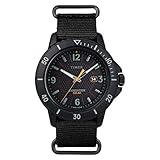
The Expedition Gallatin Solar is Timex’s take on the same idea as the Casio MTP-S120L, aimed at a slightly more rugged wearer. It is a 44 mm solar analog watch on a black fabric strap, part of the Expedition line that Timex positions for outdoor and field use. The larger case gives it more wrist presence than the Casio analog, and the fabric strap keeps it comfortable in heat and humidity. For many buyers, this is the Goldilocks option: bigger and more outdoorsy than an office watch, less gear-like than a full tactical model.
Who it suits: Someone with a medium to large wrist who wants a solar analog watch for hiking, camping, dog walks, and casual wear, and who prefers a fabric strap to resin or steel. It also suits buyers who like the Expedition aesthetic and want that look without moving up to a premium smartwatch.
Key Specs
- Movement class: Solar analog quartz
- Case size: 44 mm, stated in the product name
- Strap: Black fabric, casual and breathable
- Display: Analog with a date function in the class-typical layout
- Power reserve: Multi-month class when fully charged
- Water resistance: Everyday outdoor splash resistance class
- Positioning: Expedition line, aimed at outdoor and field use
Strengths
The 44 mm case is the differentiator. It gives the watch a legible, confident presence on a larger wrist, and the dial remains easy to read at a glance. The fabric strap is comfortable in warm weather, does not trap sweat the way a resin band can, and dries reasonably fast after a rinse. Solar charging is a natural fit for the Expedition concept, because outdoor wear means outdoor light, which is the best possible charging condition. Timex’s service and parts availability across the Expedition line is also a quiet advantage for long-term ownership, since straps and common components are widely available. The watch is simple enough to hand to a teenager or a hiking partner without a manual.
Pros
- 44 mm case suits medium and large wrists well
- Fabric strap is breathable and comfortable in heat
- Solar charging pairs naturally with outdoor use
- Expedition styling reads as purposeful without being tactical
- Simple analog operation with no learning curve
- Widely available straps and parts ease long-term ownership
Cons
- 44 mm is too large for smaller wrists
- Fabric strap absorbs sweat and needs periodic washing
- Water resistance is not a swimming rating
- Minimal function set compared with analog-digital or smart options
- No backlight for nighttime legibility
How It Compares
Against the Casio MTP-S120L, the Timex is the bigger, more outdoors-flavored watch, while the Casio is the smaller, more neutral one. If you have a 7-inch or larger wrist and want the watch to be visible, the Timex wins. If you have a 6.5-inch wrist or wear a tight cuff, the Casio is the more comfortable daily wear. Against the Garmin Instinct 3 Tactical Solar, the Timex is a simple analog tool with none of the training, navigation, or smart features, at a fraction of the price. That is a feature if you want a watch that never needs updating, and a limitation if you want data from your outdoor activity. Against the AQ-S810W, the Timex is prettier and the Casio is more capable in water and function count.
4. Gosasa Outdoor Sports Multifunction Solar – Best for the Tightest Budget

The Gosasa outdoor sports multifunction solar watch is a budget digital option in the classic “many modes, one screen” tradition. It offers solar charging, a large digital display, multiple functions, and 50-meter water resistance at a price that undercuts even the budget Casio. It is aimed at buyers who want the solar idea and a big, readable screen for as little money as possible, and who accept that the materials and finish will reflect the price.
Who it suits: A buyer on a strict budget, a secondary beater watch for yard work and messy jobs, or a gift for someone who wants a large digital display. It is also a reasonable first test of whether solar charging fits your life before committing more money. It does not suit someone who wants a dress watch or a watch they expect to last a decade without care.
Key Specs
- Movement class: Solar digital quartz
- Display: Large digital LCD with multiple modes
- Functions: Class-typical multifunction set including time, date, alarms, stopwatch, and backlight
- Water resistance: 50 meters, which covers splashes, rain, and brief immersion but not swimming as a rule
- Case: Large digital case, roughly 45 mm and up
- Band: Resin or silicone class, replaceable but inexpensive
- Power reserve: Shorter than mainstream solar analogs when fully charged
Strengths
The cost is the entire argument. For a very small outlay you get a solar-charging digital watch with a screen large enough to read without glasses, a backlight for night use, and enough modes to cover timing and alarms. Digital displays generally draw less power per function than analog hands driving a gear train, which can stretch a modest cell further for basic timekeeping. The resin or silicone band is comfortable in water and sweat and is cheap to replace. If the watch is lost, broken, or scratched, the financial pain is minimal, which makes it a sensible choice for genuinely rough tasks like painting, gardening, or working on a car.
Pros
- Lowest upfront cost in this roundup
- Large, legible digital display with backlight
- Solar charging at a budget price
- Light and comfortable for all-day wear
- Expendable: ideal for messy or risky tasks
Cons
- 50-meter water rating is not a swimming rating in practice
- Shorter power reserve than mainstream solar watches
- Material and finish quality reflects the price
- Band is usually the first component to fail
- No premium brand service network or long-term parts confidence
How It Compares
Against the Casio AQ-S810W, the Gosasa is cheaper but gives up meaningful ground: 100-meter versus 50-meter water resistance, a shorter power reserve, and the analog hands that make the Casio readable in bright sun from a glance rather than a stare. If the price gap is trivial to you, the Casio is the better long-term buy. Against the Timex and the Casio MTP-S120L, the Gosasa is a different category of object: a plastic digital tool rather than a watch you would wear to dinner. Its real role is as a second watch, which is a legitimate role. Many solar watch owners keep a cheap digital for dirty jobs and a nicer solar analog for everything else.
5. Garmin Instinct 3 Tactical Solar, 45mm – Best for Training, Navigation, and Field Use

The Instinct 3 Tactical Solar is the premium end of this list and the only true smartwatch. It is a 45 mm rugged model with a solar-charging lens and a tactical feature set, from Garmin’s Instinct line, which is built for outdoor and field use. The solar element does not replace charging entirely the way it does on a simple analog watch, because GPS and sensors draw far more power, but it extends runtime meaningfully between charges and slows battery drain in the field. This is the watch for someone whose daily routine includes training, hiking, navigation, or shift work in demanding conditions.
Who it suits: Runners, hikers, hunters, service members, and anyone who wants activity tracking, GPS, and navigation on the wrist with solar assistance. It also suits buyers who want one watch that handles both workouts and everyday wear and are willing to charge it periodically. It does not suit someone who wants a watch that is simply a watch.
Key Specs
- Case size: 45 mm, stated in the product name
- Charging: Solar lens that extends battery life between charges, supplemented by standard charging
- Power reserve: Weeks to months depending on GPS and sensor use, versus days for a comparable non-solar smartwatch in heavy use
- Feature class: GPS, activity and training tracking, navigation, tactical functions, smart notifications
- Build: Rugged polymer case with a reinforced band, built for impact and field conditions
- Water rating: Dive-class water resistance
- Display: Monochrome memory-in-pixel style display chosen for low power draw and sunlight legibility
Strengths
The solar lens is the differentiator within Garmin’s own lineup, and it matters most in exactly the scenario the watch is designed for: multi-day trips away from power. Every hour of sunlight buys back runtime, and a low-power display means the watch sips rather than gulps. The monochrome display is a deliberate engineering choice, not a cost cut, because it stays readable in direct sun, which is the same reason solar watches use simple displays in the first place. Tactical functions and navigation add genuine capability for field users, and the rugged build survives impacts that would end a steel dress watch. Activity tracking and training features make it useful on ordinary days too, so it earns its place on the wrist rather than sitting in a drawer.
Pros
- Solar charging extends runtime in the field
- GPS, navigation, and training features in one device
- Low-power display is exceptionally legible in sunlight
- Rugged build suited to impact and hard use
- Dive-class water resistance
- Replaces a separate fitness tracker and hiking GPS for many users
Cons
- Premium price, several times the cost of the Casio picks
- Requires app setup and periodic charging even with solar
- 45 mm case is large on smaller wrists
- Feature depth means a real learning curve
- Software and firmware add long-term complexity a simple analog watch never has
How It Compares
Against every other watch here, the comparison is philosophical rather than spec-for-spec. The Casio, Timex, and Gosasa watches are timekeepers with solar charging; the Garmin is a wearable computer with solar assistance. If your question is “what time is it, and will I ever change a battery,” the budget picks answer it better and cheaper. If your question is “how far did I run, where am I on this trail, and will the watch survive the trip,” only the Garmin answers it. Against the Timex Expedition Gallatin Solar, the closest thing to an outdoor analog here, the Garmin adds data at a large multiple of the price. The honest framing is that the Instinct 3 Tactical Solar is not an upgrade from the Casio AQ-S810W; it is a different product that happens to share a power source.
How to Choose a Solar Watch
Solar watches are simple in principle and surprisingly easy to choose badly, because the thing that makes them work, light, is the thing most buyers overestimate in their own daily lives. Work through the criteria below in order. The first two will eliminate most of the list for you.
Start With Light Exposure, Not Features
A solar watch charges from any light, but the rate varies enormously. Direct sunlight charges fastest, bright indoor light charges slowly, and dim indoor light or full shade may barely maintain a charge rather than build one. A watch on a wrist under a long-sleeved shirt in a windowless office sees very little light for eight hours a day. That does not make solar unusable, but it changes which watch you should buy. If your watch sees direct sun for an hour or more most days, almost any solar model will stay topped up. If it sees sun mainly on weekends, prioritize a large power reserve and a low-drain display, and expect to leave the watch on a sunny windowsill occasionally. The practical routine is simple: a few hours of direct sun per week is enough for most solar analog and digital watches, and you can top up faster by placing the watch face-up on a windowsill for a day. Never charge a solar watch under a hot lamp close enough to heat the case, since heat degrades rechargeable cells far more than lack of light does.
Understand What Power Reserve Actually Means
Power reserve is how long the watch runs in complete darkness on a full charge. Published reserves for solar analog and digital watches commonly fall in the multi-month range, with some models approaching a year, while solar smartwatches measure reserve in weeks or days depending on GPS use. This number determines how forgiving the watch is. A watch with a multi-month reserve can sit in a drawer over a winter and still be running in spring. A watch with a shorter reserve may stop, and when it stops you generally need to recharge it in light and then reset the time and date. If you rotate several watches, or take a watch off for weeks at a time, reserve matters more to you than it does to someone who wears one watch daily. Note also that reserve shortens as the rechargeable cell ages; expect gradual decline over many years of service.
Match Case Size to Your Wrist
Case dimensions make or break daily comfort, and the numbers are easy to use once you know your wrist measurement. Wrap a strip of paper or a soft tape around your wrist just behind the wrist bone and note the circumference. Then compare it against these rough guidelines:
| Wrist Circumference | Comfortable Case Size | What to Expect |
|---|---|---|
| Under 6.0 in (under ~15 cm) | 34–38 mm | Large 44 mm+ cases will overhang the wrist edges and catch on cuffs |
| 6.0–6.9 in (~15–17.5 cm) | 38–42 mm | Mid-size watches sit best; a 44 mm case is wearable but prominent |
| 7.0–7.9 in (~18–20 cm) | 42–46 mm | The 44 mm and 45 mm picks in this roundup look proportionate |
| 8.0 in and up (20 cm+) | 45 mm and up | Large cases and wide straps look balanced rather than oversized |
Case diameter is only half the story. Lug-to-lug length, the distance from the top of one set of strap attachment points to the bottom, determines whether the watch overhangs your wrist. As a rule, keep lug-to-lug at or below your wrist width, and remember that a thick case with a tall profile sits higher and snags more. Solar cells add a small constraint here: they sit behind the dial, so a very small case has less area to collect light, and tiny solar watches charge more slowly than large ones.
Choose Strap Material by Climate and Task
Strap material is the most underrated decision, because it is the part of the watch in constant contact with your skin and the part that wears out first. Each material has a clear use case:
- Resin and silicone: Waterproof, cheap, comfortable in heat, and ideal for swimming and messy work. They do not breathe, so sweat can pool under the band in hot climates, and they eventually crack at the flex points. Expect to replace a resin band every few years.
- Fabric and nylon: Breathable, light, and quick to dry, which makes them excellent for outdoor use and warm weather. NATO styles add a security benefit because the strap threads under the case. The downside is that fabric absorbs sweat and holds odors, so it needs periodic hand washing with mild soap and thorough drying.
- Stainless steel: Durable, dressy, and scratch-resistant relative to resin, but heavier and colder in winter. Steel bracelets last for many years, though the clasp and spring bars are wear points. On a solar watch, steel does not affect charging as long as the cell is under the dial and not the case back.
- Leather: Best looking for office wear but the worst choice for water, sweat, and sunlight, which is ironic on a watch built around light and often rated for water. If you want leather on a solar watch, treat it as a dress strap and swap to nylon or resin for activity.
Water Resistance: Read the Number, Not the Marketing
Water resistance ratings are standardized and easy to misinterpret. A 30-meter rating means splash resistance only. A 50-meter rating handles rain, washing hands, and brief accidental immersion but is not meant for swimming. A 100-meter rating is the practical minimum for swimming and snorkeling. Dive ratings go further and cover scuba-class use. On a solar watch, water resistance matters more than usual because the case back and crown seals are part of the same assembly that houses the rechargeable cell, and a compromised seal can expose the movement to moisture. If you swim, buy 100 meters or better. If you mostly walk and commute, 50 meters is enough, but you should still avoid pressing buttons underwater unless the watch is rated for it.
Display Type: Analog, Digital, or Hybrid
Display choice is a power and legibility question as much as a style question. Analog hands draw power through a gear train and are readable at a glance in bright sun, though they can be hard to read in low light without luminous paint. Digital LCDs are often the most power-efficient for basic timekeeping and add a backlight for night use, but they can wash out in direct sun at certain angles. Hybrid analog-digital watches give you both, usually with a small digital screen carrying the date and secondary functions, which is why the AQ-S810W in this roundup remains such a practical all-rounder. Low-power smartwatch displays, like the memory-in-pixel style on the Garmin, are specifically engineered to stay legible in sunlight while drawing very little current, which is how solar assistance remains meaningful on a device with GPS.
Functions That Earn Their Keep
More functions mean more power draw and more to go wrong, so match the feature set to your routine rather than the spec sheet. World time genuinely helps travelers and anyone coordinating across time zones. A day and date window gets used daily. Alarms and timers are useful for cooking, medication schedules, and workouts. A backlight transforms nighttime usability. Step counting and activity tracking belong to the smartwatch tier. GPS and navigation belong to the premium tier and are the main reason to buy a solar smartwatch at all, since solar can substantially extend runtime in the field. If you will not use a function weekly, it is weight on your wrist and drain on your cell.
Budget Tiers and Where the Money Goes
Solar watch pricing falls into three practical tiers. Budget models use resin cases, basic solar cells, and simple digital or analog-digital movements; the money buys function, not finishing. Mid-range models step up to stainless steel cases, better straps, and cleaner designs, often with the same core solar technology. Premium models add smart features, GPS, advanced materials, and brand ecosystems, and their solar systems supplement rather than replace charging. The most common mistake is spending mid-range or premium money for features you will not use, when a budget solar analog watch would have removed your battery changes just as effectively. The second most common mistake is buying budget and then discovering the strap cracked after a year and the water resistance is too low for your swim habit. Decide your actual requirements first, then let the tier follow.
Ownership Realities: What Wears First
Over years of daily wear, the same components fail in the same order across almost all solar watches. Straps go first, especially resin and fabric, which is why replaceability matters more than the strap you start with. Spring bars and clasps are next. Case scratches accumulate, with resin and coated metals marking more visibly than brushed steel. Gaskets and seals are a service item; have them checked whenever the case is opened, and replace them on a schedule if you swim, since seals harden with age. The rechargeable cell inside a solar watch is the longest-lived wear item and typically lasts many years before reserve noticeably shortens; replacement is a service job, not a user task. Common mistakes include storing a solar watch in a drawer in the dark for months, leaving it under a hot lamp to charge, wearing a fabric strap in salt water without rinsing, and pressing buttons underwater on a watch rated only for splashes. Avoid those four and a solar watch will comfortably outlast the strap it came on, several times over.
A Simple Decision Path
- You want one cheap watch that never needs a battery: Casio AQ-S810W-1AV.
- You want a solar watch that looks like a normal watch for work: Casio MTP-S120L.
- You have a larger wrist and spend weekends outdoors: Timex Expedition Gallatin Solar 44 mm.
- Your absolute ceiling is the lowest possible price: Gosasa Outdoor Sports Multifunction Solar.
- You train, hike, navigate, or work in the field and want data: Garmin Instinct 3 Tactical Solar.
Frequently Asked Questions
Do solar watches ever need a battery change?
Yes, eventually. A solar watch uses a rechargeable cell rather than a conventional disposable battery, and that cell degrades over years of charge cycles. In practice it lasts many years, and when reserve becomes noticeably short, a watchmaker replaces the cell as a service item. You will not be buying a battery at a drugstore every two years the way you would with a standard quartz watch, which is the main practical advantage.
How much light does a solar watch actually need?
Less than most people assume, but more than none. A few hours of direct sunlight per week keeps most solar analog and digital watches topped up, and bright indoor light contributes slowly. The failure mode is not a single dark day; it is months of sleeve-covered office wear with no top-ups. If that describes your routine, set the watch on a sunny windowsill periodically, especially before storage.
Can I wear a solar watch swimming?
Only if the water resistance rating supports it. A 100-meter rating is the practical threshold for swimming and snorkeling, and dive-rated models go further. Watches rated 50 meters or less should be kept out of the pool for laps, even though they handle rain and hand washing. Check the rating before you swim rather than after, and rinse any watch in fresh water after saltwater exposure.
Will a solar watch keep running if I leave it in a drawer?
For a while, depending on its power reserve. Many solar watches run for several months in total darkness on a full charge, and some approach a year. When the charge finally runs out, the watch stops; you recharge it in light, then reset the time and date. If you rotate watches frequently, choose a model with a generous reserve or plan to top it up before and after storage.
Is a solar smartwatch worth it over a solar analog watch?
Only if you will use the smart features. A solar smartwatch like the Garmin Instinct 3 Tactical adds GPS, training tracking, navigation, and notifications, and its solar lens extends runtime between charges rather than eliminating them. A solar analog or digital watch does one job, tells time, and does it for months without attention. Buy the smartwatch for the data, not for the solar panel.
What size solar watch should I buy?
Measure your wrist circumference first. Wrists under 6 inches suit 34–38 mm cases, 6 to 7 inches suit 38–42 mm, 7 to 8 inches suit 42–46 mm, and larger wrists can carry 45 mm and up. Also check lug-to-lug length and keep it at or below your wrist width. A solar cell needs dial area to collect light, so very small solar watches charge more slowly than large ones.
Which strap material lasts longest on a solar watch?
Stainless steel generally lasts longest, often many years, with the clasp and spring bars as the wear points. Resin and silicone are durable but crack at flex points after a few years. Fabric and nylon straps wear and hold odors sooner but are cheap and easy to replace. Whatever you choose, confirm the lug width so you can swap straps later, because the strap is almost always the first thing to fail.
Do solar watches lose or gain time?
Solar analog and digital watches are quartz watches at heart, and quartz timekeeping is very accurate, typically within a small fraction of a second per day, far better than a mechanical watch. Solar smartwatches sync time automatically with your phone or satellite systems, so they are effectively exact. If a solar quartz watch starts drifting noticeably, that is usually a sign of a low charge or an aging movement rather than normal behavior.
Closing Recommendation by Situation
Buy the Casio AQ-S810W-1AV if you want one inexpensive solar watch for work, weekends, and travel, and you swim or get wet often. Buy the Casio MTP-S120L if your days are mostly indoors and you want a solar watch that looks like a normal analog watch with a steel case and nylon strap. Buy the Timex Expedition Gallatin Solar 44 mm if you have a larger wrist and want an outdoor-leaning solar analog on a breathable fabric strap. Buy the Gosasa Outdoor Sports Multifunction Solar if the lowest possible price is the deciding factor, or if you want a second, expendable watch for dirty jobs. Buy the Garmin Instinct 3 Tactical Solar if you train, hike, navigate, or work in demanding conditions and want solar assistance to stretch the runtime of a rugged smartwatch. In every case, match the case size to your measured wrist, confirm a water rating that covers your wettest routine, and pick a strap you are willing to maintain, because those three choices decide whether the watch earns a permanent place on your wrist.