What's inside
As an Amazon Associate I earn from qualifying purchases. This post may contain affiliate links at no extra cost to you.
Sections
Our Top Picks
 Narex Set of Skew Chisels in Wooden Box6 mm (0.2 inch)9.92 x 1.34 x 1.34 Inches0.25 poundsCheck on Amazon


The short answer
For cleaning a tight inside corner, a narrow bench chisel is usually the more useful first purchase. It can pare a shoulder, trim a corner, and remove waste from a small recess without requiring a special grip. A skew chisel earns its place when a straight chisel’s side or handle keeps bumping the wall of the recess, or when you need a clean cut right into a corner that is difficult to approach squarely.
These tools overlap, but they are not interchangeable. A narrow bench chisel is narrow from edge to edge; a skew chisel has an edge set at an angle to its sides. The first gives you a slim blade. The second gives you an angled cutting edge and better access from one side. For occasional fitting work, a sharp narrow chisel is often enough. For repeated dovetails, narrow stopped housings, or fine corner cleanup, a skew can save awkward tool handling.
As an Amazon Associate we earn from qualifying purchases at no extra cost to you.

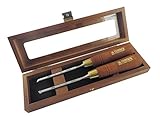
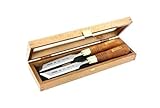

What each chisel does
A narrow bench chisel is a conventional bench chisel in a small width, commonly around 6 mm (1/4 in) to 12 mm (1/2 in). It is suited to paring and light chopping where a wider blade will not fit. Its square edge is easy to register against a straight wall, and it can work equally well from either side of a recess.
A skew chisel has a cutting edge angled across the blade, often roughly 20 to 30 degrees from square. That angle lets the cutting edge reach into a corner while the blade’s side stays clear of the adjacent wall. Skews are generally used by hand pressure for controlled paring, though some can take light mallet work. They are less convenient for broad, square chopping and may be handed: a left-skew and right-skew approach the same corner differently.
How they compare
| Factor | Narrow bench chisel | Skew chisel |
|---|---|---|
| Best at | General trimming, paring shoulders, small recesses | Reaching corners where a square blade is obstructed |
| Edge shape | Straight across the blade | Angled across the blade |
| Approach | Works from either side of a corner | Works best from its intended skew direction |
| Control | Easy to register against a straight wall | Can pull or twist if the skew catches or is pushed off line |
| Versatility | Useful for many small bench and site tasks | More specialized, especially useful for joinery cleanup |
| Buying trade-off | Often the better value as a first small chisel | Worth buying when access, not blade width alone, is the problem |
Choose by the corner you have
Look at the access before choosing the tool. If the recess is open enough to bring a straight blade down onto the waste, a narrow bench chisel is simpler. It is also easier to keep its edge parallel to a shoulder line. For work such as trimming a 6 mm-wide housing or cleaning the end of a small mortise, a narrow bench chisel in a size that fits the cut is a sensible starting point.
If a recess has a wall close beside the cut, a skew may reach the corner without the blade rubbing that wall. This matters in dovetail sockets, narrow stopped grooves, and small rebates with limited approach room. A woodworking skew chisel can also help pare the end grain at the bottom of a corner, where a square-edged blade would need to be angled awkwardly.
Check whether you need a left or right skew before buying. If the cutting edge has to enter from both directions, one skew may not cover the job. For occasional work, turning the board around or using a narrow straight chisel may be cheaper and less fiddly than owning a pair.
Clean corners without tearing out
First mark the finished boundary with a knife or a sharp marking gauge, then remove most of the waste before paring to the line. Trying to take the full depth in one pass encourages the edge to dive, bruises the corner, or splits the grain past the mark. For a recess about 10 mm deep, take several shallow cuts rather than forcing a deep one; the exact depth per pass depends on the wood and grain direction.
Keep the bevel facing the waste when paring to a wall. Use short cuts and stop as soon as the floor or wall reaches the knife line. In end grain, work toward the corner from both sides where possible. That reduces the chance of a split running out beyond the corner. With a skew, keep the flat side referenced against the finished wall and make sure the angled edge is cutting into waste, not levering against the corner.
A sharp edge matters more than a premium handle. If the chisel crushes fibers instead of slicing them, stalls in end grain, or needs heavy pressure for a thin shaving, hone it before blaming the geometry. A narrow blade is less forgiving of twisting than a wide one: keep your fingers close to the work and avoid levering sideways, especially in hard or cross-grained stock.
Buying and maintenance
Buy the narrowest width that fits the work, not the narrowest one available. A blade that is too narrow takes more passes and is easier to steer off line. For general small joinery, 6 mm, 9 mm, and 12 mm are practical widths; if most of your work is larger cabinetry or site carpentry, a 12 mm chisel may see more use than a tiny 3 mm tool.
There is no need to buy an expensive skew for a corner you clean once a year. A decent, sharp narrow bench chisel is the cheaper and more versatile option, and an inexpensive chisel can do clean work if its back is reasonably flat and its edge holds up. Consider a skew after you have repeatedly found that the straight blade cannot reach without rubbing a finished wall. A single skew is a targeted purchase; a matching left- and right-hand pair is justified mainly when the work regularly demands access from both sides.
Whichever style you choose, protect the edge between jobs. A nick only a fraction of a millimeter wide can leave a visible ridge in a fine corner. Hone out small defects before they grow, and do not use a paring chisel as a pry bar. The practical choice is straightforward: start with a narrow bench chisel for mixed work; add the appropriate skew when the corner’s geometry, rather than the chisel’s sharpness, is what is stopping you.