What's inside
As an Amazon Associate I earn from qualifying purchases. This post may contain affiliate links at no extra cost to you.
Sections
Our Top Picks
 Stanley 1-12-204 Smooth Plane Handyman No. 4250mm10.43 x 2.56 x 5.91 inches3.7 PoundsCheck on Amazon

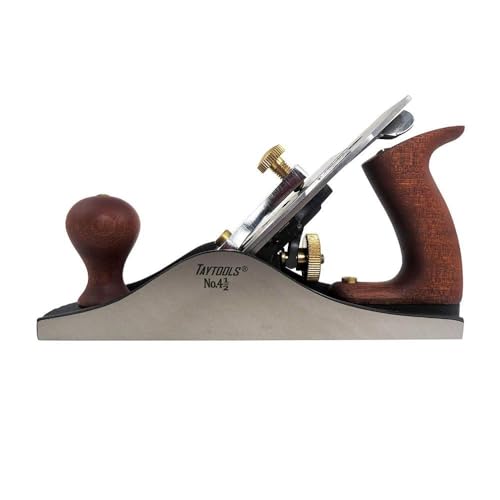
Why pine trim tears out
Pine is soft, but it is not always easy to plane cleanly. Grain can reverse within a short length, and a plane set for a heavy cut may lift long fibers ahead of the blade instead of slicing them. Knots and resin add their own problems: knots can deflect the cut, while pitch can collect on the iron and sole.
For trim, the goal is usually a light final pass that removes roughly 0.05–0.15 mm (about 0.002–0.006 in.) at a time. A sharp iron, a fine mouth opening and steady support matter more than owning an expensive plane. Test on an offcut from the same board before planing visible work.
As an Amazon Associate we earn from qualifying purchases at no extra cost to you.

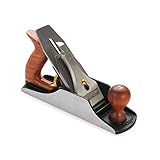

Which plane to buy
| Plane type | Best use on pine trim | Trade-off |
|---|---|---|
| Block plane | Small edges, end grain, short touch-ups and narrow trim | Easy to control, but short sole can follow dips on long edges |
| Bench plane, about 9–10 in. | General smoothing and fitting ordinary trim lengths | More versatile than a block plane; needs room and careful setup |
| Bench plane, about 14 in. | Straightening longer edges and flattening wider stock | More weight and length than most trim touch-ups require |
| Scraper plane | Reversing grain or small tear-out that a cutting plane keeps lifting | Can leave a slightly different surface and needs a properly prepared scraper |
For one plane to handle most trim fitting and cleanup, a well-adjusted bench plane around 9–10 inches long is a sensible starting point. Look for an iron that can be sharpened and adjusted reliably, a sole that is reasonably flat, and a mouth that can be set close to the edge. A general-purpose bench plane is more useful for this work than a very long jointer plane.
If your work is mostly easing sharp edges or correcting a short fit, a block plane may be all you need. It is cheaper, compact and convenient, but it is not a substitute for a longer plane when you need a straight, even edge along a long board. Low-angle block planes are especially handy on end grain; on long-grain faces, blade sharpness and cut depth still decide the finish.
Set up for a clean cut
First, sharpen the iron. A practical setup is a primary bevel around 25 degrees with a small secondary bevel around 30 degrees, though the plane’s design may call for a different angle. The important test is a consistent, burr-free edge that can take a fine shaving. If the plane crushes fibers, leaves ridges, or needs force to advance, stop and check the edge before changing your technique.
Set the blade for a thin, continuous shaving. Retract it until it stops cutting, then advance it in small increments. Sight along the sole to check that the cutting edge projects evenly across its width. A slightly heavier shaving on one side can leave a step or make the plane steer. Close the mouth as far as practical without clogging it: the opening should clear the shaving, not leave a large gap ahead of the blade.
A mouth adjustment is useful but not magic. If the board has strongly changing grain, even a fine setting can tear fibers. Plane in the direction that leaves the grain lying down—often, but not always, the direction that feels smooth when you run a hand lightly over the surface. Grain can change halfway along a piece, so make short test strokes in both directions.
Plane trim without lifting fibers
Clamp the work securely on a bench or support it close to the cutting area. A loose, narrow moulding can chatter, tip or split under a plane. For delicate profiles, use a padded vise or a simple stop rather than crushing the trim in a metal jaw. Keep the plane’s sole flat on the work as it starts and finishes the stroke; tipping it can create a hollow at an end.
Take several light passes instead of trying to remove material in one go. On long stock, use a full-length stroke where you can, but vary the starting point slightly so you do not create a low spot by always pressing hardest at the same end. Check progress with a straightedge or by bringing the trim to the joint. For a small edge break, one or two controlled passes are usually enough. A block plane gives good control here, but too much pressure can round an edge that should remain crisp.
If tear-out starts, stop. Continuing can pull out a deeper patch that is difficult to disguise under paint. Try reversing the planing direction, reducing the cut, and checking for a dull or nicked edge. If the grain reverses locally, a card scraper can remove a shallow rough patch with less risk of lifting long fibers. It takes practice to prepare and use well, so it is not essential for occasional trim fitting.
Common buying mistakes
Do not assume a heavier or more expensive plane will prevent tear-out. A poorly sharpened premium plane can perform worse than a modest plane with a keen iron and sensible setup. At the budget end, check whether the sole is flat enough for your task, whether the blade adjustment holds, and whether replacement or resharpening is straightforward. If the plane needs only minor tuning, the lower price may be worthwhile; if its adjuster slips or the iron will not take a clean edge, the savings disappear quickly.
Also avoid buying a long plane just because longer sounds more accurate. A 14-inch bench plane is useful for longer straightening jobs, but it can feel cumbersome on short trim. Conversely, a tiny block plane is excellent for a corner or edge, but its short sole can ride over bumps rather than bridge them. Match the plane to the work you actually do, then spend time on sharpening and setup before buying another tool.