What's inside
As an Amazon Associate I earn from qualifying purchases. This post may contain affiliate links at no extra cost to you.
Sections
Our Top Picks


Why use a hand plane on painted timber edges?
A hand plane can remove paint from a timber edge while also bringing the wood beneath it back to a straight, clean line. That makes it useful on door edges, window parts and trim where a scraper may follow every bump and a power sander can round over corners or remove too much material. It is not the right first tool for every job: thick, brittle paint is usually quicker to scrape, and any coating that might contain lead needs proper testing and safe handling before you disturb it.
For ordinary paint on sound wood, start with a sharp blade and a shallow cut. A plane removes paint and timber together, so check the fit or finished dimension as you work. If the edge only needs a small amount removed to clear a sticking door, a few controlled passes are better than trying to strip the whole surface in one go.
As an Amazon Associate we earn from qualifying purchases at no extra cost to you.



Which hand plane should you buy?
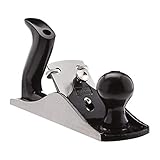
A block plane is the easiest choice for short edges, corners and small repairs. Its compact size gives good control, and many block planes let you adjust the blade angle and mouth opening. A bench plane is steadier on a long edge, but is heavier and needs more room to guide. A No. 4 smoothing plane is a useful general-purpose size; a longer No. 5 jack plane is more forgiving when you need to straighten an edge over several feet.
For occasional DIY work, a decent adjustable block plane is often enough. Look for a flat sole, a blade that can be sharpened, and adjustments that hold their setting. Very cheap planes can work, but a blade that will not stay aligned or a sole with a noticeable hollow makes consistent cuts harder. If you plan to plane long edges regularly, spend more on a well-made bench plane rather than expecting a small block plane to do that job comfortably.
Browse adjustable block planes for small edges and localised paint removal. For longer work, compare No. 4 bench planes and choose one you can set up and sharpen.
Plane types at a glance
| Plane type | Best use | Main trade-off |
|---|---|---|
| Block plane | Short edges, end grain, corners and small repairs | Can leave a wavy result on long edges if you do not keep it level |
| No. 4 smoothing plane | General edge work and moderate-length boards | Needs more space and setup than a block plane |
| No. 5 jack plane | Long edges and correcting unevenness | Heavier; overkill for a few inches of paint |
Prepare the edge before planing
Check the coating and timber first. If paint is flaking, scrape off loose pieces so they do not jam the mouth. Look for nails, screws, staples and grit; a blade hitting metal can chip its edge immediately. For old paint of unknown age, test for lead before sanding, scraping or planing. Follow local guidance for containment and disposal. A plane is not a safe shortcut around hazardous-paint precautions: its shavings and dust still carry the coating.
Clamp the work so it cannot move, with the edge accessible and supported close to where you are cutting. Mark the area you intend to remove with pencil. On a door, check the hinge and latch sides and measure the gap before changing the edge; removing 1–2 mm may solve a tight spot, while taking off more can spoil the fit or expose bare wood beyond what you planned.
Set the plane and make controlled passes
A sharp iron matters more than an expensive body. If the blade tears paint instead of shaving it, or needs force to move, stop and sharpen it. Set the iron for a fine shaving—about 0.1 to 0.2 mm is a sensible starting point—and make a test pass on a hidden section or scrap. A heavy cut can catch at the paint boundary, tear fibres, or dig a hollow into a narrow edge.
Plane with the grain where possible. Keep the sole flat on the edge, push steadily, and overlap passes slightly. On an edge that changes grain direction, take shorter cuts and inspect often; reversing grain can cause tear-out even with a sharp blade. For end grain, a low-angle block plane can help, but use a very fine cut and support the far corner to prevent breakout.
Paint can build up in the mouth and make the plane stop cutting cleanly. Clear it with the blade retracted and the tool safely set down; do not poke at the mouth while holding the plane in your other hand. Check the edge every few passes with a straightedge and a square. If the plane begins cutting only at one end, adjust your pressure rather than leaning harder on the tool.
When a plane is the wrong tool
For thin paint on a detailed moulding or a surface that must keep its original profile, use a hand scraper or a suitable paint-removal method instead. A plane will flatten projections and can erase small beads or chamfers. For large areas, a random-orbit sander may be faster, but it can round the edge and create hazardous dust; use appropriate extraction and precautions, especially with older coatings. A cabinet scraper is a quiet, controlled alternative for localised paint, though it will not correct an uneven edge as effectively as a plane.
After planing, ease a sharp corner with one or two light strokes if the finished part needs it. Remove shavings and inspect for patches of remaining paint, tear-out and changes in thickness. If you have exposed bare timber, prime or finish it as required for the job. The cheapest plane is fine for occasional, shallow work if its sole is flat and its blade holds an edge. For repeated fitting or long edges, a better-adjusting plane saves time because it is easier to set for a consistent, fine cut.