What's inside
As an Amazon Associate I earn from qualifying purchases. This post may contain affiliate links at no extra cost to you.
Sections
Our Top Picks
 KLEIN TOOLS 80188 Skribes 2.8 mm Mechanical Carpenter1 Count (Pack of 1)16.25 x 7.5 x 5.5 inches0.13 poundsCheck on Amazon
 KLEIN TOOLS 80189 Skribes 2.8 mm Mechanical Carpenter1 Count (Pack of 1)16.25 x 7.5 x 5.5 inches0.13 poundsCheck on Amazon


What matters when marking wet timber
Wet timber is hard on a carpenter’s pencil. Water darkens the surface, blunts exposed lead against grit, and can make a fine line disappear into the grain. A pencil that works well on dry, planed stock may leave a weak mark on a rain-soaked joist or rough-sawn board.
For most site work, look for a flat carpenter’s pencil with a medium or dark core, a sturdy casing, and enough lead exposed to make a visible line without snapping. The classic flat shape resists rolling and holds up well in a pocket. A mechanical carpenter’s pencil can be quicker to use, but its thin lead is more vulnerable to breakage on rough timber.
As an Amazon Associate we earn from qualifying purchases at no extra cost to you.

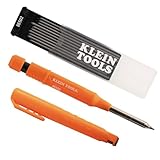


There is no pencil that makes a reliable mark through standing water, mud, or oily grime. Wipe the marking area first. If the timber is saturated, test the pencil on an offcut or an inconspicuous spot before marking a cut line.
Flat, round, and mechanical pencils
A traditional flat pencil is the dependable, low-cost choice for framing and general carpentry. Its broad lead can be sharpened to a chisel-like edge for a fine line, or left broad for a mark that is easy to see from a few feet away. It is awkward to sharpen with a small round-pencil sharpener, though; a knife or purpose-made flat-pencil sharpener is easier to control.
Round carpenter’s pencils feel more like a standard pencil and can be easier to turn in the hand, but they may roll off a bench and often have less material around the lead. Mechanical versions avoid sharpening and keep a consistent point. They suit repeat layout and pocket carry, but spare lead costs more, and a hard push on coarse timber can break the point or jam the mechanism.
For rough, wet framing, start with flat carpenter’s pencils with dark lead. If you make frequent fine marks and can keep the tool protected from grit, consider a mechanical carpenter’s pencil with replacement lead.
Quick comparison
| Type | Wet, rough timber | Fine layout | Main drawback |
|---|---|---|---|
| Flat wood-cased pencil | Good; broad mark is easy to see | Good if sharpened to a narrow edge | Needs sharpening; lead quality varies |
| Round wood-cased pencil | Fair to good | Good when sharpened finely | Can roll; less suited to rough handling |
| Mechanical carpenter’s pencil | Fair; use a robust lead and light pressure | Very good and consistent | Lead can snap or jam; higher upkeep cost |
Choose lead for visibility, not claims
Lead hardness and darkness matter more than a fancy casing. A harder core can keep a point longer but may leave a faint line on damp, textured wood. A softer or darker core tends to show better, but wears faster and can smear. Packaging does not always give a useful hardness rating, so the practical test is simple: make a line on the timber you actually use and check whether it remains visible after handling.
Line width is a trade-off. A broad mark is easy to find on wet, dirty stock, but it can shift a cut by several millimetres if you do not know which edge of the line to follow. For a close-fitting joint, sharpen one face into a narrow edge and mark consistently from that edge. For rough framing cuts, a broader line is usually easier to read.
On very wet wood, pencil marks can feather or fade as water spreads through the surface. Pressing harder is not a good fix: it can break the lead, crush soft fibres, and leave a groove that misleads the saw. Dry a narrow strip with a rag and use a light, controlled stroke instead.
Sharpening and marking technique
A knife gives the most control over a flat pencil. Trim the wood casing in short slices, then shape the lead to a wedge. Keep the broad face of the lead aligned with the line you want to make. A dedicated sharpener is faster for routine sharpening, but check that it produces a point suited to your work; some leave a rounded tip that makes a thick, vague mark.
Carry a spare pencil. On a wet site, a dropped pencil can pick up grit that quickly wears the point or scratches the timber. Keep the pencil in a pocket or tool belt rather than loose in a sawdust-filled pouch. If using a mechanical pencil, carry spare lead in a closed container and clear the tip if it starts to feed unevenly.
Before cutting, identify the waste side of the line and keep the blade on that side. This matters more than making the line exceptionally fine: a visible mark placed consistently gives a better result than a faint line that is easy to lose in wet grain. For repeated measurements, mark an offcut first and compare it with the tape or square.
What to buy for your work
If you frame, fit rough timber, or work outside in changing weather, a pack of inexpensive flat pencils is often the sensible buy. They are easy to replace, survive ordinary site use, and give a broad mark that remains readable. The cheapest pack is fine if the leads do not crumble and the marks show on your stock; pay more only if you have tested a particular pencil and found its lead lasts longer or writes more clearly.
Choose a mechanical pencil when accurate, repeated layout and quick point renewal matter more than rough-site toughness. It is a poor choice if you routinely jab marks into coarse, wet timber or leave tools uncovered in a wet pouch. For a mixed kit, keep a flat pencil for framing and a finer-point option for joinery or hardware positions. That combination costs little and avoids asking one pencil to do two different jobs.