What's inside
As an Amazon Associate I earn from qualifying purchases. This post may contain affiliate links at no extra cost to you.
Recording an existing stair angle is a simple job only when the gauge holds its setting and transfers it without movement. A poor bevel gauge can leave you with a riser, skirt board, tread return, or handrail cut that is a few degrees wrong—and on a long stair run, that error becomes obvious. The best tool is not necessarily the most expensive one. It needs a rigid blade, a locking mechanism you can trust, and a stock that references the stair parts cleanly.
As an Amazon Associate we earn from qualifying purchases at no extra cost to you.



Sections
Our Top Picks
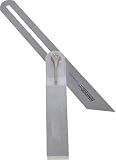
 Johnson Level & Tool 1913-1000 Professional Aluminum T-Bevel10 Inch0.75 x 3.75 x 13.13 inches0.02 poundsCheck on Amazon


What to Look for in a Bevel Gauge
A bevel gauge has two main parts: a stock, which references the edge or face of the work, and a blade, which pivots to match the angle. For recording stair angles, the stock should be long enough to sit flat against the work without rocking. A stock around 5 to 8 inches long is practical for most stair work. Shorter gauges fit in a tool belt but are less stable against wide skirt boards and stringers.
The blade should be stiff enough that it does not flex when you press it into a corner. A thin blade may be adequate for light trim, but it is less reliable when you are copying the angle between a tread and riser or working against a rough plaster wall. Stainless steel resists rust and is easy to clean, while a thicker carbon-steel blade can feel more rigid but needs occasional protection from moisture.
Pay close attention to the locking screw. A wing nut is quick to adjust and works well with bare hands, but it can loosen if the gauge is bumped. A lever lock is faster and often easier to operate while holding the gauge in position. Some gauges use a knurled thumb screw or brass screw; these provide good control, although they take more turns to tighten.
For a basic, reliable option, compare adjustable bevel gauges for woodworking. The cheaper versions are fine when you are recording one or two angles and checking the setting before every cut.
Which Type Works Best on Stairs?
| Type | Best use | Advantages | Limitations |
|---|---|---|---|
| Traditional sliding bevel | Copying tread, riser, and stringer angles | Simple, inexpensive, versatile | Can shift if the lock is weak |
| Digital angle gauge | Recording and repeating a numerical angle | Shows degrees directly; useful for multiple identical cuts | Needs batteries; requires flat reference surfaces |
| Long bevel gauge | Skirt boards, wide trim, and long miters | More stable over broad surfaces | Less convenient in tight stair corners |
| Small pocket bevel | Quick trim checks and tool-belt work | Compact and fast to carry | Short stock magnifies rocking and alignment errors |
For most carpenters, a traditional sliding bevel is the best first purchase. It records the physical angle directly, so you do not need to know whether the angle is 37.5 or 52.5 degrees. If the new part is held against the same references, the gauge transfers the existing geometry without conversion.
A digital angle gauge is useful when you must make several identical parts in a shop or communicate the angle to another person. Search for a digital angle finder for woodworking if that is your workflow. It is not automatically more accurate. Dust, a rounded edge, or a slightly tilted gauge can produce a precise-looking number that is still wrong.
How to Record an Existing Stair Angle
First, clean the contact surfaces. Remove loose paint, plaster lumps, adhesive, and sawdust where the gauge will sit. A bevel gauge records the angle between the surfaces it touches, including any dirt or damage. On an old staircase, this preparation can matter more than buying a premium tool.
Loosen the lock enough for the blade to move freely. Place the stock against the most important reference surface—usually the face of a riser, the edge of a tread, or the wall-side edge of a stringer. Swing the blade until it contacts the second surface. Do not force it into a concave corner; that can bend a thin blade or lift the stock away from its reference.
Hold the stock firmly with one hand and tighten the lock with the other. Then remove the gauge without allowing the blade to slide. Mark the setting with a pencil line or take a quick photograph showing which side of the stock faced up. This matters because a bevel gauge can be flipped and produce the supplementary angle. A 38-degree setting and a 142-degree setting describe the same pair of lines but are not interchangeable when laying out a cut.
For repeated work, transfer the angle to a scrap board first. Mark the cut, make a test piece, and check it in the actual stair opening. A test piece 150 to 250 mm (6 to 10 inches) long is usually enough to reveal a bad fit without wasting a full-length skirt board.
Accuracy, Locking, and Common Failure Modes
The most common failure is lock movement. If the blade shifts even 1 degree, the end of a 12-inch-wide board can move roughly 0.2 inch. That is enough to create a visible gap at a stair skirt or a handrail return. After tightening, press lightly on the blade to confirm it does not move. If it does, inspect the pivot, washer, and locking screw rather than trusting the setting.
Another problem is measuring from different surfaces. If you record the angle from the front of a tread but cut from its underside, the result may differ because stair parts are rarely perfectly square. Choose the exact faces that will meet and use those faces for both recording and cutting.
For a long skirt board, a long sliding bevel gauge for carpentry can reduce rocking. However, do not assume length alone improves accuracy; the stock must remain flat and the blade must be parallel to the intended cut line.
How Much Should You Spend?
A basic metal sliding bevel in the low-cost range is sufficient for occasional stair repairs, especially if you verify every setting with a test cut. Spending more generally buys a smoother pivot, a stronger stock, better machining, and a lock that holds under repeated use. Those improvements are worthwhile for site carpenters who record angles every week, but they do not compensate for dirty reference surfaces or incorrect orientation.
Choose a traditional sliding bevel for direct copying, a digital gauge for documenting several numerical angles, and a longer gauge for wide boards. Whichever style you buy, favor a rigid stock and a lock you can tighten securely without shifting the blade. Those two details prevent more stair-fitting mistakes than extra scales, markings, or electronic features.