What's inside
As an Amazon Associate I earn from qualifying purchases. This post may contain affiliate links at no extra cost to you.
Sections
Best air compressor for the money: the short answer
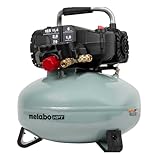
For most home woodworking shops, the best air compressor for the money is a 6-gallon, 150-PSI pancake compressor: it’s affordable, portable, and well suited to brad and finish nailers, staplers, and occasional inflation. If you’ll spray finishes or run an air-hungry tool for more than short bursts, spend more on a quiet, larger-tank model with higher delivered airflow—or choose a stationary compressor sized to the tool.
Price alone can mislead. Tank capacity determines how long you can draw air before pressure drops; CFM (cubic feet per minute) indicates how well a compressor can keep up; noise and weight affect where you’ll tolerate using it. The useful comparison is therefore not simply dollars per gallon, but whether the compressor can support your tools without constant recovery pauses.
As an Amazon Associate we earn from qualifying purchases at no extra cost to you.



Comparing good-value compressor types
The figures below are representative specifications for established models, rounded where appropriate. CFM figures are at 90 PSI when available. Retail pricing changes by seller and season, so the ranges are general market estimates, not guaranteed current quotes.
| Compressor | Tank | Airflow at 90 PSI | Weight | Noise | Typical price range | Best fit |
|---|---|---|---|---|---|---|
| PORTER-CABLE C2002 pancake | 6 gal | 2.6 CFM | About 31 lb | About 82 dBA | $100–$180 | Budget trim work, stapling, and inflation |
| DEWALT DWFP55126 pancake | 6 gal | 2.6 CFM | About 30 lb | About 75.5 dBA | $150–$250 | Portable trim work where lower noise matters |
| California Air Tools 8010 | 8 gal | 2.2 CFM | About 48 lb | About 60 dBA | $250–$400 | Indoor shops and noise-sensitive work |
| California Air Tools 10020C | 10 gal | 5.3 CFM | About 82 lb | About 70 dBA | $450–$700 | More frequent use and higher airflow demand |
Specifications can vary by revision and measurement method. Check the exact model’s manual before buying, especially if a tool has a demanding airflow requirement. Noise figures are manufacturer-reported; distance, room acoustics, and surface placement affect what you hear.
Choose by the work you actually do
Best value for occasional trim and finish nailing
A 6-gallon pancake model is the sensible starting point for most DIY woodworkers. Brad nailers, finish nailers, and narrow-crown staplers use air in brief bursts, so they don’t need the continuous output demanded by sanding or spraying. A PORTER-CABLE C2002 keeps the entry cost down; the DEWALT DWFP55126 is worth considering if the compressor will operate near people or inside the shop, where its lower reported noise is a meaningful comfort advantage.
Neither is quiet in the way a refrigerator is quiet: compressors still make a sharp mechanical sound while filling the tank. They are portable enough to move between a garage, jobsite, and storage shelf, but their limited airflow means frequent cycling during sustained use.
Best for a small indoor shop
The California Air Tools 8010 trades some portability and airflow for substantially lower reported noise. Its 8-gallon tank gives a little more reserve than a pancake compressor, but its 2.2 CFM at 90 PSI is not an upgrade for continuous-demand tools. It is a better match for intermittent nailing and inflation when compressor noise is the deciding factor.
Best when airflow matters more than easy carrying
The California Air Tools 10020C offers more than twice the 90-PSI airflow of the 8010 and a larger tank. That makes it more capable for repeated tool use, though it weighs roughly 82 pounds and is no longer an easy one-handed carry. For regular spraying or other sustained applications, compare the tool’s required CFM with the compressor’s delivered CFM and consider a larger stationary unit if the compressor cannot keep up.
Match compressor output to the tool
Look at the tool’s air requirement at its working pressure—not just the compressor’s maximum PSI. PSI is pressure; CFM is volume. A compressor may reach 150 PSI yet still fail to supply enough air for a tool that continuously demands more volume than the pump can deliver.
- Brad and finish nailers: Low average air use because each shot consumes a small burst. A pancake compressor is usually adequate for one nailer at a time.
- Framing nailers and staplers: Still intermittent, but rapid firing and multiple tools can make a small tank cycle more often.
- Blow guns and inflation: Fine for short tasks; long, unrestricted blowing can drain a small tank quickly.
- Spray guns, air sanders, and grinders: Often require sustained airflow. Check the tool’s stated CFM and allow a margin; a small portable unit may run continuously without maintaining pressure.
How much tank capacity do you need?
A larger tank stores more compressed air, so it can reduce how often the motor starts during short bursts. It does not increase the compressor’s long-term air production. If a tool consumes air faster than the pump supplies it, a larger tank only delays the pressure drop; it does not solve the mismatch.
For example, when comparing two compressors rated at 2.6 CFM at 90 PSI, the one with a 10-gallon tank will generally have more reserve than a 6-gallon model. But once that reserve is used, both depend on the same rated airflow to recover. This is why a larger tank can improve comfort during intermittent work, while a higher-CFM pump is the more important upgrade for sustained work.
Ownership costs that are easy to overlook
Oil-free compressors need no pump oil changes, making them convenient for occasional shop use, but their pump components can wear and may be difficult or uneconomical to repair on inexpensive models. Oil-lubricated units require periodic oil checks and changes, yet can be a worthwhile choice for frequent use if the manufacturer supports maintenance and replacement parts.
Moisture is another routine concern. Compressed air cools in the tank, allowing water to collect inside. Drain the tank after use, especially in humid conditions, and follow the manual’s instructions. Neglecting drainage encourages internal corrosion; water in the air line can also interfere with finishing work. For spraying, use suitable filtration and moisture control rather than assuming the tank drain alone will provide dry air.
Other practical costs include a regulator, compatible hose and fittings, and hearing protection for louder models. Keep the intake unobstructed, avoid running the compressor in an unventilated enclosure, and use an extension cord only if its gauge and length meet the manufacturer’s requirements. An undersized cord can cause poor starting and excess heat.
Quick decision guide
| Your situation | Best-value direction | Why |
|---|---|---|
| Occasional DIY trim, tight budget | 6-gallon pancake compressor | Low purchase cost and enough output for intermittent nailer use |
| Indoor work, noise-sensitive household | Quiet 8-gallon model | Lower reported operating noise; suitable for burst-use tools |
| Frequent nailing, fewer recovery pauses | Higher-airflow model with a larger tank | More reserve and better replenishment between bursts |
| Regular spraying or continuous air tools | Compressor selected by tool CFM, often stationary | Delivered airflow matters more than tank size alone |
For the typical woodworking beginner, a 6-gallon pancake compressor remains the strongest value if the job is mainly finish nailing. Pay extra for quiet operation when the compressor will run indoors, and pay for airflow—not merely a larger tank—when your tools consume air continuously.