
Key takeaways
- Pull, tension and lift heavy loads with the best come-along winches: cable and rope pullers in 2 to 5 ton capacities for fences, logs and vehicle recovery.
What's inside
- Quick Answer
- How to Choose a Come-Along Winch
- 1. YATOINTO Come Along Winch 2 Ton
- 2. VEVOR Come Along Winch 2 Ton
- 3. Maasdam A-100 Pow’R Pull Rope Puller
- 4. VEVOR Come Along Winch 5 Ton
- 5. TEKTON 5547 4-Ton Dual Gear Power Puller
- Who Should Skip These Pullers
- Final Verdict
- Frequently Asked Questions
- Product and ASIN Reference
As an Amazon Associate I earn from qualifying purchases. This post may contain affiliate links at no extra cost to you.
A come-along is a hand-powered winch that pulls, tensions and lifts heavy loads without a motor, a battery or a power outlet. One person working a lever can drag a log, straighten a leaning fence post, tension a wire fence, or pull a stuck vehicle out of a ditch.
The five pullers below cover the range most owners need, from a 2-ton cable puller for fence and yard work to a 5-ton model for heavier recovery, plus a rope puller that trades tonnage for reach. Read the capacity figures with care: the box number is often a maximum pull figure, while the safe working load is the number to plan around.
As an Amazon Associate, we earn from qualifying purchases.
Sections
- Quick Answer
- How to Choose a Come-Along Winch
- 1. YATOINTO Come Along Winch 2 Ton
- 2. VEVOR Come Along Winch 2 Ton
- 3. Maasdam A-100 Pow’R Pull Rope Puller
- 4. VEVOR Come Along Winch 5 Ton
- 5. TEKTON 5547 4-Ton Dual Gear Power Puller
- Who Should Skip These Pullers
- Final Verdict
- Frequently Asked Questions
- Product and ASIN Reference
Quick Answer
A 2-ton cable puller covers most fence, log and vehicle recovery jobs, while a 5-ton model suits heavier loads and a rope puller wins on reach. The five pullers below cover 2 to 5 ton capacities with cable or rope lines, dual-gear ratchets and safety-latch hooks. Match the working load to the job, check the line length, and confirm each listing is live before ordering.
How to Choose a Come-Along Winch
Capacity and working load
Capacity is the first number to settle, and the easiest to misread. A puller rated at 4 tons may carry a safe working load of 2 tons on a single line, with the larger figure applying only when the cable is doubled back through a pulley. Plan every job against the safe working load and keep a margin below it. A 2-ton puller handles most fence tensioning, log dragging and light recovery, while a 4 or 5-ton puller suits heavier logs and larger vehicles. Never lift a person, and never lift overhead unless the maker states a lifting capacity for that use.
Cable or rope
Cable pullers wind a steel cable on a drum, which keeps the tool compact and the line short, usually 6 to 12 feet. Rope pullers feed rope through the mechanism instead, so the reach can run to 100 feet or more. Cable suits short, hard pulls where the anchor sits close to the load. Rope suits long fence lines and tree work, and it is lighter and kinder to bark and paint.
Reach and line length
Measure the distance from the anchor point to the load before buying, and remember that a cable puller loses usable length as the cable winds onto the drum. A 12-foot cable gives more choice of anchor point than a 7-foot cable when the ground near a stuck vehicle offers nothing solid. A rope puller removes the problem by pulling the full rope length through the mechanism, which is why the Maasdam below can work a fence line end to end without a reset.
Gears, pawls and hooks
Dual-gear ratchets spread the force across two gears and two pawls, which makes each stroke smoother and holds the load more securely between strokes. Look for a pawl release that works with gloved hands, and a ratchet guard that keeps grit out of the gears. Hooks should be drop-forged steel with self-closing safety latches, so the line cannot slip off mid-pull. Three hooks allow double-line rigging, which doubles the force while halving the travel.
Handle, weight and build
A longer handle gives more leverage and less effort per stroke, with 21 inches a common length on heavier models. A cushioned, non-slip grip matters on a long pull, since bare steel gets slick with sweat and hard on the hands. Weight runs from about 6 pounds on a light 2-ton puller to about 14 pounds on a rope puller with 100 feet of rope, so think about how far the tool must be carried. Galvanized steel resists rust, and a one-piece gear design resists jamming better than a stack of thin laminations.
1. YATOINTO Come Along Winch 2 Ton

The YATOINTO is the most versatile 2-ton puller in this guide, and the one to buy first when a single tool must cover fence work, yard jobs and light recovery. It pulls 2 tons, or 4,400 pounds, through a dual-gear ratchet that spreads the force evenly and lets one hand work the lever. Two lifting slings come in the box: a sling wraps around a post, a log or a bumper without a separate strap. The steel cable runs 6.56 feet with two hooks, and the tool is built from heavy-duty steel with a corrosion-resistant finish. One caution: the latest crawl of this listing showed no featured offers, so confirm the listing is live before ordering.
Specs
- Capacity: 2 ton (4,400 lb) pulling; Cable: 6.56 ft steel cable; Slings: two 1 in x 8 ft lifting slings; Gears: dual-gear ratchet; Hooks: 2 with self-closing safety latches; Model: YJRP-2T-2D; Weight: 9.68 lb; ASIN: B0D4Q5PLJQ
2. VEVOR Come Along Winch 2 Ton

The VEVOR 2-ton puller is the best choice when reach matters more than extras, since its 12-foot steel cable is the longest in the 2-ton class here. It pulls 2 tons, or 4,409 pounds, through a one-piece dual-gear structure that resists jamming, with an anti-reverse mechanism that holds the load with no backtracking between strokes. The extended handle works one-handed, the grip is rubberized, and the hooks carry spring latches. At 6.39 pounds it is the lightest puller in this guide, which counts when the tool rides in a truck bed or gets carried across a field. The box carries no lifting slings, so add a strap when the load has nothing to hook onto.
Specs
- Capacity: 2 ton (4,409 lb) pulling; Cable: 12 ft steel cable; Gears: one-piece dual-gear ratchet with anti-reverse mechanism; Hooks: 2 with spring latches; Handle: extended, rubberized grip; Model: JX20; Weight: 6.39 lb; ASIN: B0DX6ZV1TX
3. Maasdam A-100 Pow’R Pull Rope Puller

The Maasdam A-100 is not a cable come-along at all: it is a rope puller, which trades tonnage for the one thing cable cannot give, which is reach. Feed it up to roughly 100 feet of half-inch rope and it pulls the whole length at 3/4 ton, or 1,500 pounds, which makes it the fence-line, tree-work and long-driveway tool. The rope is highway-approved Dacron polyester, supplied in a 100-foot length, and the mechanism can take an unlimited length of rope. The build follows the classic Maasdam pattern: a one-piece, precision-cast aluminum alloy ratchet wheel, interlocking steel alloy pawls, a cold-rolled steel frame and handle, and drop-forged steel slip hooks with safety latches. The A-100 is a pulling tool only, not a hoist, so do not use it to hang a load overhead.
Specs
- Capacity: 3/4 ton (1,500 lb) pulling; Line: rope puller, 100 ft of 1/2 in Dacron polyester rope; Leverage: 10:1; Ratchet: one-piece aluminum alloy wheel, steel alloy pawls; Hooks: drop-forged steel slip hooks with safety latches; Model: A-100; UPC: 732454493007; Weight: 14.31 lb; ASIN: B000PWJTC8
4. VEVOR Come Along Winch 5 Ton

The VEVOR 5-ton puller is the heavyweight of this guide, built for the pulls that stop a 2-ton tool cold. It pulls 5 tons, or 11,023 pounds, on an 11.5-foot steel cable, with three hooks and a dual-gear ratchet with an anti-reverse mechanism. The longer cable and third hook allow double-line rigging for the hardest jobs, and the one-piece dual-gear structure keeps the pull smooth and jam-free under load. At 13 pounds it is a substantial tool, and it earns its weight on large vehicles, heavy logs and stubborn stumps. The 5-ton figure is a pulling figure, so plan the job against it as a drag load and keep a margin below it. The listing is live in the United States through the maker store and a national retailer, both showing stock, so check it again before ordering.
Specs
- Capacity: 5 ton (11,023 lb) pulling; Cable: 11.5 ft steel cable; Gears: one-piece dual-gear ratchet with anti-reverse mechanism; Hooks: 3 with spring latches; Part number: GSSJXQ-5 Ton; Weight: 13 lb; ASIN: B0CH3RGLGX
5. TEKTON 5547 4-Ton Dual Gear Power Puller
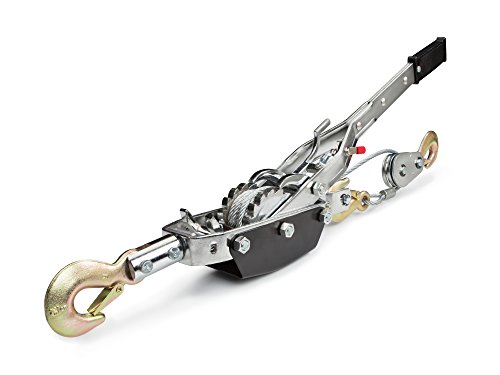
The TEKTON 5547 is the heavy end of the honest budget class, and the pick for anyone who wants a strong cable puller without paying for a premium brand. It carries a 4-ton maximum rated capacity, or 8,000 pounds, with a safe working load of 4,000 pounds on a single line, and TEKTON prints both numbers. Doubling the cable through a pulley doubles the pull to the 8,000-pound maximum while halving the travel. The build is all steel with a corrosion-resistant galvanized finish, a 21-inch handle with a cushioned, non-slip grip, and a quarter-inch aircraft-grade braided steel cable running to 12 feet 7 inches. Dual gears and locking pawls distribute the force evenly, and three hooks with self-closing safety latches allow single or double-line rigging. One caution: the tracker for this listing was last updated 8 months ago, so confirm the listing is live before ordering.
Specs
- Capacity: 8,000 lb maximum rated, 4,000 lb safe working load (single line); Cable: 1/4 in aircraft-grade braided steel, 12 ft 7 in; Gears: dual-gear ratchet with locking pawls; Hooks: 3 with self-closing safety latches; Handle: 21 in, cushioned non-slip grip; UPC: 020209055472; Weight: about 13 lb; ASIN: B000NPPBHO
Who Should Skip These Pullers
Skip the whole group when the job needs a powered winch. A come-along moves a load a few feet at a time with lever strokes, so a long drag across a field or a repeated daily pull belongs to an electric or hydraulic winch, not a hand tool. Skip them for overhead lifting above people or property unless the maker states a lifting capacity for that exact use, since most of these pullers are rated for pulling only. Skip the 5-ton VEVOR for light fence work or small yard jobs, since a 2-ton puller is easier to carry and quicker to rig. Skip the Maasdam when the pull is short and heavy, since 3/4 ton will not move a load that needs 2 tons. Anyone who needs a chain hoist, a lever hoist, or a snatch block should buy those tools instead, since this guide covers hand cable and rope pullers only.
Final Verdict
For most owners, the YATOINTO 2-ton puller is the best first come-along: it covers fence work, log dragging and light recovery, and the two slings in the box solve the attachment problem that slows down most jobs. Buy the VEVOR 2-ton when a longer cable matters for a stuck vehicle or a long fence run. Buy the Maasdam A-100 when reach is the whole job, since 100 feet of rope pulls a fence line end to end without a reset. Buy the VEVOR 5-ton for the heaviest pulls, and the TEKTON 5547 when a strong cable puller at a budget figure is the priority, planning every job against the 4,000-pound safe working load. Whichever puller fits, anchor to a rated point, inspect the line before every pull, and confirm the listing is live before ordering.
Frequently Asked Questions
What size come-along do I need for fence work?
A 2-ton cable puller handles most fence tensioning, including straightening leaning posts and pulling wire taut between posts. Choose the Maasdam rope puller when the fence line is long, since 100 feet of rope works the whole run without moving the anchor. Move up to a 4 or 5-ton puller only when the posts sit in concrete.
Can a come-along lift a load overhead?
Most come-alongs are rated for pulling, not lifting, and the two figures are different. A puller rated at 4 tons for dragging may carry a safe working load of 2 tons, and neither figure allows lifting above people. Only lift overhead when the maker states a lifting capacity for that exact use, and never lift a person with a hand puller.
What is the difference between a cable puller and a rope puller?
A cable puller winds a steel cable on a drum, which keeps the tool compact but limits reach to the cable length, usually 6 to 12 feet. A rope puller feeds rope through the mechanism, so the reach equals the rope length, which can run to 100 feet or more. Cable suits short, hard pulls, while rope suits long fence lines.
How do I keep a come-along in working order?
Inspect the cable or rope before every pull and retire any line with broken strands, kinks or fraying. Keep the gears clean and lightly oiled, work the pawls to check they engage and release freely, and store the tool dry so the steel does not rust. Replace a hook with a bent tip or a broken safety latch, since the hook holds the whole pull.
Product and ASIN Reference
| Product | ASIN |
|---|---|
| YATOINTO Come Along Winch 2 Ton | B0D4Q5PLJQ |
| VEVOR Come Along Winch 2 Ton | B0DX6ZV1TX |
| Maasdam A-100 Pow’R Pull Rope Puller | B000PWJTC8 |
| VEVOR Come Along Winch 5 Ton | B0CH3RGLGX |
| TEKTON 5547 4-Ton Dual Gear Power Puller | B000NPPBHO |
Related guides
More from Amazon
Programs that pair well with the guide above. Offers and eligibility are set by Amazon and may change.
A free business account with business pricing and bulk-buying tools for work, shop or home office.
Create a business accountFree shipping on eligible items, Prime Video and more. Eligible new members can start with a free trial.
Start a Prime free trialAudiobooks and podcasts to listen to on the go. Eligible new members can start with a free trial.
Try Audible freeAd-free music streaming. Eligible new subscribers can start with a free trial.
Try Music Unlimited freeAs an Amazon Associate we earn from qualifying purchases.

Write Your Review
No reviews yet. Be the first to share your experience!