What's inside
- Top 3 Picks
- Quick Comparison
- How We Chose
- 1. YEQIN Thick Material Walking Foot #672580-FBD10 Gliding Foot – Best for Budget Leather and Canvas on a Home Machine
- 2. HONEYSEW Open Toe Walking Foot with Guide – Best for Quilting and Visible-Seam Topstitching
- 3. YEQIN 5-Piece Industrial Rolled Hem Presser Foot Set – Best for Hemming Canvas, Denim, and Light Leather
- 4. CKPSMS 6-Set Piping Walking Feet – Best for Piping and Welted Upholstery Seams
- 5. Consew Upholstery Walking Foot Industrial Sewing Machine with Table and Servo Motor – Best Overall for Heavy Materials
- Top 3 Picks
- Quick Comparison
- How We Chose
- 1. YEQIN Thick Material Walking Foot #672580-FBD10 Gliding Foot – Best for Budget Leather and Canvas on a Home Machine
- 2. HONEYSEW Open Toe Walking Foot with Guide – Best for Quilting and Visible-Seam Topstitching
- 3. YEQIN 5-Piece Industrial Rolled Hem Presser Foot Set – Best for Hemming Canvas, Denim, and Light Leather
- 4. CKPSMS 6-Set Piping Walking Feet – Best for Piping and Welted Upholstery Seams
- 5. Consew Upholstery Walking Foot Industrial Sewing Machine with Table and Servo Motor – Best Overall for Heavy Materials
As an Amazon Associate I earn from qualifying purchases. This post may contain affiliate links at no extra cost to you.
Best overall for heavy materials: the Consew Upholstery Walking Foot Industrial Sewing Machine with Table and Servo Motor. It is the only pick in this guide that arrives as a complete, ready-to-run walking-foot setup — head, table, stand, and servo motor — and it suits anyone sewing leather, canvas, webbing, or upholstery at production pace, where layer shifting is the enemy. If you already own a home or industrial machine and just need the walking-foot grip, the YEQIN Thick Material Walking Foot #672580-FBD10 is the cheapest way to get top feed onto a Brother, Singer, Janome, or Toyota machine, and the KQZZIV Walking Foot Industrial Sewing Machine with Table Unit is the premium alternative when you want a high-speed head plus a full table unit in one purchase. Everything else here is a presser-foot or accessory change: the right foot solves one specific problem — rolled hems, piping, sticky vinyl, high-speed lockstitch work — while the machine underneath stays the same. Decide first whether you are buying a machine or a foot, and the rest of this guide falls into place quickly.
Sections
- Top 3 Picks
- Quick Comparison
- How We Chose
- 1. YEQIN Thick Material Walking Foot #672580-FBD10 Gliding Foot – Best for Budget Leather and Canvas on a Home Machine
- 2. HONEYSEW Open Toe Walking Foot with Guide – Best for Quilting and Visible-Seam Topstitching
- 3. YEQIN 5-Piece Industrial Rolled Hem Presser Foot Set – Best for Hemming Canvas, Denim, and Light Leather
- 4. CKPSMS 6-Set Piping Walking Feet – Best for Piping and Welted Upholstery Seams
- 5. Consew Upholstery Walking Foot Industrial Sewing Machine with Table and Servo Motor – Best Overall for Heavy Materials
Top 3 Picks
Best Overall: Consew Upholstery Walking Foot Industrial Sewing Machine with Table and Servo Motor
The combination of drop feed, needle feed, and a walking foot (compound feed) is the mechanism that actually solves heavy-material sewing, because all three feed elements move together and hold every layer of the stack. Because it ships with the table unit and a servo motor, there is no stand to source, no clutch motor to swap out, and no mounting hardware to guess at. It is the pick for upholstery shops, marine canvas fabricators, and leatherworkers running 4 oz to 12 oz material all day.
Best Budget: YEQIN Thick Material Walking Foot #672580-FBD10 Gliding Foot
This is a drop-in walking-foot attachment for home machines, not a machine — and that is exactly why it earns the budget slot. For the price of a foot, a home-machine owner gets top-feed grip that stops leather, vinyl, and layered canvas from creeping, without buying a table, a servo motor, or 60 square inches of floor space. It is the right first step for someone testing whether heavy-material work is worth investing in.
Best Premium Alternative: KQZZIV Walking Foot Industrial Sewing Machine with Table Unit
The listing specifies a walking-foot head, a table unit, and a 5,000 rpm top speed — the highest figure in this group and a strong option if your mix is mostly medium-weight canvas, denim, and upholstery fabric rather than thick leather. You get a complete industrial footprint in one purchase and a machine that will not run out of speed on long straight seams. Read the section below on why that rpm number matters before you commit.
Quick Comparison
| Product | Best for | Key specs (as listed / spec class) | Price tier |
|---|---|---|---|
| YEQIN Thick Material Walking Foot #672580-FBD10 | Budget top-feed grip on a home machine | Drop-in walking-foot attachment; part designation 672580-FBD10; stated fit for Toyota, Brother, Singer, Janome; thick-material use | Budget |
| HONEYSEW Open Toe Walking Foot with Guide | Quilting, topstitching, visible seams | Open-toe walking-foot attachment with integrated side guide; multi-layer stitching; Brother-oriented fit | Mid-range |
| YEQIN 5-Piece Industrial Rolled Hem Presser Foot Set | One-pass rolled hems on canvas, denim, light leather | 5 feet in graduated hem widths; screw-on industrial presser-foot mounting; stated fit for Brother, JUKI, most industrial machines | Mid-range |
| CKPSMS 6-Set Piping Walking Feet | Piping and welted upholstery seams | 6-piece set for compound-feed machines; stated fit for Consew 206RB, 225, 226R and JUKI LU-series | Mid-range |
| Consew Upholstery Walking Foot Machine with Table and Servo Motor | Heavy leather, canvas, webbing, marine upholstery at production pace | Compound feed (drop feed + needle feed + walking foot); single-needle industrial lockstitch; servo motor; complete table unit | Premium |
| YEQIN Industrial Ring Roller Foot | Sticky, grippy, and coated materials; tight curves | Roller presser foot; stated fit for Brother, Singer, JUKI and more; industrial mounting | Budget |
| Fbshicung 5-Piece Presser Foot Set for Juki DDL | High-speed single-needle lockstitch machines | 5 presser feet including an S518NS-designation foot; stated fit for Juki DDL-555, DDL-5550, DDL-8500 | Budget |
| KQZZIV Walking Foot Industrial Machine with Table Unit | High-speed production on medium-to-heavy fabric | Walking-foot industrial head; table unit included; heavy-duty build; 5,000 rpm stated top speed | Premium |
How We Chose
This is a desk review of published listing information and well-established category knowledge, not a bench test. The first cut was mechanism: does the item feed material from above the fabric, or does it only change the shape of the contact point? A walking foot, a compound-feed head, and a piping foot that rides the machine’s existing upper feed all belong in a heavy-material guide; a plain zipper foot does not, unless it fills a documented gap on a machine class people actually own.
From there we filtered on fit and upgrade path. Every item had to state the machines it mounts to, because presser feet are not universal — shank type, hinged-versus-snap mounting, and needle system all change what will bolt on. We favored items that serve a machine class readers plausibly have (home machines in the Brother/Singer/Janome/Toyota family, Juki DDL-class lockstitch machines, and Consew/JUKI compound-feed machines) rather than one-off curiosities. Finally we spread the picks across budget, mid-range, and premium tiers, and asked a single question of each: if you outgrow this, where do you go next? A budget walking-foot attachment leads logically to a compound-feed machine; a mid-range piping set leads to a fuller foot kit for the same head. Items that led nowhere did not make the list.
1. YEQIN Thick Material Walking Foot #672580-FBD10 Gliding Foot – Best for Budget Leather and Canvas on a Home Machine
As an Amazon Associate we earn from qualifying purchases at no extra cost to you.

This is the item to buy if you own a home sewing machine, you occasionally sew leather, canvas, denim, or layered upholstery fabric, and you are not ready to give up a table, a dedicated room, or a four-figure budget. It is not a sewing machine. It is a walking-foot attachment — a presser foot with an arm that hooks over the needle clamp so the foot and the needle rise and fall together — and that single mechanical trick is what stops the top layer of a stack from sliding forward while the feed dogs pull the bottom layer.
The listing states fit for Toyota, Brother, Singer, and Janome machines and calls out thick-material use specifically, with the part designation 672580-FBD10. That stated fit is broad, and that is the first thing to check rather than the last. Home-machine walking feet are built around a shank standard — low shank, high shank, or a snap-on adapter — and the attachment has to sit at the right height on the presser bar for the needle to clear the fabric and the fork to engage the needle clamp screw. On the right machine it drops on in a minute. On the wrong one it will not seat properly no matter how the listing reads.
Key specs at a glance
- Type: drop-in walking-foot attachment (presser foot with integrated upper feed arm)
- Part designation: 672580-FBD10
- Stated compatibility: Toyota, Brother, Singer, Janome home machines
- Material target: thick material — leather, canvas, denim, layered upholstery fabric
- Feed type: adds top feed to the machine’s existing drop feed; no needle feed
- Price tier: budget
Where it earns its place
Layer control is the whole point. If you have ever sewn a vinyl cushion and watched the top panel creep half an inch ahead of the bottom one by the end of a seam, you have met the problem this foot solves. It also helps on leather that sticks to a standard presser foot, because the foot’s motion is synchronized with the needle rather than dragging across a stationary sole. And it is genuinely inexpensive — a budget-tier item that costs a small fraction of any industrial setup, which makes it the sensible way to find out whether you enjoy heavy-material work before you commit floor space to it.
What it cannot do is change your machine’s underlying limits. Presser foot lift on a home machine is measured in a few millimeters, needle penetration force is limited by a domestic motor, and stitch length typically tops out around 4 mm. Six ounces of leather is realistic. A doubled 12 oz harness stack is not, no matter which foot is bolted on.
Pros
- Cheapest route to real top-feed grip on a machine you already own
- Stops layer creep on leather, vinyl, and multi-layer canvas
- No table, no motor swap, no dedicated footprint
- Stated fit across the most common home-machine brands
- Easy to remove when you go back to garment sewing
Cons
- Shank-type mismatches are common; broad compatibility claims need verifying against your specific machine
- Does nothing about a domestic motor’s limited punching power
- Bulky attachment can block visibility at the needle
- Not built for production volume — a composite or thin-steel body will not hold tolerance like an industrial foot
- No needle feed, so the most stubborn stacks can still shift
How it compares with the nearest alternative
The HONEYSEW Open Toe Walking Foot with Guide is the direct step up: same category of attachment, mid-range tier, but with the front of the foot cut away so you can see the needle and a side guide to run along the fabric edge. Choose the YEQIN if you want the lowest possible spend and mostly sew straight seams through thick stacks. Choose the HONEYSEW if you topstitch for a living or quilt, where visibility and a consistent seam allowance matter more than a few dollars. If neither solves your problem, the issue is probably the machine, and the Consew compound-feed setup further down is where that conversation ends.
2. HONEYSEW Open Toe Walking Foot with Guide – Best for Quilting and Visible-Seam Topstitching

The open-toe walking foot is the version of the attachment that quilters, bag makers, and anyone who topstitches by eye reaches for first. The mechanism is the same as any walking foot — an upper feed arm synchronized with the needle — but the front of the foot is open rather than closed, which means you can watch the needle land. Add the integrated guide on the side and you have a foot that does two jobs at once: it feeds multiple layers evenly and it gives you a hard edge to run along when you need a consistent distance from a seam.
This is a mid-range attachment, and the price difference over a basic walking foot buys visibility and the guide, not more punching power. It suits the sewer working with quilt sandwiches, layered bag panels, coated fabrics, and mid-weight upholstery cloth on a home machine — work where the layers want to separate but where the material is still within a domestic machine’s comfort zone. The listing is oriented toward Brother machines and quilting and sewing through multiple layers, and the same shank-type caveat that applies to every home walking foot applies here.
Key specs at a glance
- Type: open-toe walking-foot attachment with integrated side guide
- Feed: adds upper feed to the machine’s drop feed; no needle feed
- Best material class: quilt sandwiches, layered canvas, coated fabric, mid-weight upholstery cloth
- Stated orientation: Brother machines, quilting and multi-layer stitching
- Visibility: open toe exposes the needle and the stitch line
- Price tier: mid-range
Where it earns its place
Visibility is not a luxury when you are stitching a line that will be looked at. With a closed-toe foot, the front of the foot sits exactly where you want to look, and you end up leaning around the machine to catch the needle. The open toe removes that problem entirely. The guide is the second benefit: on long straight seams — bag gussets, cushion panels, quilt borders — running the fabric edge against a fixed guide is far more consistent than watching the needle, especially at speed.
It also handles the classic multi-layer problem well. A quilt sandwich of top, batting, and backing is three layers with wildly different friction characteristics, and the top layer is the one that slides. Top feed pins it down. The same applies to a bag panel with interfacing and lining stacked under the needle.
Pros
- Open toe gives a clear view of the needle at the exact moment of stitch formation
- Integrated guide supports repeatable seam allowances on straight runs
- Handles quilt sandwiches and layered panels without creeping
- Useful for decorative topstitching where the seam is meant to be seen
- Mid-range price with no machine upgrade required
Cons
- Open toe contains very thick or very sticky stacks less positively than a closed toe
- The guide can get in the way on tight curves and small-radius work
- Still bounded by home-machine presser foot lift and motor torque
- Shank compatibility must be confirmed before purchase
- Not a substitute for needle feed on stubborn leather stacks
How it compares with the nearest alternative
Against the YEQIN Thick Material Walking Foot #672580-FBD10, this is the more refined tool for the same job. The YEQIN is closed-toe and budget-tier, which makes it the better pick if your material is thick and you mostly want containment plus the lowest price. The HONEYSEW wins on any work where you need to see the needle or hold a consistent margin — quilting, topstitching, bag assembly. If your layers still shift after either foot, you have moved past what a domestic attachment can fix, and the answer is a compound-feed machine with a needle feed, covered in the Consew section below.
3. YEQIN 5-Piece Industrial Rolled Hem Presser Foot Set – Best for Hemming Canvas, Denim, and Light Leather

A rolled hem foot does in one pass what most people do in three: it curls the raw edge of the fabric into a tight roll and stitches it down, so the hem comes out narrow, clean, and identical along its whole length. This YEQIN set bundles five of them, and the reason to buy five rather than one is that rolled hem feet are sized. Each foot has a fixed scroll that determines the finished hem width, and a 3 mm foot will not produce a 6 mm hem. A graduated set lets you match the foot to the project instead of redesigning the project around the foot.
The listing describes these as industrial machine feet compatible with Brother, JUKI, and most industrial machines. That is the important detail: industrial presser feet mount differently from home-machine feet, typically screwing onto a hinged foot bar rather than snapping on, and the mounting style is what you check first. This is a foot set for someone who already has a machine with an industrial-style presser bar. It suits curtain and home-decor work, canvas bags and covers, denim hems, table linens, and light leather edges where a rolled finish looks intentional.
Key specs at a glance
- Set contents: 5 rolled hem presser feet in graduated widths
- Function: folds, rolls, and stitches a narrow hem in a single pass
- Stated compatibility: Brother, JUKI, and most industrial machines
- Mounting class: industrial presser-foot mounting — confirm screw-on hinged versus snap-on before ordering
- Best material class: light-to-medium canvas, cotton duck, denim, voile and sheeting, light leather
- Price tier: mid-range
Where it earns its place
Rolled hems are one of the few finishes where the machine does the hard part. Feeding a raw edge into the scroll while keeping the fabric level takes a little practice, but once it is running, the foot holds the fold width perfectly and the result is a hem that looks factory-made. On long runs — a set of curtains, a stack of napkins, a run of tote bags — the time saving is substantial, because there is no pressing, no second pass, and no pinning.
Having five widths also changes what you can make. A narrow foot on light fabric produces a fine, dress-shirt-style hem; a wider foot on canvas produces a sturdy edge finish that reads as deliberate. Because these are industrial feet, the bodies are steel and hold their scroll geometry far longer than a stamped home-machine accessory.
Pros
- One-pass hemming saves pressing and a second stitching pass
- Five widths cover light sheeting through medium canvas
- Steel industrial construction holds shape under repeated use
- Consistent hem width across long runs, which is hard to achieve freehand
- Useful on curves and gentle bias edges where a rolled edge is wanted
Cons
- Won’t mount on a home machine without the matching presser bar or an adapter
- Heavy canvas and thick leather may not roll cleanly through a narrow scroll
- Requires trimming the edge square first, or the roll goes crooked
- Each foot only makes one width — there is no adjustment
- Slow going on tight inside curves
How it compares with the nearest alternative
The Fbshicung 5-Piece Presser Foot Set for Juki DDL machines is the same idea — a bundle of five industrial feet — but aimed at a different machine class and a different job. The Fbshicung set is general-purpose feet for high-speed single-needle lockstitch machines, while this YEQIN set is a single specialized function in five sizes. If you hem a lot, the YEQIN set is the one; if you need everyday feet with a walking foot elsewhere in the list, the Fbshicung set is. For piping and welted seams rather than hems, the CKPSMS set below is the correct geometry entirely.
4. CKPSMS 6-Set Piping Walking Feet – Best for Piping and Welted Upholstery Seams

Piping feet are one of those tools where the geometry does all the work and there is no improvisation that matches it. A piping foot has a groove or tunnel underneath that the cord rides in, so the fabric wraps snugly around the cord and the needle stitches right up against it. Sew piping without that groove — with a zipper foot, say — and you can get close, but the cord wanders and the finished welt is uneven along its length. This CKPSMS set is built for compound-feed machines, and the listing states compatibility with Consew 206RB, 225, and 226R machines and JUKI LU-series machines, which are the standard heads in upholstery and marine shops.
That machine specificity is the whole story here. These are not home-machine feet. They are sized and shaped for walking-foot industrial machines, where the presser foot and the upper walking foot operate as separate parts that move independently, and a piping set has to account for both. If you own a class-206 or class-LU compound-feed machine and you build cushions, boat interiors, or slipcovers, this is the kind of set that pays for itself on the first welted cushion.
Key specs at a glance
- Set contents: 6 piping/cording feet configured for walking-foot machines
- Stated compatibility: Consew 206RB, 225, 226R; JUKI LU-series
- Machine class: compound-feed (walking foot plus needle feed plus drop feed) industrial machines
- Function: wraps fabric around cord and stitches tight to the welt
- Material class: upholstery fabric, vinyl, marine vinyl, canvas, light-to-medium leather
- Price tier: mid-range
Where it earns its place
Welted seams are the visual signature of upholstery work, and the difference between a welt that reads as professional and one that reads as homemade is almost entirely consistency of the cord line. A piping foot holds that line for you. The six-piece set also means you are not stopping mid-project to order the right width when the cord you have on hand is thicker or thinner than the last roll.
Because these feet are designed for machines where the upper walking foot is a separate component, they work with the feed system rather than fighting it. That matters on a cushion where the piping, the cover fabric, and the boxing strip are all feeding under the needle at once — a stack where a plain foot would let the layers separate and the welt would go wavy.
Pros
- Purpose-built groove geometry produces a straight, tight welt
- Six pieces cover a range of cord diameters without reordering
- Fits the machine classes most upholstery shops already own
- Steel construction tolerates production volume
- Cheaper than buying piping feet one at a time as projects demand
Cons
- Will not fit home machines or Juki DDL-class drop-feed lockstitch machines
- Each foot matches a cord size range, so an unusual cord still needs a new foot
- Requires the machine’s walking-foot mechanism to be properly timed first
- Narrow job scope — these are piping feet, not general-purpose feet
- Correct Consew or JUKI model confirmation is essential before ordering
How it compares with the nearest alternative
The Fbshicung 5-Piece Presser Foot Set for Juki DDL-555, DDL-5550, and DDL-8500 covers the same brand territory but a completely different machine class: DDL machines are high-speed, drop-feed, single-needle lockstitch heads with no walking foot, and they take a different needle system and a different foot mounting. If you have a DDL machine, buy the Fbshicung set. If you have a Consew 206RB or a JUKI LU, the CKPSMS piping set is the correct fit. Buying the wrong one is not a matter of preference; it simply will not mount.
5. Consew Upholstery Walking Foot Industrial Sewing Machine with Table and Servo Motor – Best Overall for Heavy Materials
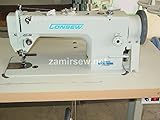
This is the pick that ends the search for anyone sewing heavy material seriously. The listing describes a complete setup — an upholstery-class walking-foot industrial machine with a table and a servo motor, using drop feed, needle feed, and walking foot together. That trio is what the industry calls compound feed or triple feed, and it is the reason upholstery shops use machines in this class rather than anything lighter: the needle, the presser foot, and the feed dogs all move in sync, so every layer in a stack advances by exactly the same amount. Layer creep stops being something you manage and becomes something the machine prevents.
Who it suits is straightforward. Upholstery shops running vinyl, Sunbrella-type acrylic canvas, and upholstery-weight fabric. Marine fabricators building covers, biminis, and cushions where seams take real load. Leatherworkers moving past 6 oz into 8 oz, 10 oz, and 12 oz hides and needing to sew through a fold. Anyone who has hit the ceiling of a home machine and wants the ceiling gone. It is the premium tier of this guide, and the value proposition is not the head alone — it is that the table, stand, and servo motor arrive together, so there is no second order and no compatibility puzzle.
Key specs at a glance
- Mechanism: compound feed — drop feed, needle feed, and walking foot acting together
- Machine class: single-needle industrial lockstitch, upholstery weight
- Motor: servo motor included, mounted on the table unit
- Included: table and stand assembly as a complete unit
- Typical class specs: 135×17 (DPx17) needle system, M-size bobbin, stitch length up to roughly 4-6 mm, presser-foot lift in the 10-13 mm range, working speed typically 2,000-2,500 stitches per minute on heavy material
- Material class: 4-12 oz leather, multi-layer canvas and duck, webbing, marine vinyl, upholstery fabric
- Price tier: premium
Where it earns its place
The servo motor deserves its own paragraph, because it changes daily ownership more than any other single feature. A traditional clutch motor runs continuously at full speed whenever the machine is switched on, with a slipping clutch engaging the head; a servo motor only draws power when it is actually turning the machine, and it typically offers needle positioning so the needle stops up or down on command. That means quieter operation, less heat, a far lower idle electricity draw, and much better control when you are creeping through a corner on thick leather at two stitches per second.
The rest of the package is about capability rather than convenience. An M-size bobbin holds substantially more thread than a home-machine bobbin, which matters when a welted cushion seam can consume meters of top thread. A knee lifter on a table-mounted machine lets you raise the presser foot with your knee while both hands stay on the work — a small thing that becomes essential the first time you turn a corner on a thick leather panel. And the compound feed means the machine can pull a folded seam through webbing without stalling or slipping.
Pros
- Compound feed eliminates layer creep on the heaviest stacks
- Servo motor cuts idle power draw, noise, and heat dramatically
- Complete setup — head, table, stand, and motor arrive as one purchase
- M-size bobbin and 135×17 needle system handle heavy thread and leather points
- Table-mounted format supports knee lift and two-handed work
Cons
- Premium price tier; the single largest spend in this guide
- Requires real floor space — plan on roughly 4 feet by 2 feet of table plus clearance on all sides
- Heavy: a complete setup generally needs two people or a hand truck to move
- Needs daily oiling and periodic timing, belt, and tension service
- Straight stitch only — no zigzag, no decorative stitches, single needle only
How it compares with the nearest alternative
The KQZZIV Walking Foot Industrial Sewing Machine with Table Unit is the other complete premium setup in this guide, and the two are aimed at different sewers. The Consew is the upholstery-class compound-feed machine: slower at the top end, built to push needles through 10 oz leather and folded webbing, and configured with the bobbin and needle system that heavy work needs. The KQZZIV listing emphasizes heavy-duty build and a 5,000 rpm top speed, which points toward a high-speed head better suited to long runs on medium-weight canvas and upholstery fabric. If your material is thick, choose the Consew. If your