What's inside
- Top 3 Picks
- Quick Comparison
- How We Chose
- 1. Dell Pro Thunderbolt 4 Smart Dock SD25TB4 – Best for Dell Fleets and Quad-Display Desks
- 2. Anker Prime TB5 Docking Station – Best for Thunderbolt 5 Laptops With Heavy Port Needs
- 3. Plugable Thunderbolt 4 Dock for M4/M5 MacBook Air & Pro – Best Budget Pick for Apple Silicon
- 4. UGREEN 8-in-1 Thunderbolt 4 Docking Station – Best for Dual-4K Desks on a Mid-Range Budget
- 5. Dell Thunderbolt Dock WD19TBS – Best Budget Pick for Older and Mixed-Brand Fleets
- 6. UGREEN Maxidok Thunderbolt 5 Docking Station – Best Premium Pick for Internal NVMe Storage
- 7. CalDigit TS5 Thunderbolt 5 Dock – Best for Port-Hungry All-Round Desks
- 8. UGREEN 13-in-1 Thunderbolt 4 Docking Station – Best for Filling a Desk With Monitors and Peripherals
- How to Choose
- Frequently Asked Questions
- Which Dock Should You Buy?
- Top 3 Picks
- Quick Comparison
- How We Chose
- 1. Dell Pro Thunderbolt 4 Smart Dock SD25TB4 – Best for Dell Fleets and Quad-Display Desks
- 2. Anker Prime TB5 Docking Station – Best for Thunderbolt 5 Laptops With Heavy Port Needs
- 3. Plugable Thunderbolt 4 Dock for M4/M5 MacBook Air & Pro – Best Budget Pick for Apple Silicon
- 4. UGREEN 8-in-1 Thunderbolt 4 Docking Station – Best for Dual-4K Desks on a Mid-Range Budget
- 5. Dell Thunderbolt Dock WD19TBS – Best Budget Pick for Older and Mixed-Brand Fleets
- 6. UGREEN Maxidok Thunderbolt 5 Docking Station – Best Premium Pick for Internal NVMe Storage
- 7. CalDigit TS5 Thunderbolt 5 Dock – Best for Port-Hungry All-Round Desks
- 8. UGREEN 13-in-1 Thunderbolt 4 Docking Station – Best for Filling a Desk With Monitors and Peripherals
- How to Choose
- Frequently Asked Questions
- Which Dock Should You Buy?
As an Amazon Associate I earn from qualifying purchases. This post may contain affiliate links at no extra cost to you.
Sections
- Top 3 Picks
- Quick Comparison
- How We Chose
- 1. Dell Pro Thunderbolt 4 Smart Dock SD25TB4 – Best for Dell Fleets and Quad-Display Desks
- 2. Anker Prime TB5 Docking Station – Best for Thunderbolt 5 Laptops With Heavy Port Needs
- 3. Plugable Thunderbolt 4 Dock for M4/M5 MacBook Air & Pro – Best Budget Pick for Apple Silicon
- 4. UGREEN 8-in-1 Thunderbolt 4 Docking Station – Best for Dual-4K Desks on a Mid-Range Budget
- 5. Dell Thunderbolt Dock WD19TBS – Best Budget Pick for Older and Mixed-Brand Fleets
- 6. UGREEN Maxidok Thunderbolt 5 Docking Station – Best Premium Pick for Internal NVMe Storage
- 7. CalDigit TS5 Thunderbolt 5 Dock – Best for Port-Hungry All-Round Desks
- 8. UGREEN 13-in-1 Thunderbolt 4 Docking Station – Best for Filling a Desk With Monitors and Peripherals
- How to Choose
- Frequently Asked Questions
- Which Dock Should You Buy?
Top 3 Picks
The best Thunderbolt dock for most people is the CalDigit TS5 Thunderbolt 5 Dock, because its 15-port layout and 240W power supply give you the widest margin for displays, drives, and laptop charging without juggling adapters. If your priority is squeezing maximum value from a Thunderbolt 4 laptop, the UGREEN 8-in-1 Thunderbolt 4 Docking Station is the smarter mid-range pick. For a no-compromise premium setup with Thunderbolt 5 bandwidth and internal SSD expansion, the UGREEN Maxidok Thunderbolt 5 Docking Station is the one to beat.
Quick Comparison
| Product | Best for | Key specs | Price tier |
|---|---|---|---|
| Dell Pro Thunderbolt 4 Smart Dock SD25TB4 | Dell laptop fleets and quad-display desks | USB-C station, 130W charging, up to 4 displays 4K, 2x DP 1.4, HDMI 2.1, 2x Thunderbolt | Budget |
| Anker Prime TB5 Docking Station | Thunderbolt 5 laptops needing many ports | 14-in-1 layout, Thunderbolt 5, laptop charging, multi-display support | Premium |
| Plugable Thunderbolt 4 Dock for M4/M5 MacBook Air & Pro | Apple silicon owners wanting simple charging | Thunderbolt 4, 100W charging, Mac-focused port set | Budget |
| UGREEN 8-in-1 Thunderbolt 4 Docking Station | Dual-4K desks on a mid-range budget | 8-in-1, dual 4K@60Hz, 3x Thunderbolt 4, 40Gbps | Mid-range |
| Dell Thunderbolt Dock WD19TBS | Older Dell and mixed-brand work laptops | 130W power delivery, Thunderbolt dock, business port set | Budget |
| UGREEN Maxidok Thunderbolt 5 Docking Station | Editors needing fast internal storage | Thunderbolt 5, 8TB M.2 NVMe SSD support, high port count | Premium |
| CalDigit TS5 Thunderbolt 5 Dock | Port-hungry all-round desks | 15 ports, 240W PSU | Mid-range |
| UGREEN 13-in-1 Thunderbolt 4 Docking Station | Filling a desk with monitors and peripherals | 13-in-1, dual 4K@60Hz, 3x Thunderbolt 4, 40Gbps | Mid-range |
How We Chose
We selected these docks by comparing published specifications across four categories that determine whether a dock actually fits a desk: port selection, display support, charging wattage, and laptop compatibility. We grouped candidates by price tier rather than by brand, then checked each one against the realities of real setups. A dock that offers 40Gbps Thunderbolt 4 links but only charges a 16-inch workstation laptop at 90W is a poor match even if its port count looks impressive. A dock with Thunderbolt 5 bandwidth but no upstream host support on your machine is overkill.
Our criteria were:
- Specification clarity — we favored docks whose listings state concrete refresh rates, resolutions, and charging wattages rather than vague “4K ready” claims.
- Category fit — budget docks should still drive at least one high-refresh monitor and charge a mainstream laptop; premium docks should justify their tier with bandwidth or storage expansion.
- Use case — we matched docks to scenarios: multi-monitor productivity, video editing with scratch storage, hot-desking with a single cable, and travel-adjacent hybrid work.
- Upgrade path — a dock should survive at least one laptop generation. Thunderbolt 5 models with backward compatibility to Thunderbolt 4 and USB4 hosts scored higher than models locked to a single vendor ecosystem.
We did not test, benchmark, or own these products in a lab. Everything below reflects manufacturer specifications, published compatibility notes, and well-established category behavior. Where a listing does not specify an exact figure, we describe it by spec class instead of inventing a number.
1. Dell Pro Thunderbolt 4 Smart Dock SD25TB4 – Best for Dell Fleets and Quad-Display Desks
As an Amazon Associate we earn from qualifying purchases at no extra cost to you.

The Dell Pro Thunderbolt 4 Smart Dock SD25TB4 is the dock to shortlist if you run a Dell business laptop and want to drive an unusually large number of displays from a single cable. Its headline claim — support for up to four 4K displays via two DisplayPort 1.4 outputs, one HDMI 2.1 output, and its Thunderbolt downstream ports — is unusually aggressive for a budget-tier dock. Most docks in this class top out at two external monitors. If your workflow involves trading dashboards, timelines, or reference material across three or four screens, this is one of the few budget options that even attempts it.
Who it suits:
- Dell Latitude, Precision, and XPS owners who want a vendor-matched dock with predictable firmware behavior.
- Analysts, traders, and developers who genuinely use three or more monitors.
- Anyone who needs a mix of DisplayPort and HDMI without buying active adapters.
Key specs:
- Charging: 130W power delivery to the host laptop.
- Display outputs: 2x DisplayPort 1.4, 1x HDMI 2.1, plus Thunderbolt downstream for additional displays.
- Stated display ceiling: up to 4 displays at 4K.
- Thunderbolt ports: 2x Thunderbolt (one upstream to the host, one downstream).
- Form factor: desktop dock with a horizontal footprint.
Strengths:
130W is the sweet spot for charging. A 14-inch business laptop typically pulls 65W to 100W under load, so 130W leaves headroom to charge while running monitors and peripherals. Ten years ago, this wattage was a premium feature; today it sits at budget pricing because the market has moved to Thunderbolt 5. That makes the SD25TB4 a value play: you get last-generation-but-still-fast 40Gbps Thunderbolt 4 bandwidth and a display count that newer budget docks rarely match.
The HDMI 2.1 port is a quiet advantage. HDMI 2.1 supports higher refresh rates and resolutions than HDMI 2.0, which matters if you want a 4K monitor at 120Hz rather than 60Hz. On a productivity desk, that’s the difference between scrolling that feels smooth and scrolling that feels like a slideshow. Pairing HDMI 2.1 with DisplayPort 1.4 also means you can mix a gaming monitor and a color-accurate work panel on the same dock.
Dell’s firmware and driver ecosystem is the other draw. Dell publishes dock firmware updates through its support tools, and the “Smart Dock” naming signals that the dock coordinates with Dell’s power and display management software. On a Dell laptop, that usually means fewer wake-from-sleep display glitches than a third-party dock.
Pros
- Four-display support is exceptional at the budget tier.
- 130W charging covers most 14- and 15-inch business laptops with headroom.
- HDMI 2.1 plus dual DisplayPort 1.4 gives flexible monitor mixing.
- Vendor-matched firmware for Dell laptops.
Cons
- Best experience is on Dell hardware; mixed-brand laptops may see fewer simultaneous displays.
- Thunderbolt 4 bandwidth, not Thunderbolt 5, so it’s a generation behind the premium picks.
- No internal storage bay.
How it compares: against the Dell Thunderbolt Dock WD19TBS, the SD25TB4 is the newer, more display-capable design. The WD19TBS remains the safer pick for older Dell laptops and mixed fleets where you want maximum backward compatibility, but the SD25TB4 wins on display count and port modernity.
2. Anker Prime TB5 Docking Station – Best for Thunderbolt 5 Laptops With Heavy Port Needs

The Anker Prime TB5 Docking Station is a 14-in-1 Thunderbolt 5 dock aimed at people who bought into the newest laptop generation and want the dock to keep pace. Thunderbolt 5 roughly doubles the bandwidth of Thunderbolt 4 in its high-bandwidth mode, and that headroom is what lets a single dock drive multiple high-resolution, high-refresh displays while also feeding fast external storage. If you own a Thunderbolt 5-capable laptop, pairing it with a Thunderbolt 4 dock wastes the host’s best feature.
Who it suits:
- Owners of a Thunderbolt 5 laptop who want one cable for everything.
- Creative professionals running color-graded 4K or high-refresh monitors alongside fast external SSDs.
- Power users who dislike swapping dongles and want a fixed 14-port layout.
Key specs:
- Interface: Thunderbolt 5.
- Port count: 14-in-1 layout.
- Charging: laptop power delivery via the upstream Thunderbolt connection.
- Display support: multi-monitor output over Thunderbolt and video ports.
- Form factor: desktop dock intended to stay put.
Strengths:
The 14-in-1 port count is the practical argument. A 14-port dock typically covers the full furniture of a desk: multiple USB-A peripherals, USB-C accessories, wired network, audio, SD card media, and video outputs. Once you’ve lived with a dock that has enough ports, going back to a 6- or 8-port unit feels like working with one hand tied behind your back. Anker has a strong track record in charging hardware, which matters here — a dock is, in part, a power supply with a networking and display controller attached.
Thunderbolt 5 compatibility is also a future-proofing decision. Thunderbolt 5 docks generally remain backward compatible with Thunderbolt 4 and USB4 hosts, so the Anker Prime TB5 can serve a current laptop and a future replacement. That’s the upgrade path argument: buy the bandwidth once, and the dock outlives at least one laptop cycle.
The main caveat is that Thunderbolt 5’s biggest advantage only materializes on a Thunderbolt 5 host. On an older Thunderbolt 4 or USB4 laptop, this dock runs at the older standard’s ceiling — you still get the ports, but not the bandwidth. That’s fine, but it means paying a premium tier for headroom you may not use yet.
Pros
- 14 ports eliminates most adapter clutter.
- Thunderbolt 5 bandwidth future-proofs the purchase.
- Anker’s power-supply expertise is a real asset for a dock’s charging role.
- Backward compatible with Thunderbolt 4 and USB4 hosts.
Cons
- Premium tier pricing is hard to justify if your laptop is Thunderbolt 4 only.
- Full bandwidth benefits require a Thunderbolt 5 host.
- No internal NVMe bay, unlike the Maxidok.
How it compares: against the UGREEN Maxidok Thunderbolt 5 Docking Station, the two share Thunderbolt 5 status but diverge on philosophy. The Anker leans on port count and charging heritage; the Maxidok leans on internal M.2 NVMe storage expansion. If you need fast scratch storage inside the dock, the Maxidok wins. If you just want the most ports per cable, the Anker has the edge.
3. Plugable Thunderbolt 4 Dock for M4/M5 MacBook Air & Pro – Best Budget Pick for Apple Silicon
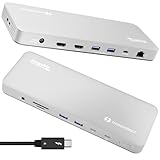
The Plugable Thunderbolt 4 Dock is explicitly positioned for M4 and M5 MacBook Air and MacBook Pro owners, offering 100W charging over a single Thunderbolt 4 cable. Plugable has long been one of the more reliable names in the dock space, and this model is the straightforward answer for Apple silicon users who want a Mac-friendly port expansion without paying premium prices.
Who it suits:
- MacBook Air or MacBook Pro owners who want one cable for charging, displays, and peripherals.
- Students and home-office users who don’t need Thunderbolt 5 bandwidth.
- Anyone who wants a dock whose compatibility notes explicitly name their laptop generation.
Key specs:
- Interface: Thunderbolt 4.
- Charging: 100W over the upstream connection.
- Display support: multi-monitor output appropriate to Apple silicon’s capabilities.
- Port set: Mac-oriented mix of USB, video, and networking.
- Form factor: compact desktop dock.
Strengths:
The 100W charging figure is well matched to Apple silicon. A 14-inch MacBook Pro ships with a charger in the 70W to 96W range depending on configuration, and a 16-inch model can pull more. 100W covers the smaller machines comfortably and keeps the larger ones topped up under moderate load. Paying more for 130W or 140W on a MacBook Air is wasted money — the Air will simply cap its draw.
Explicit M4/M5 compatibility naming is more valuable than it sounds. Apple silicon has specific display limitations: base M-series chips historically drive fewer external displays than Pro and Max variants. A dock that’s validated against these machines saves you the trial-and-error of discovering that your dual-monitor plan won’t work on a base chip. Plugable also publishes compatibility documentation and firmware updates, which reduces the “why did my monitor go black after sleep” problem that plagues cheap hubs.
Thunderbolt 4 at 40Gbps is plenty for a mainstream desk. Unless you’re editing 8K footage off an external NVMe array, you won’t notice the difference between Thunderbolt 4 and Thunderbolt 5 in daily use. That’s the core argument for this dock as the budget pick: buy the standard your workflow saturates, not the one with the bigger number.
Pros
- 100W charging is right-sized for Apple silicon laptops.
- Explicit M4/M5 compatibility reduces setup guesswork.
- Plugable’s documentation and firmware support are above average.
- Budget-tier pricing for full Thunderbolt 4 bandwidth.
Cons
- Thunderbolt 4 only, so no Thunderbolt 5 bandwidth headroom.
- Apple silicon base chips still limit external display count regardless of dock.
- Fewer ports than the 13- and 14-in-1 docks above it in this list.
How it compares: against the UGREEN 8-in-1 Thunderbolt 4 Docking Station, the Plugable trades one or two ports for Mac-specific validation and a slightly lower price. Mac users should lean Plugable; mixed-OS desks should lean UGREEN for its dual-4K focus.
4. UGREEN 8-in-1 Thunderbolt 4 Docking Station – Best for Dual-4K Desks on a Mid-Range Budget

The UGREEN 8-in-1 Thunderbolt 4 Docking Station is a compact, focused dock built around three Thunderbolt 4 ports at 40Gbps and dual 4K at 60Hz output. It’s the “just enough” dock: eight ports is fewer than the 13-in-1 and 14-in-1 models, but the ports it does have are the right ones for a two-monitor productivity setup.
Who it suits:
- Users with exactly two 4K monitors and a handful of peripherals.
- Anyone who wants full Thunderbolt 4 bandwidth without paying for ports they’ll never use.
- Small desks where a bulky 13-port dock would be overkill.
Key specs:
- Interface: Thunderbolt 4, 40Gbps.
- Port count: 8-in-1.
- Thunderbolt ports: 3x Thunderbolt 4.
- Display support: dual 4K at 60Hz.
- Form factor: compact desktop dock.
Strengths:
Three Thunderbolt 4 ports is unusually generous at this size. Most 8-port docks give you one or two. Three means you can daisy-chain a Thunderbolt SSD and still have a downstream port for a display or another device. Daisy-chaining is the underrated Thunderbolt feature: run one cable from the laptop to the dock, then chain devices off the dock’s downstream Thunderbolt ports rather than running separate cables to each accessory.
Dual 4K at 60Hz is the correct target for office work. 60Hz is the threshold where text rendering and window dragging stop feeling sluggish. Docks that claim 4K but only manage 30Hz are actively unpleasant to use — 30Hz looks like a slideshow when you move a cursor. UGREEN stating 60Hz explicitly is a good sign.
The 8-in-1 limitation is also a virtue for cable management. Fewer ports usually means a smaller chassis and less heat, and heat is the quiet enemy of docks: a dock that runs hot will throttle its charging and, in extreme cases, drop display connections. A leaner dock generally runs cooler than a 14-port unit doing the same job.
Pros
- Three Thunderbolt 4 ports at a mid-range price is strong value.
- Dual 4K@60Hz covers the vast majority of two-monitor desks.
- Compact chassis suits small desks and travel between home and office.
- 40Gbps bandwidth matches Thunderbolt 4 laptops perfectly.
Cons
- Eight ports runs out fast if you have many USB-A peripherals.
- Two displays is the practical ceiling.
- No internal storage expansion.
How it compares: against the UGREEN 13-in-1 Thunderbolt 4 Docking Station, this is the same family with a smaller port count and a lower price. If you regularly plug in five or more USB peripherals, step up to the 13-in-1; if your desk is two monitors and a keyboard, the 8-in-1 saves money and space.
5. Dell Thunderbolt Dock WD19TBS – Best Budget Pick for Older and Mixed-Brand Fleets

The Dell Thunderbolt Dock WD19TBS is the veteran of this list. It offers 130W power delivery, making it one of the few budget-tier docks that can fully charge a power-hungry business laptop over a single cable. It’s a generation older than the SD25TB4, but that older status is exactly why it remains relevant: it’s widely deployed, well documented, and broadly compatible.
Who it suits:
- Offices standardizing on a dock across a fleet of mixed-age Dell laptops.
- Owners of older Thunderbolt 3 or Thunderbolt 4 business laptops.
- Buyers who want a proven design rather than the newest controller.
Key specs:
- Charging: 130W power delivery.
- Interface: Thunderbolt, backward compatible with older Thunderbolt generations.
- Port set: business-oriented mix of USB, video, and networking.
- Form factor: desktop dock with a wedge profile.
- Deployment: widely used in enterprise environments, with published firmware tooling.
Strengths:
130W charging is the headline. Business laptops with discrete graphics or high-wattage CPUs can demand more than 100W during heavy workloads. A 100W dock will charge them, but slowly, or only while idle. 130W keeps the battery climbing even under load. For anyone who runs long video calls, compiles code, or works in CAD all day, that difference shows up as fewer “plugged in, not charging” moments.
Compatibility breadth is the second strength. Because the WD19TBS has been in the field for years, its behavior across Dell generations and even non-Dell Thunderbolt laptops is well understood. Firmware updates are available through Dell’s standard tools, and IT departments know how to deploy and troubleshoot it. If you value predictability over having the newest port layout, this is the safe choice.
The trade-off is age. Its port set predates HDMI 2.1 and Thunderbolt 5, and its display configuration is less ambitious than the SD25TB4’s four-display ceiling. But for a single or dual 4K desk, that doesn’t matter.
Pros
- 130W power delivery at a budget price.
- Very broad laptop compatibility, including older Thunderbolt generations.
- Enterprise-grade firmware updates and documentation.
- Proven, widely deployed design.
Cons
- Older port set; no HDMI 2.1 or Thunderbolt 5.
- Bulky compared with modern compact docks.
- Display ambition is lower than the SD25TB4’s four-screen claim.
How it compares: against the Dell Pro Thunderbolt 4 Smart Dock SD25TB4, the WD19TBS is the conservative choice. Pick the WD19TBS if compatibility with older laptops matters most; pick the SD25TB4 if you want more displays and newer port standards.
6. UGREEN Maxidok Thunderbolt 5 Docking Station – Best Premium Pick for Internal NVMe Storage

The UGREEN Maxidok Thunderbolt 5 Docking Station stands out for a feature almost no other dock in this list offers: support for an internal M.2 NVMe SSD up to 8TB. That turns the dock from a passive port expander into a workstation hub that also holds your fast storage. For video editors, photographers, and anyone who wants a single dock that delivers displays, ports, and speed, this is a genuinely different proposition.
Who it suits:
- Video editors who want a fast internal scratch drive that travels with the dock.
- Photographers handling large RAW libraries who want NVMe speed without an external enclosure.
- Anyone with a Thunderbolt 5 laptop who wants maximum future-proofing.
Key specs:
- Interface: Thunderbolt 5.
- Storage expansion: internal M.2 NVMe SSD bay, supporting drives up to 8TB.
- Charging: laptop power delivery over the upstream connection.
- Display support: Thunderbolt 5 multi-monitor capability.
- Form factor: larger desktop chassis to accommodate the SSD bay.
Strengths:
The integrated SSD bay is the reason to buy this dock. An external NVMe enclosure costs extra, takes up a port and desk space, and adds another cable. A dock with an internal bay consolidates all of that into one box: your laptop connects once, and it sees both the display array and the fast drive. For editors who move between a home desk and an office desk, carrying one dock that contains the working drive is a real workflow simplification.
8TB is a substantial ceiling. Not every M.2 NVMe dock supports drives that large, and listing it explicitly matters because the drive is user-supplied. When choosing an SSD for it, note that NVMe drives come in different lengths, primarily 2280 (the common 80mm size) and shorter 2242 or 2230 variants; some docks only fit one length, so this is worth confirming before purchase.
Thunderbolt 5 bandwidth ensures the internal drive can actually run fast. A high-end NVMe SSD can read data far quicker than Thunderbolt 4’s 40Gbps ceiling allows — Thunderbolt 4 would bottleneck it. Thunderbolt 5’s higher bandwidth narrows that gap, which is why pairing an internal NVMe bay with Thunderbolt 5 makes more sense than putting the same bay in a Thunderbolt 4 dock.
The cost is size and price. A dock with a storage bay is physically larger and costs more than a port-only equivalent. If you don’t need internal storage, you’re paying for a feature you won’t use — in that case, the CalDigit TS5 or Anker Prime TB5 is a better fit.
Pros
- Internal M.2 NVMe bay up to 8TB eliminates an external enclosure.
- Thunderbolt 5 bandwidth keeps the internal drive from bottlenecking.
- Consolidates storage, displays, and ports into one cable.
- Ideal for media workflows that depend on fast scratch storage.
Cons
- Premium price, partly for a feature not everyone needs.
- Larger chassis than port-only docks.
- User must supply and install the SSD separately.
- Full Thunderbolt 5 benefit requires a Thunderbolt 5 host.
How it compares: against the Anker Prime TB5 Docking Station, the key difference is where the speed goes. The Anker spreads its 14 ports across peripherals; the Maxidok concentrates on internal storage. Choose the Maxidok if you want a drive inside the dock, the Anker if you want the widest port array.
7. CalDigit TS5 Thunderbolt 5 Dock – Best for Port-Hungry All-Round Desks

The CalDigit TS5 Thunderbolt 5 Dock is the most complete all-rounder in this list: 15 ports and a 240W power supply. The 240W figure refers to the dock’s internal power supply capacity, which is a different specification from how much it sends to your laptop — but it matters, because a larger PSU means more headroom for charging the laptop while simultaneously powering displays, drives, and peripherals. CalDigit has been making Thunderbolt docks since the earliest generations, and the TS5 represents that accumulated design experience.
Who it suits:
- Power users who want every port they might need on day one and next year.
- Desks running multiple displays, external drives, and many USB peripherals at once.
- Thunderbolt 5 laptop owners who want a dock that won’t need replacing soon.
Key specs:
- Interface: Thunderbolt 5.
- Port count: 15 ports.
- Power supply: 240W internal PSU.
- Charging: high-wattage laptop power delivery.
- Display support: multi-monitor via Thunderbolt 5 and dedicated video outputs.
- Form factor: full-size vertical or horizontal desktop chassis.
Strengths:
The 240W power supply is the differentiator, and it’s worth understanding why. A dock’s PSU has to feed everything: the laptop, the USB peripherals, the card readers, and its own controller. If the PSU is small, the dock has to share its budget — plug in a bus-powered external drive and a couple of phone chargers, and the laptop’s charge rate can sag. A 240W supply gives the dock enough capacity to satisfy every port at once without compromising the laptop’s charging. On a fully loaded desk, that’s the difference between a dock that works and a dock that works reluctantly.
15 ports is the highest count here. That typically covers multiple USB-C and USB-A ports, Ethernet, audio in and out, SD and microSD card readers, and several video outputs. The practical benefit is redundancy: when you have three spare USB-A ports, you stop thinking about which device to unplug. That psychological shift — from managing scarcity to ignoring it — is what premium docks actually sell.
CalDigit’s history in the category matters for a less obvious reason: firmware. Thunderbolt docks depend on firmware to maintain stable display links and proper sleep/wake behavior. Vendors with long track records tend to ship more polished firmware and update it longer. A dock that reliably wakes your monitor on the first try every morning is worth more than one extra port on a spec sheet.
Pros
- 15 ports is the most generous layout in this roundup.
- 240W PSU prevents charging compromises on a fully loaded desk.
- Thunderbolt 5 future-proofs the purchase.
- CalDigit’s category experience generally translates to mature firmware.
Cons
- Mid-range-to-premium pricing; not the cheapest way to get two monitors.
- Large footprint compared with compact docks.
- No internal NVMe bay — storage is external only.
- You pay for ports you may never populate.
How it compares: against the Anker Prime TB5 Docking Station, both are Thunderbolt 5 docks with high port counts (15 vs 14). The CalDigit’s 240W PSU gives it an edge on a heavily loaded desk, where power sharing becomes a real constraint. The Anker counters with its charging-hardware background. Either is a strong premium-tier centerpiece; choose on port layout and PSU headroom.
8. UGREEN 13-in-1 Thunderbolt 4 Docking Station – Best for Filling a Desk With Monitors and Peripherals

The UGREEN 13-in-1 Thunderbolt 4 Docking Station is the middle child of UGREEN’s range: three Thunderbolt 4 ports at 40Gbps, dual 4K at 60Hz, and five more ports of headroom than the 8-in-1 model. It’s for the desk that outgrew a compact dock but doesn’t need Thunderbolt 5.
Who it suits:
- Users with two 4K monitors plus a keyboard, mouse, webcam, headset, and a couple of external drives.
- Thunderbolt 4 laptop owners who want maximum ports at the older standard.
- Anyone whose current hub keeps running out of USB ports.
Key specs:
- Interface: Thunderbolt 4, 40Gbps.
- Port count: 13-in-1.
- Thunderbolt ports: 3x Thunderbolt 4.
- Display support: dual 4K at 60Hz.
- Form factor: desktop dock, larger than the 8-in-1.
Strengths:
13 ports is where a dock stops feeling restrictive. The typical taxonomy of a 13-in-1 layout covers upstream Thunderbolt to the laptop, two downstream Thunderbolt ports, several USB-A ports for legacy peripherals, USB-C for modern accessories, HDMI or DisplayPort for monitors, Ethernet for a wired connection, and audio. That’s the complete anatomy of a desktop, on one cable.
Retaining three Thunderbolt 4 ports keeps daisy-chaining viable. You can hang a Thunderbolt SSD off one downstream port and a display off another, without giving up the dock’s other ports. Daisy-chaining is also how you exceed the dock’s own display outputs: a Thunderbolt monitor with a built-in hub can pass the signal along to a second monitor, effectively adding screens without adding cables back to the dock.
Staying at Thunderbolt 4 keeps the price sensible. The bandwidth difference between Thunderbolt 4 and Thunderbolt 5 is real in benchmarks but invisible in most office work; 40Gbps is enough for dual 4K displays, gigabit networking, and fast external SSDs simultaneously. Choosing Thunderbolt 4 here means paying for ports — the thing you’ll actually notice — rather than bandwidth you’ll rarely saturate.
Pros
- 13 ports covers a fully populated desk.
- Three Thunderbolt 4 ports enable flexible daisy-chaining.
- Dual 4K@60Hz is the right display target for productivity.
- Cheaper than equivalent Thunderbolt 5 docks.
Cons
- No Thunderbolt 5 bandwidth for future hosts.
- Larger and heavier than the 8-in-1 sibling.
- No internal storage bay.
How it compares: against the UGREEN 8-in-1 Thunderbolt 4 Docking Station, this is the same design philosophy with five more ports and a higher price. Buy the 8-in-1 if your desk is two monitors and a keyboard; buy the 13-in-1 the moment you find yourself unplugging one device to plug in another.
How to Choose
Dock shopping goes wrong when people buy by port count alone. The right approach is to work through four criteria in order — charging wattage, display support, port selection, and laptop compatibility — and let each one eliminate candidates until one dock remains. Here’s how to do that with concrete numbers.
Step 1: Match charging wattage to your laptop’s draw
Find your laptop’s original charger wattage. That number is roughly the maximum the machine will pull. Then apply these thresholds:
| Laptop class | Typical charger wattage | Dock charging you need |
|---|---|---|
| Ultraportable / thin-and-light | 45–65W | 65–100W |
| Mainstream 14–15″ business laptop | 65–90W | 100–130W |
| MacBook Pro 14″ | 70–96W | 96–100W (higher won’t hurt) |
| Workstation / gaming laptop with discrete GPU | 130–240W+ | 130W minimum, ideally higher |
A dock that delivers less than your laptop’s charger wattage won’t fail — it will just charge slowly, or hold the battery steady while you work rather than topping it up. If you regularly run heavy loads, aim for a dock that meets or exceeds the original charger. This is why the Dell WD19TBS and SD25TB4, both at 130W, are strong picks for business machines, and why the 100W Plugable is well matched to Apple silicon.
One caution: not every laptop accepts high-wattage charging over a dock. Some vendors restrict fast charging to their own chargers or docks. Check your laptop’s documentation for the maximum USB-C or Thunderbolt power input.
Step 2: Count your displays and check refresh rates, not just resolution
“Supports 4K” is a meaningless claim without a refresh rate. A monitor at 4K and 30Hz is technically 4K but feels broken in daily use — the cursor lags, and text smears when you scroll. Insist on 60Hz minimum for every display you plan to run.
Then work out how many displays your laptop can actually drive. This is the step most buyers skip, and it’s the one that causes the most disappointment:
- Apple silicon base chips (M-series non-Pro/Max): typically limited to one or two external displays depending on the generation and whether the lid is open. A four-display dock won’t change this.
- Apple silicon Pro and Max chips: support multiple external displays; Pro and Max tiers generally handle two to four depending on resolution and refresh rate.
- Intel and AMD laptops with Thunderbolt 4 or USB4: usually support two to four displays, but integrated graphics may cap refresh rates at high resolutions.
- Laptops with discrete graphics: often the highest display ceilings, but the video outputs must route through the right GPU.
Match the dock’s display ceiling to the laptop’s, not the other way around. If your laptop caps at two external monitors, the Dell SD25TB4’s four-display capability is wasted — and the UGREEN 8-in-1’s dual-4K output is a perfect fit.
Step 3: Pick ports by inventory, not by ambition
List every device you plug in on a typical day, then add two spare ports. Common port types and what they’re for:
- USB-A (5Gbps or 10Gbps): keyboards, mice, webcams, older drives, printers. Most desks need two to four.
- USB-C (10Gbps or higher): modern SSDs, phones, some monitors. One or two is generally enough.
- Thunderbolt downstream: high-bandwidth devices — fast SSDs, additional monitors, daisy-chains. Two or three is generous; one is workable if you don’t daisy-chain.
- Ethernet: essential for stable video calls and large file transfers. Prefer 2.5GbE if your network supports it.
- SD / microSD readers: indispensable for photographers; irrelevant otherwise.
- Audio in/out: useful for wired headsets and speakers, increasingly rare on laptops.
- Display outputs (HDMI / DisplayPort): count them against your monitor plan. HDMI 2.1 supports higher refresh at 4K than HDMI 2.0.
A good rule of thumb: eight ports is enough for a two-monitor desk with a keyboard, mouse, and one drive. Thirteen ports is enough for that plus a webcam, headset, card reader, and two spare devices. Fifteen ports means you stop thinking about ports entirely.
Step 4: Verify laptop compatibility before you buy
Three compatibility questions decide everything:
- Does your laptop have Thunderbolt or USB4? A Thunderbolt dock connected to a plain USB-C port may work in a limited mode — often just one display and slower data — or not at all. Look for the Thunderbolt lightning-bolt icon or check the spec sheet.
- Which Thunderbolt generation? Thunderbolt 5 docks are generally backward compatible with Thunderbolt 4 and USB4 hosts, so a Thunderbolt 5 dock is a safe purchase even on an older laptop — you just won’t get Thunderbolt 5 bandwidth. Going the other way is the problem: a Thunderbolt 5 laptop connected to a Thunderbolt 4 dock runs at Thunderbolt 4 speeds.
- Are there vendor-specific requirements? Some docks deliver full functionality only on their own brand’s laptops, and some laptops’ display outputs behave differently with third-party docks. Vendor-matched pairs — Dell laptop with Dell dock, MacBook with a Mac-validated dock — reduce the number of surprises.
Durability and ownership realities
A dock is a long-term purchase, and a few things wear or fail first:
- Cables, not electronics. The upstream Thunderbolt cable takes the most abuse — it’s plugged and unplugged daily, and it bends at the connector. A damaged cable causes display dropouts, charging failures, and intermittent device disconnects. Replace the cable first when troubleshooting.
- Heat and dust. Docks with internal power supplies and storage bays generate heat. Keep them out of direct sun and off carpet, and blow dust out of vents periodically. A dock that runs hot may throttle charging or drop display links.
- Firmware drift. Thunderbolt docks depend on firmware, and updates fix display and sleep bugs. Check the manufacturer’s support page a couple of times a year; feature updates are less common than stability fixes.
- Port wear. USB-A and USB-C ports loosen with hundreds of insertions. If you plug a device in daily, consider leaving a short extension cable permanently attached to reduce strain on the dock’s port.
- Power supply aging. The internal PSU is usually the first electronic component to degrade. Symptoms include the laptop no longer charging at full speed. On docks with external power bricks, the brick is replaceable; on docks with internal supplies, it isn’t, which is one reason a dock with generous PSU headroom (like the CalDigit TS5’s 240W) tends to have a longer useful life.
Common mistakes to avoid
- Buying Thunderbolt 5 for a Thunderbolt 4 laptop and expecting more speed. You’ll pay a premium for bandwidth your host can’t use. Buy Thunderbolt 5 as future-proofing, not as a performance upgrade today.
- Ignoring the display ceiling of the laptop. The dock can’t exceed what the laptop’s graphics can output.
- Assuming every USB-C port is Thunderbolt. They look identical but perform very differently.
- Choosing a dock with too few ports “for now.” The cost of upgrading later exceeds the cost of buying the right port count once.
- Overlooking the internal SSD option. If you were planning to buy an external NVMe enclosure anyway, a dock with an internal bay like the UGREEN Maxidok can be cheaper overall and tidier on the desk.
Frequently Asked Questions
What is the difference between Thunderbolt 4 and Thunderbolt 5 for a dock?
Thunderbolt 4 delivers 40Gbps of bandwidth, supports up to two 4K displays at 60Hz through a single connection, and provides at least 32Gbps of PCIe data tunneling. Thunderbolt 5 raises the bandwidth substantially in its high-bandwidth mode and supports higher refresh rates and resolutions, including multiple high-refresh 4K displays.
Do I need Thunderbolt 5, or is Thunderbolt 4 enough?
For office work, dual 4K monitors, and external SSDs, Thunderbolt 4 at 40Gbps is generally plenty. Thunderbolt 5 pays off if you run multiple high-refresh displays, edit high-bitrate video off fast external storage, or want the dock to outlast your current laptop. If you own a Thunderbolt 4 laptop, spending less on a Thunderbolt 4 dock and putting the savings toward a monitor is usually the better trade.
Can a Thunderbolt dock charge my laptop while running displays and peripherals?
Yes — that’s the point of a dock with a large enough power supply. The dock’s PSU has to cover laptop charging plus all attached devices. A dock with a 130W or higher supply will typically charge a mainstream business laptop while driving two monitors and several peripherals. On a heavily loaded desk, a larger PSU such as 240W provides more headroom so charging doesn’t slow down when every port is in use.
Will a Thunderbolt dock work with a laptop that only has USB-C?
Sometimes, but with limits. Many Thunderbolt docks will function on a plain USB-C port, driving one display and running USB devices at reduced speed. However, full multi-display output and maximum data rates usually require the host to support Thunderbolt or USB4. Check your laptop’s specification for a Thunderbolt or USB4 label before relying on a dock’s full feature set.
Why can my laptop only drive one external monitor even with a multi-display dock?
The limitation is almost always the laptop’s graphics, not the dock. Base Apple silicon chips, for example, historically support fewer external displays than Pro and Max variants. Many thin-and-light laptops with integrated graphics cap at two external screens. The dock can only distribute the video signals the laptop is capable of generating.
Is an internal NVMe SSD in a dock better than an external SSD enclosure?
It depends on how you work. An internal bay consolidates storage into the dock, eliminating a separate enclosure, cable, and port — which is ideal if you move between desks and want your working drive to travel with the dock. An external enclosure is more flexible if you want to swap drives frequently or use the SSD with other machines. Either way, pair NVMe storage with a Thunderbolt 5 dock if you want to avoid the interface bottlenecking the drive.
What wears out first on a Thunderbolt dock?
The upstream cable is the most common failure point, because it’s flexed and reconnected daily. Display dropouts and charging problems often trace back to a worn or damaged cable rather than the dock itself. After cables, the internal power supply is typically the first electronic component to degrade with age, followed by mechanical wear on frequently used ports.
How many ports do I actually need on a dock?
Count every device you plug in on a typical day, then add two spares. A two-monitor desk with a keyboard, mouse, and one external drive generally needs around eight ports. Add a webcam, headset, card reader, and a couple of spare devices and you’re into the 13- to 15-port range. Buying two or three ports beyond your current needs is cheaper than replacing the dock in a year.
Which Dock Should You Buy?
If you want the best overall dock with the fewest compromises, choose the CalDigit TS5 Thunderbolt 5 Dock — 15 ports and a 240W PSU handle any desk you can build. If you’re on Apple silicon and want a simple, well-matched dock at a budget price, the Plugable Thunderbolt 4 Dock is the easy answer. On a Dell laptop, spend a little more on the Dell Pro Thunderbolt 4 Smart Dock SD25TB4 for its four-display capability, or save with the WD19TBS if you’re supporting older machines. For a two-monitor desk on a sensible budget, the UGREEN 8-in-1 is the sweet spot, while the 13-in-1 version covers desks that keep accumulating peripherals. Finally, if you want Thunderbolt 5 and internal storage in one box, the UGREEN Maxidok is the only pick here that puts an 8TB-capable NVMe bay inside the dock — and the Anker Prime TB5 remains the go-to when sheer port count matters most.