What's inside
As an Amazon Associate I earn from qualifying purchases. This post may contain affiliate links at no extra cost to you.
Sections
Best Air Cooler for CPU: Quiet Cooling on a Budget
The best air cooler for CPU buyers on a budget is usually the Thermalright Peerless Assassin 120 SE: its dual-tower design, six heat pipes, broad socket support, and low typical market price make it a strong fit for mainstream gaming and productivity systems. It is not the right answer for every case, however. Height, RAM clearance, noise, and socket compatibility can matter more than peak cooling capacity.
A compact case may need a 120 mm single-tower cooler such as the Thermalright Assassin X 120 or DeepCool AK400. A quiet workstation may be better served by the be quiet! Dark Rock 5 or Noctua NH-D15 G2. The comparison below separates those choices by physical fit and ownership priorities rather than treating every CPU cooler as interchangeable.
As an Amazon Associate we earn from qualifying purchases at no extra cost to you.
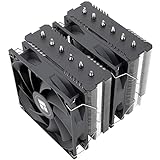
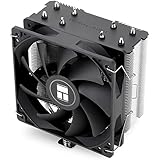

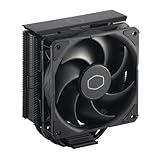
Quick comparison: air coolers worth considering
| Cooler | Approx. height | Weight | Fan size | Noise and clearance notes | Typical market range |
|---|---|---|---|---|---|
| Thermalright Assassin X 120 Refined SE | 148 mm | About 0.66 kg | 120 mm single fan | Good compact option; moderate RAM interference | $20–$30 |
| DeepCool AK400 | 155 mm | About 0.93 kg | 120 mm single fan | Low-profile front section; generally easy RAM clearance | $30–$45 |
| Thermalright Peerless Assassin 120 SE | About 157 mm | About 1.0 kg with fans | Two 120 mm fans | Excellent value; front fan can overhang tall memory | $35–$50 |
| Thermalright Phantom Spirit 120 SE | About 154 mm | About 1.0 kg with fans | Two 120 mm fans | Strong high-load cooling; check RAM and side-panel clearance | $35–$55 |
| be quiet! Dark Rock 5 | About 161 mm | About 1.3 kg | 135 mm single fan | Quiet-focused; taller and heavier than most budget towers | $60–$80 |
| Noctua NH-D15 G2 | About 168 mm | About 1.5 kg with fans | Two 140 mm fans | Excellent compatibility options; very large and premium-priced | $120–$150 |
Dimensions can vary slightly by revision, fan position, and mounting hardware. Always compare the cooler’s listed height with the case’s maximum CPU-cooler height, and check the manufacturer’s socket and motherboard compatibility information before ordering.
Best choices by case size and workload
For a compact or older mid-tower case: Assassin X 120 or AK400
A 148–155 mm cooler is substantially easier to fit than a large dual-tower model. The Thermalright Assassin X 120 Refined SE is the budget-first choice for a six-core or moderate eight-core processor running at sensible power limits. The DeepCool AK400 costs more in many regions but has a particularly tidy single-tower layout and a useful balance of cooling, mounting quality, and noise.
These coolers are suitable when the case has limited width, the memory modules have tall heat spreaders, or the computer is used mainly for gaming and everyday applications. They are less appropriate for sustained rendering or unrestricted high-power CPUs, where a second tower and additional heat-pipe capacity can reduce temperature and fan speed.
For the best performance per dollar: Peerless Assassin 120 SE
The Peerless Assassin 120 SE remains one of the most compelling answers to “what is the best air cooler for CPU?” because it delivers dual-tower performance at a relatively low price. Six heat pipes transfer heat into two fin stacks, while two 120 mm fans provide airflow without requiring the large 140 mm fans used by premium coolers.
Its main disadvantage is not thermal performance but fit. The front fan may need to be raised to clear tall RGB memory. That increases the total height: if the fan is lifted by 10 mm, a nominal 157 mm cooler can require roughly 167 mm of case clearance. Measure the adjusted height, not just the number printed on the product page.
For demanding sustained workloads: Phantom Spirit 120 SE
The Phantom Spirit 120 SE is a sensible step up for CPUs that spend long periods compiling, encoding, or rendering. Its dual-tower layout and additional heat-pipe capacity give it more thermal headroom than most single-tower coolers. It is especially attractive when the goal is to avoid liquid-cooling pump noise, pump wear, or radiator installation.
It still needs careful memory planning. Install the memory modules before mounting the cooler if possible, and check whether the front fan must move upward. On some boards, the cooler may also crowd the top PCI Express slot or tall motherboard heatsinks.
For a quieter premium build: Dark Rock 5 or NH-D15 G2
The be quiet! Dark Rock 5 uses a large 135 mm fan and a single substantial tower. It is a good choice when low acoustic output and a clean appearance matter more than the lowest price. Its 161 mm height rules it out for some compact cases, and its weight makes careful mounting important.
The Noctua NH-D15 G2 is the premium option for buyers who value long-term support, refined mounting hardware, and excellent large-cooler performance. It is expensive and physically imposing, but Noctua’s replacement-fan availability can extend the useful life of the cooler. The NH-D15 G2 is available in different compatibility configurations, so verify the exact version for your socket and memory layout.
How to check fit before buying
- Measure cooler height: find the case’s maximum CPU-cooler height and leave a few millimeters of practical margin. Side-panel bulges, raised fans, and measurement differences can eliminate a nominal fit.
- Check the socket: current mainstream platforms commonly include AMD AM4 and AM5 and Intel LGA1700 and LGA1851. Older or unusual sockets may require a separate mounting kit.
- Measure RAM height: standard modules around 32–36 mm are easier to clear. Tall RGB modules can exceed 44–45 mm and may force a front fan upward.
- Inspect motherboard space: look for large VRM heatsinks, an obstructed top PCIe slot, and limited access to the memory latches.
- Confirm fan orientation: the usual arrangement is front-to-back airflow, with the rear case fan exhausting warm air.
Noise: what the specifications do and do not tell you
Advertised maximum noise figures are useful for comparing fan designs but do not predict the sound of a complete computer. A cooler running at 1,200 revolutions per minute can be quieter than a smaller cooler running at 1,800 RPM, even if both list similar maximum noise numbers. Case airflow, motherboard fan curves, CPU power limits, and dust buildup all affect the result.
For a quiet system, use a gradual fan curve rather than allowing the fan to jump immediately to maximum speed. Set a reasonable temperature response delay in the motherboard firmware if available. A dual-tower cooler often stays quiet because it can dissipate the same heat at a lower fan speed; it is not automatically silent simply because it has two fans.
Installation and ownership realities
Apply a small, pea-sized amount of thermal paste unless the cooler’s instructions specify another method. Tighten the mounting screws gradually and alternate between sides so the base sits evenly. Excess paste rarely improves cooling, while an uneven mounting pressure can create more trouble than the choice between two similar coolers.
Dust is the first maintenance issue to expect. Every three to six months, power down the computer and hold the fan blades still while using compressed air to clear the heatsink. Do not allow the fan to spin freely at high speed from an air blast. Clean the case filters at the same time, because a clogged intake filter raises both CPU temperature and fan speed.
The fan is normally the first replaceable part to wear. Bearings may become noisy after years of use, while the metal heatsink can remain serviceable indefinitely. Before replacing an entire cooler, check whether a standard 120 mm or 140 mm replacement fan will fit the clips and whether the manufacturer sells a compatible mounting kit for a newer socket.
Final buying decision
- Choose the Assassin X 120 Refined SE for the lowest-cost compact build.
- Choose the DeepCool AK400 for a straightforward single-tower cooler with generally easy memory clearance.
- Choose the Peerless Assassin 120 SE for the strongest budget performance, provided your case and RAM can accommodate it.
- Choose the Phantom Spirit 120 SE for heavier sustained CPU workloads without moving to liquid cooling.
- Choose the Dark Rock 5 when quiet operation and premium construction matter more than minimum size.
- Choose the NH-D15 G2 when long-term support and top-tier air cooling justify the price and large dimensions.
The best air cooler for CPU is therefore the one that fits the case with the fan installed, clears the memory, supports the motherboard socket, and can handle the processor’s sustained power. A slightly smaller cooler that fits correctly and runs at a moderate fan speed is a better purchase than a larger model forced into an incompatible case.