What's inside
- Best 200 Amp Welders for Home Shops and Heavy Repairs
- Quick comparison: what the 200-amp rating gets you
- Choose by job, not by the largest number on the dial
- What thickness can a 200 amp welder realistically handle?
- Decision matrix: match the machine to your shop
- Input power and duty cycle: the details that change the decision
- Ownership costs and common wear points
- Best 200 Amp Welders for Home Shops and Heavy Repairs
- Quick comparison: what the 200-amp rating gets you
- Choose by job, not by the largest number on the dial
- What thickness can a 200 amp welder realistically handle?
- Decision matrix: match the machine to your shop
- Input power and duty cycle: the details that change the decision
- Ownership costs and common wear points
As an Amazon Associate I earn from qualifying purchases. This post may contain affiliate links at no extra cost to you.
Sections
- Best 200 Amp Welders for Home Shops and Heavy Repairs
- Quick comparison: what the 200-amp rating gets you
- Choose by job, not by the largest number on the dial
- What thickness can a 200 amp welder realistically handle?
- Decision matrix: match the machine to your shop
- Input power and duty cycle: the details that change the decision
- Ownership costs and common wear points
Best 200 Amp Welders for Home Shops and Heavy Repairs
For most home shops, the best 200 amp welder is a dual-voltage multiprocess inverter such as the ESAB Rogue EMP 210 PRO; choose a dedicated machine instead if you mainly stick-weld outdoors, need TIG control, or will run it from a limited household circuit. A “200 amp” rating alone doesn’t tell you what a welder can do: output at your available voltage, duty cycle, process, and the joint’s fit-up matter just as much.
Quick comparison: what the 200-amp rating gets you
The figures below are published specifications, not a guarantee that every machine will sustain maximum output on a home circuit. Verify the exact version and manual before purchase; product configurations can vary by market.
As an Amazon Associate we earn from qualifying purchases at no extra cost to you.


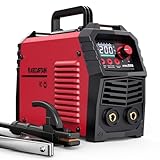

| Model | Processes | Input | Rated output and duty cycle | Weight | Best fit |
|---|---|---|---|---|---|
| ESAB Rogue EMP 210 PRO | MIG, flux-core, stick, lift TIG | 120/230 V | Up to 210 A; duty cycle varies with output and input | About 36 lb | One machine for mixed home-shop work |
| Lincoln Electric POWER MIG 211i | MIG, flux-core, stick, lift TIG | 120/230 V | Up to 211 A; duty cycle varies by process and input | About 41 lb | Portable MIG-first shop setup |
| Lincoln Electric Ranger 225 GXT | Stick, DC TIG; engine-driven power | Gasoline engine | 225 A maximum; rated duty cycle depends on output | About 260 lb | Field repairs without dependable mains power |
Weights are approximate machine weights; cables, gas cylinder, wire, and accessories add substantially to what you must move. Duty-cycle percentages are deliberately not presented as directly comparable without matching the manufacturers’ test conditions and output settings. Check the specification sheet for the exact amperage and duty cycle you expect to use.
Choose by job, not by the largest number on the dial
Best all-rounder for a home shop: ESAB Rogue EMP 210 PRO
This is a strong choice when projects alternate between MIG on clean steel, flux-core outside, and occasional stick or TIG work. Dual-voltage input lets you use a suitable 120 V outlet for lighter work and 230 V for more demanding output. That does not mean a standard household outlet can deliver 200 amps of welding output: input current, circuit capacity, and the machine’s output limits still apply.
For typical mild-steel work, expect a practical range from thin sheet—once settings and technique are dialed in—to moderate plate with proper preparation and multiple passes. It is not a shortcut to welding thick, highly restrained structural parts in one pass. The right procedure depends on joint design, material, and required strength.
Best for a MIG-first shop: Lincoln Electric POWER MIG 211i
If most of your work is brackets, gates, mower equipment, or automotive fabrication, a MIG-focused setup is often easier to use productively than paying for features you rarely need. The 211i supports multiple processes, but its appeal is the familiar wire-feed workflow and the flexibility of 120/230 V operation. A gas-shielded setup is well suited to clean indoor work; flux-core is more forgiving outdoors, where wind can disrupt shielding gas.
For thin automotive sheet, prioritize low, stable output and careful fit-up rather than chasing maximum amperage. For heavier repairs, a 230 V supply and suitable wire, gas, and joint preparation become increasingly important. Welding on a vehicle can also involve fire risks and sensitive electronics; isolate the work area and follow the equipment and vehicle manufacturers’ precautions.
Best for outdoor repairs without mains power: Lincoln Electric Ranger 225 GXT
An engine-driven welder makes sense for farm, trailer, and equipment repairs far from a shop outlet. Its high output is useful for stick welding in the field, and DC TIG capability adds flexibility for suitable jobs. The trade-off is substantial weight, engine maintenance, fuel, exhaust, noise, and a much higher purchase commitment than a portable inverter.
Do not buy an engine drive simply because its amperage number is higher. If the work is mostly at a bench, a compact inverter on a correctly sized circuit is usually easier to store and operate.
What thickness can a 200 amp welder realistically handle?
There is no dependable thickness limit based on amperage alone. Process, electrode or wire size, voltage, joint geometry, position, material, and number of passes all change the result. As a practical planning guide for mild steel:
- Thin sheet, roughly 22-gauge to 1/8 inch: A capable machine can handle it, but low-end control and technique are crucial. Thin material can burn through quickly, especially with stick electrodes.
- About 1/8 to 1/4 inch: This is a comfortable range for many 200-amp home-shop jobs with suitable MIG or stick settings and good preparation.
- About 1/4 to 3/8 inch: Often feasible with beveling, multiple passes, and a suitable 230 V supply. Confirm the machine’s output and duty cycle at the intended setting.
- Thicker or safety-critical parts: Do not infer suitability from “200 A.” Follow an appropriate welding procedure and get qualified guidance for structural, lifting, pressure, or vehicle-safety components.
These are broad shop-planning ranges, not certified capacity ratings. Stainless steel and aluminum need process-appropriate setup; a machine’s ability to strike an arc does not by itself establish a sound or code-compliant weld.
Decision matrix: match the machine to your shop
| Your situation | Best direction | Why |
|---|---|---|
| Mostly light repairs, limited budget, 120 V only | Consider a lower-output 120 V MIG or stick inverter rather than insisting on 200 A | Usable output and circuit limits matter more than a headline rating. |
| Beginner, mixed indoor projects, room for a gas cylinder | Dual-voltage multiprocess MIG-capable inverter | MIG is approachable on clean steel; stick and flux-core extend outdoor options. |
| Frequent thick steel work and a 230 V circuit | Compare duty cycle at the amperage you will actually use | More sustained output reduces cooling pauses during long welds. |
| Remote repairs with no reliable power | Engine-driven stick welder | It brings its own power, at the cost of weight and engine upkeep. |
| Thin, precise work is a priority | A dedicated TIG-capable setup with good low-amp control | “200 amp TIG welder” describes maximum output, not how smoothly it runs at low amperage. |
Input power and duty cycle: the details that change the decision
A welder’s input requirements can make or break the purchase. Check the manual for recommended breaker size, input current, plug type, and extension-cord guidance. A 120 V setting is useful for lighter work, but it cannot provide the same sustained high output as a proper 230 V supply. Have an electrician assess a new circuit; do not substitute an oversized breaker or undersized cord.
Duty cycle is the portion of a standard ten-minute period a machine can weld at a stated output before cooling. For example, a 30% duty cycle means three minutes welding and seven minutes cooling under the manufacturer’s test conditions. Duty cycle generally falls as amperage rises, and actual performance can be affected by ambient temperature, ventilation, and input voltage. Compare the rating at the output you plan to use—not just the machine’s best-looking specification.
Ownership costs and common wear points
Budget for more than the power source: helmet, gloves, jacket, clamps, gas regulator and cylinder for gas MIG or TIG, and process-specific consumables. Wire-feed users will replace contact tips and nozzles; spatter can clog the nozzle and cause erratic feeding. Stick users go through electrodes and should keep them dry according to their storage instructions. TIG adds tungsten, cups, filler rod, and gas use.
Keep vents clear, store the machine dry, inspect leads and connectors for heat damage, and clean the wire drive when feed becomes inconsistent. Common mistakes include running wire with the wrong drive-roll groove, using a poor ground connection, choosing an extension cord that causes voltage drop, and welding through paint or contamination. On a 200 amp stick welder, selecting an electrode outside the machine’s usable range can also make arc starts and bead control frustrating.
Bottom line: Pick a dual-voltage multiprocess inverter for varied home-shop work, a MIG-first machine for frequent wire welding, or an engine-driven stick unit for remote repairs. Before buying, confirm the required circuit, duty cycle at your working amperage, and process-specific accessories—the right match matters more than the 200-amp label.