What's inside
- Best Portable Generator Welders for Reliable Jobsite Power
- Quick comparison of leading portable generator welders
- Best choices by jobsite situation
- Gas generator welder or inverter generator welder?
- How much generator power do you need?
- Duty cycle matters more than the maximum amp number
- Fuel runtime, weight, and transport realities
- Durability and maintenance issues buyers often overlook
- Buying recommendation
- Best Portable Generator Welders for Reliable Jobsite Power
- Quick comparison of leading portable generator welders
- Best choices by jobsite situation
- Gas generator welder or inverter generator welder?
- How much generator power do you need?
- Duty cycle matters more than the maximum amp number
- Fuel runtime, weight, and transport realities
- Durability and maintenance issues buyers often overlook
- Buying recommendation
As an Amazon Associate I earn from qualifying purchases. This post may contain affiliate links at no extra cost to you.
Sections
- Best Portable Generator Welders for Reliable Jobsite Power
- Quick comparison of leading portable generator welders
- Best choices by jobsite situation
- Gas generator welder or inverter generator welder?
- How much generator power do you need?
- Duty cycle matters more than the maximum amp number
- Fuel runtime, weight, and transport realities
- Durability and maintenance issues buyers often overlook
- Buying recommendation
Best Portable Generator Welders for Reliable Jobsite Power
The best portable generator welder for most construction crews is a 300-amp-class engine-driven welder with at least 10,000 continuous watts, while a lighter 200-amp machine is the better choice for occasional repairs and easier transport.
A generator welder combines an engine, welding power source, and jobsite generator in one unit. That makes it useful for repairing gates, trailers, farm equipment, structural steel, and construction hardware where utility power is unavailable. The right choice depends less on the highest advertised amperage than on continuous generator output, duty cycle, fuel consumption, weight, and how often the machine will be moved.
As an Amazon Associate we earn from qualifying purchases at no extra cost to you.

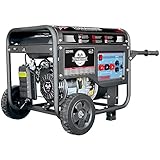
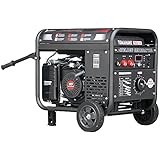

Quick comparison of leading portable generator welders
| Model | Welding output | Generator output | Approx. dry weight | Best fit |
|---|---|---|---|---|
| Miller Bobcat 265 | Up to 265 A; 100% duty cycle at rated output | About 9,500 continuous / 11,000 peak watts | About 501 lb | General construction, maintenance, and service trucks |
| Miller Trailblazer 330 | Up to 330 A; 100% duty cycle at rated output | About 11,000 continuous / 13,000 peak watts | About 520 lb | Heavy field welding and simultaneous tool use |
| Lincoln Ranger 330MPX | Up to 330 A; 100% duty cycle at rated output | About 10,500 continuous / 12,000 peak watts | About 530 lb | Construction crews needing high output and auxiliary power |
| Hobart Champion Elite | Up to 225 A; duty cycle varies by output | About 9,000 continuous / 11,000 peak watts | About 455 lb | Budget-conscious repair and farm work |
Specifications can vary with engine, fuel, and regional configuration, so confirm the exact data plate before purchase. “Peak” generator watts are useful for motor starting; continuous watts are the figure that matters when running grinders, lights, pumps, or compressors for extended periods.
Best choices by jobsite situation
- Best all-around construction choice: Miller Bobcat 265. It provides enough welding capacity for common stick and wire-feed field repairs while supplying practical auxiliary power. Its conventional design is widely supported, and the 265-amp output covers most work involving 1/8-inch and 5/32-inch electrodes.
- Best for demanding structural work: Miller Trailblazer 330. The extra welding headroom and approximately 11,000 continuous watts are valuable when welding heavy material or operating a grinder and other tools at the same time.
- Best high-output alternative: Lincoln Ranger 330MPX. This is suited to crews that regularly weld at high amperage and need substantial generator capacity. Its MPX electrical design is intended to provide cleaner auxiliary power than older conventional engine-driven machines.
- Best value for occasional repairs: Hobart Champion Elite. A 225-amp machine is sufficient for trailers, farm implements, brackets, gates, and general maintenance. It is not the first choice for continuous heavy structural welding, but it can reduce purchase cost and payload compared with a 330-amp unit.
- Best for frequent relocation: a compact inverter engine-driven welder. Inverter-based machines generally offer smoother control, better fuel efficiency, and a smaller footprint than traditional copper-transformer designs. They still weigh several hundred pounds, so “portable” normally means truck-, trailer-, or skid-mounted rather than hand-carried.
Gas generator welder or inverter generator welder?
Most portable generator welders are gas generator welders: a gasoline engine turns an alternator, and the machine supplies welding current plus 120- and 240-volt auxiliary power. Gasoline models are easy to refuel and commonly available, but fuel should be stored safely and stale gasoline can cause carburetor problems.
An inverter generator welder uses electronic power conversion to regulate the welding arc and, in many modern designs, to produce cleaner auxiliary power. The result can be quieter operation, better fuel economy at partial load, and more precise arc behavior. However, not every “inverter generator” can weld. A small portable inverter generator may power a separate welding machine, but it usually lacks the high-current welding circuitry and duty cycle of a purpose-built engine-driven welder.
For a field-repair truck, an inverter engine-driven welder is attractive when fuel savings, low noise, and generator quality matter. For rough construction use where maximum simplicity and repairability are priorities, a conventional gas engine-driven welder remains a sensible choice.
How much generator power do you need?
Size the machine from the tools you will run at the same time, not from the welding amperage alone. A typical simultaneous load might include a 3,000-watt welder accessory load, a 2,000-watt angle grinder, and 1,000 watts of lights or battery chargers. That totals 6,000 running watts. Adding roughly 25 percent for starting and load variation gives a target near 7,500 watts, so a generator welder rated at 9,000 or more continuous watts provides useful margin.
For example, a 5/32-inch E7018 electrode commonly operates around 125 to 160 amps. A 265-amp welder therefore has reserve capacity rather than needing to run at its limit. That reserve reduces nuisance overloads when the arc starts, cables are long, or another tool starts under load.
Duty cycle matters more than the maximum amp number
Duty cycle states how long a welder can operate during a ten-minute period at a specified output. A 60% duty cycle at 250 amps means six minutes of welding followed by four minutes of cooling at that output. A 100% rating means the machine can weld continuously at the stated test condition, although electrode changes, repositioning, and practical work breaks still occur.
For repair work, a 200- to 265-amp unit with a moderate duty cycle is usually adequate. Crews welding long seams, heavy pipe, or structural assemblies should favor a 300- to 330-amp model with a high duty cycle. Running beyond the rated duty cycle repeatedly can overheat windings, damage electronics, and shorten the life of cooling components.
Fuel runtime, weight, and transport realities
Many gasoline engine-driven welders carry roughly 8 to 13 gallons of fuel and may run approximately 8 to 14 hours at lighter loads. Runtime can fall sharply during continuous high-amperage welding or when auxiliary tools are connected. Treat manufacturer runtime figures as load-specific rather than as a guaranteed workday.
A useful ownership calculation is fuel cost per operating hour. If a machine burns 0.6 gallons per hour under a typical mixed load and gasoline costs $4 per gallon, fuel costs about $2.40 per hour. At 1.0 gallon per hour under heavy load, the cost rises to $4 per hour. This is why an inverter-based machine can repay a higher purchase price when it runs many hours each week at partial load.
Weights around 450 to 550 pounds affect every part of ownership. Use a properly rated skid, lifting eye, forklift pocket, or trailer ramp. Do not rely on a pickup tailgate or improvised tie-down points. A compact machine that is 50 pounds lighter may be more useful than a higher-output model if one person frequently loads it.
Durability and maintenance issues buyers often overlook
- Air filters and cooling passages: Dust, grinding debris, and welding fumes restrict airflow. Inspect the air filter frequently on demolition and roadwork sites, and clean external cooling areas without forcing debris deeper into the machine.
- Brushes, slip rings, and connections: Conventional alternators may eventually need brush or connection service. Loose welding lugs and corroded grounds create heat and unstable arcs.
- Fuel system: Use fresh fuel, follow the engine maker’s storage guidance, and drain or stabilize fuel before long-term storage. Ethanol-related deposits are a common cause of hard starting.
- Welding leads: Long, undersized leads waste voltage and generate heat. Match cable size to amperage and length, keep connectors clean, and inspect insulation for cuts.
- Oil and vibration: Check oil before every shift, follow the hour-based service schedule, and inspect engine mounts, battery cables, exhaust hardware, and frame fasteners.
Buying recommendation
Choose a 225- to 265-amp gas generator welder if your work is mostly repair, farm maintenance, and intermittent construction. Move to a 300- to 330-amp model when high-duty-cycle welding, heavy electrodes, or simultaneous tool operation is routine. Select an inverter engine-driven welder when lower noise, fuel efficiency, and refined arc control justify its added electronic complexity. Whichever format you choose, prioritize continuous generator watts, duty cycle, service access, lifting provisions, and local parts support over a headline maximum amperage.