What's inside
- Top Battery Operated Reciprocating Saws Compared
- Decision Criteria That Actually Matter for Portable Use
- Worked Runtime Calculation: Will One Battery Finish the Job?
- Find Your Fit: Decision Matrix by Situation
- Durability and Ownership Realities
- Maintenance for Peak Portability
- Bottom Line for Mobile Cutting
- Top Battery Operated Reciprocating Saws Compared
- Decision Criteria That Actually Matter for Portable Use
- Worked Runtime Calculation: Will One Battery Finish the Job?
- Find Your Fit: Decision Matrix by Situation
- Durability and Ownership Realities
- Maintenance for Peak Portability
- Bottom Line for Mobile Cutting
As an Amazon Associate I earn from qualifying purchases. This post may contain affiliate links at no extra cost to you.
The best battery operated reciprocating saw for most portable work is a brushless 18V/20V model with a 1-1/8-inch stroke length, 0-3,000 SPM, and tool-less blade change, with Milwaukee M18 FUEL, DeWalt 20V MAX, and Makita 18V LXT leading for a balance of cutting speed, runtime, and weight.
As an Amazon Associate we earn from qualifying purchases at no extra cost to you.


Sections
- Top Battery Operated Reciprocating Saws Compared
- Decision Criteria That Actually Matter for Portable Use
- Worked Runtime Calculation: Will One Battery Finish the Job?
- Find Your Fit: Decision Matrix by Situation
- Durability and Ownership Realities
- Maintenance for Peak Portability
- Bottom Line for Mobile Cutting
Top Battery Operated Reciprocating Saws Compared
For mobile work, raw power matters less than how long a saw cuts on one charge, how easily you can carry it overhead or into a crawlspace, and how fast you can swap blades between wood, metal, and demolition tasks. The models below represent the current mainstream cordless platforms you will find in 2026 and cover compact one-handed designs versus full-size demolition saws.
| Model (Bare Tool) | Voltage & Platform | Stroke Length | Strokes Per Minute (SPM) | Weight (Tool Only) | Key Features |
|---|---|---|---|---|---|
| Milwaukee M18 FUEL Sawzall 2821-20 | 18V M18 | 1-1/8″ (28.6mm) | 0 – 3,000 | 7.1 lbs (3.2 kg) | Brushless motor, orbital action, twist-lock tool-free blade clamp |
| DeWalt 20V MAX XR DCS382 | 20V MAX (18V nominal) | 1-1/8″ (28.6mm) | 0 – 3,000 | 7.0 lbs (3.17 kg) | Brushless, 4-position blade clamp, pivoting shoe, LED light |
| Makita 18V LXT XRJ06Z | 18V LXT | 1-1/4″ (32mm) | 0 – 2,800 | 8.1 lbs (3.7 kg) | Brushless, 2-speed switch, tool-free shoe adjustment, anti-vibration |
| Bosch GSA18V-083B12 | 18V | 13/16″ (21mm) | 0 – 3,050 | 5.1 lbs (2.3 kg) | Compact inline design, brushless, one-handed use |
| Ryobi 18V ONE+ HP PSR101 | 18V ONE+ | 1″ (25.4mm) | 0 – 2,900 | 7.3 lbs (3.3 kg) | Brushless, variable speed trigger, tool-free blade release |
| Milwaukee M12 FUEL Hackzall 2521-20 | 12V M12 | 5/8″ (15.9mm) | 0 – 3,000 | 3.8 lbs (1.7 kg) | Compact one-handed, brushless, ideal for overhead / tight spaces |
General market range for bare tools in 2026: compact 12V hackzall-style saws $130-$180, full-size 18V/20V brushless saws $180-$280. Kits with one 5.0Ah battery and charger typically add $90-$150 to the bare tool price within the same platform.
Decision Criteria That Actually Matter for Portable Use
1. Cutting Performance
Stroke length and SPM determine speed, but blade choice matters more than motor watts. A 1-1/8″ to 1-1/4″ stroke clears chips faster in lumber and demolition, while a shorter 5/8″ to 13/16″ stroke on compact saws gives better control for metal, PVC, and pruning. Orbital action, found on Milwaukee 2821 and similar full-size saws, accelerates wood cuts by 20-30% but should be switched off for metal to avoid dulling teeth. Look for a variable-speed trigger plus a speed dial if you frequently switch between materials.
2. Battery Runtime and Platform
Voltage does not equal runtime. Amp-hours (Ah) does. On an 18V/20V platform, expect these real-world averages with a sharp 6 TPI demolition blade:
- 2.0Ah compact battery: 20-35 cuts in 2×4 SPF lumber or 40-60 linear inches in 3/4″ plywood
- 5.0Ah battery: 65-90 cuts in 2×4 or 3-5 minutes of continuous metal cutting in 16-gauge steel stud
- 6.0Ah / 12.0Ah high-output: 1.5x to 2x the 5.0Ah count, but adds 0.6-1.4 lbs
If you already own a cordless ecosystem, staying on that battery platform saves more money than any single saw feature. For new buyers who need all-day portability, an 18V/20V system with widely available 4.0Ah and 5.0Ah packs offers the best cost-to-runtime ratio. 12V systems excel for light, intermittent cuts where every pound matters, not for framing or demo.
3. Weight and Ergonomics
A full-size battery operated reciprocating saw weighs 7-8 lbs before the battery. Add a 5.0Ah pack and you are carrying 8.2-9.5 lbs at arm’s length. For overhead cutting, ladder work, or pruning, a compact inline saw at 3.8-5.5 lbs with battery reduces fatigue dramatically but requires more time per cut in thick lumber. Check three ergonomic points: anti-vibration handle, adjustable pivoting shoe, and balance point. A saw that is nose-heavy will strain your wrist faster than a slightly heavier but better-balanced model.
4. Blade-Change Ease
Tool-free blade clamps are now standard, but execution varies. The fastest designs use a twist collar or lever that accepts the blade in any orientation (teeth up or down) without re-clamping. Avoid older hex-screw clamps that require a tool. A lever positioned on the side rather than the top is easier to operate with gloves. Also confirm the shoe adjusts without tools — a quick-release shoe lets you extend blade life by using unworn teeth and controls cut depth when cutting against walls.
Worked Runtime Calculation: Will One Battery Finish the Job?
Use this quick estimate before you leave the shop:
Formula: Estimated Cuts = (Battery Watt-Hours x Cuts per Watt-Hour) — derate 15% for dull blade or cold weather
Example: You have an 18V 5.0Ah pack. Watt-hours = 18V x 5.0Ah = 90Wh. A full-size brushless saw averages 0.8 – 1.0 cuts per Wh in 2×4 softwood with a demolition blade.
90Wh x 0.9 = 81 cuts. Derate 15% for a used blade: 81 x 0.85 = ~69 cuts. If your punch list needs 50 cuts to remove a deck section or trim branches, one 5.0Ah pack is sufficient. If you need 120 cuts, bring two 5.0Ah packs or one high-output 8.0Ah+ pack. For metal conduit (EMT) or nails-embedded wood, halve the cut count.
This is why professionals working away from power often carry two 5.0Ah batteries rather than one large 12.0Ah — you can charge one while using the other and keep tool weight lower.
Find Your Fit: Decision Matrix by Situation
| Your Situation | Best Fit Type | Specific Pick to Consider | Why |
|---|---|---|---|
| Mobile contractor doing demo, framing trim, and occasional metal | Full-size 18V/20V brushless, 1-1/8″+ stroke | Milwaukee 2821-20 or DeWalt DCS382 | Fastest wood cuts, orbital mode, durable shoe, cross-platform battery availability |
| Homeowner / DIYer with existing Ryobi, Craftsman, or similar 18V tools | Stay in your platform, full-size brushless | Ryobi PSR101 or equivalent platform model | Lowest ownership cost, shares batteries, adequate for periodic use |
| Electrician, plumber, HVAC in tight spaces / overhead | Compact one-handed inline | Bosch GSA18V-083 or Milwaukee M12 Hackzall 2521 | Lightest weight, one-hand operation, excels in joist bays and ceilings |
| Property maintenance / pruning / storm cleanup | Compact or full-size with pruning blade support | Bosch GSA18V-083 or Makita XRJ06Z with long pruning blade | Short body for branches, Makita offers 1-1/4″ stroke for faster green wood cuts |
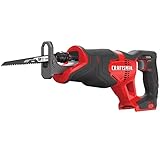
| Budget-first, infrequent use, weight is secondary | 18V brushed or entry brushless | Ryobi ONE+ or Craftsman V20 full-size | Lowest bare-tool price, still tool-free clamp, heavier and less efficient but serviceable |
Durability and Ownership Realities
A battery operated reciprocating saw is a high-vibration tool. What wears first is not the motor but the consumables and contact points:
- Blade clamp and shoe: Sawdust and metal filings pack into the clamp. Blow it out with compressed air after each job and add one drop of dry lubricant monthly. A loose blade that wobbles side-to-side usually means debris in the clamp, not a broken mechanism.
- Blades: This is the primary consumable cost. Bi-metal blades last for nail-embedded wood, carbide-tooth blades cost 3-4x more but last 10-20x longer in fiber cement, cast iron, and stainless. Using a wood blade on metal dulls it in seconds — the mistake that creates the most heat and vibration.
- Shoe and rubber boot: The pivoting shoe is sacrificial. It will get chewed up if you pry with the saw. Replace the shoe plate when the edge rounds over, or you will lose stability and cut accuracy.
- Batteries: Capacity fade accelerates if you store packs fully charged in heat or run them until the tool stalls. Recharge when power drops noticeably, store at 40-60% charge in cool, dry conditions, and avoid leaving packs in a hot work van.
- Cleaning: Never wash the housing with water. Wipe vents with a dry brush. Orbital mechanisms and counterbalance weights attract fine dust — a quick air blast through the vents extends bearing life.
Common mistakes to avoid: forcing the blade and bending it to steer the cut, which overheats the motor and snaps blades; cutting with a dull blade to save time, which doubles battery drain and vibration; and using an undersized 2.0Ah battery for continuous demo, which triggers thermal shutdown and shortens cell life.
Maintenance for Peak Portability
Before mobile work: seat the blade fully until the clamp clicks twice, tug-test it, and set the shoe to just contact the material to damp vibration. After work: remove the battery, eject the blade, clear the clamp, and check the blade for missing teeth. Store blades in a sleeve, not loose in a bag where teeth chip. If the saw will sit for weeks, cycle batteries every 30 days with a brief charge.
Bottom Line for Mobile Cutting
If you need one battery operated reciprocating saw that covers most portable jobs, choose a full-size 18V/20V brushless saw with tool-free twist or lever clamp and a 1-1/8″ stroke, and pair it with two 5.0Ah batteries. If your work is consistently overhead, in crawlspaces, or one-handed, add or substitute a compact 12V/18V inline saw and save 3-4 lbs per cut. Staying within the battery platform you already own will improve runtime and value more than chasing the highest SPM number.