What's inside
As an Amazon Associate I earn from qualifying purchases. This post may contain affiliate links at no extra cost to you.
For most joinery, a wheel marking gauge is the cleaner, more controlled tool. A traditional fence marking gauge is cheaper, quicker to sharpen, and perfectly adequate for routine work in softwood. The better choice depends on whether you value a crisp cut, easy adjustment, and repeatability over low cost and simplicity.
Both tools establish a parallel line from an edge. You set the fence against a reference face, adjust the cutter or pin to the required distance, and run the gauge along the work. That makes them useful for marking mortises, tenons, rebates, dovetails, shoulders, and housing joints.
As an Amazon Associate we earn from qualifying purchases at no extra cost to you.


Sections
Our Top Picks
What a wheel marking gauge does
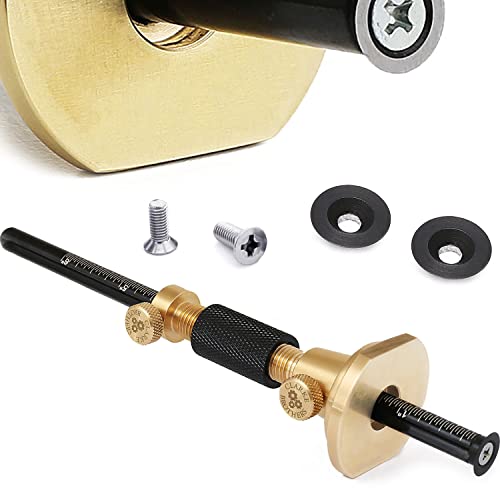
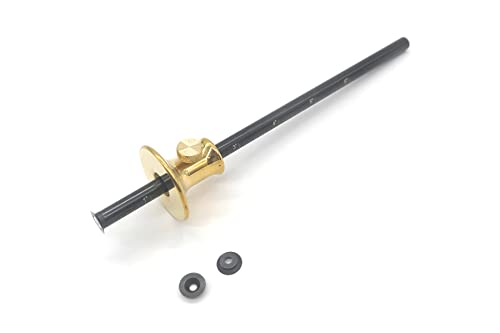
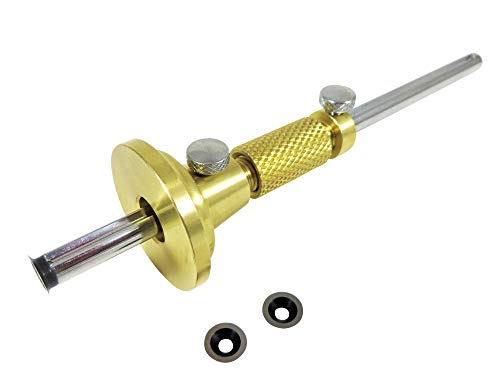
A wheel gauge uses a small circular cutter mounted on the end of the beam. As the fence travels along the reference edge, the wheel scores the fibres rather than dragging a single point through them. The result is usually a narrow, clean line that is easy to follow with a chisel.
The wheel cutter is particularly good across the grain. A conventional pointed pin can catch and follow the grain, wandering away from the fence. A wheel is less likely to do this, especially in open-grained oak, ash, and other ring-porous hardwoods. It also tends to leave a more visible line without tearing up the surface.
Most wheel gauges allow the cutter to be reversed or adjusted for left- and right-handed use. Some have a fine screw adjustment, while others use a sliding beam locked by a wedge or screw. A screw-adjusted gauge is slower to set than a simple wooden gauge, but it makes small corrections much easier.
For a first serious upgrade, a wheel marking gauge is a sensible choice if you work regularly in hardwood or make furniture where clean shoulders matter.
What a fence marking gauge does
A traditional fence marking gauge has a wooden or metal fence, a beam, and a pointed marking pin. The pin is sharpened to a small bevel and projects just enough to score the timber. It is a simple design, and good examples can be extremely accurate.
The main advantage is speed. Once the pin is sharpened, you can set the beam, lock it, and mark a batch of parts quickly. The pointed pin also works well along the grain, where it cuts a continuous groove with little effort. For softwood framing, cabinet carcasses, and general site joinery, this may be all you need.
Its weakness is grain behaviour. Pushing the gauge too hard can make the pin dive into a soft patch or deflect along a hard grain line. A blunt or badly shaped pin makes the problem worse. On the end grain of a tenon, the pin can also leave a ragged entry mark.
A basic traditional marking gauge is often the cheaper option, and it is fine when your work is mostly softwood, construction joinery, or hidden surfaces.
Wheel gauge versus traditional fence gauge
| Feature | Wheel marking gauge | Fence marking gauge |
|---|---|---|
| Line quality | Fine, consistent scored line | Good when the pin is correctly sharpened |
| Across-the-grain marking | Usually cleaner and less prone to wandering | Can follow grain or tear soft fibres |
| Along-the-grain marking | Clean, though the wheel may need more pressure | Fast and effective |
| Adjustment | Often offers precise screw adjustment | Usually a sliding beam and locking screw |
| Maintenance | Keep the wheel sharp and free-running | Sharpen and correctly orient the pin |
| Typical cost | Higher | Lower |
| Best use | Hardwood furniture and crisp joinery | Softwood, site work, and general marking |
Accuracy and setting out
Neither gauge is automatically accurate just because it has a wheel or a metal fence. Accuracy starts with a reliable reference face. Mark the face side and face edge of each component, then keep the fence against the same reference throughout the job. Switching faces can introduce errors equal to the difference in thickness or width.
For repeated parts, mark one accurately measured piece first, then use it to check the gauge setting. A useful practical test is to make two light passes in the same groove. If the second pass widens the line noticeably, the fence may be rocking, the beam may be loose, or you may be applying too much pressure.
Set the cutter to project only about 1 to 2 mm for normal joinery. Excessive projection encourages the tool to dig in and makes it harder to keep the fence flat. Make a light first pass, then deepen the line with a second pass if necessary. This is slower than forcing the gauge once, but produces fewer torn edges.
Common failure modes
A gauge can mark at the wrong distance if the fence is not square to the beam. Check this by marking on both edges of a scrap board and comparing the lines. A loose fence is another common fault: hold the beam firmly and try to twist the fence by hand before starting a batch.
With a pin gauge, do not sharpen the point into a long needle. A short, slightly skewed cutting bevel is more stable. The bevel should face the waste side where practical, so the flat side of the pin registers against the finished edge of the groove.
With a wheel gauge, check that the wheel turns freely and is not packed with resin or dust. A fixed or damaged wheel will scrape rather than cut. On very soft timber, use less pressure; a wheel can still compress the fibres and leave a shiny track instead of a clean incision.
Which one should you buy?
Choose a wheel gauge if you regularly cut mortise-and-tenon joints, dovetails, or hardwood components and want clean, repeatable lines. It is also the better choice for beginners who have not yet learned to sharpen a marking pin. The tool does not remove the need for care, but it is more forgiving of grain direction.
Choose a traditional fence gauge if price matters, you mainly work in pine or spruce, or you already sharpen small cutters confidently. A good pin gauge can mark accurately for decades. Spending more on a wheel gauge will not compensate for a poor reference edge or an incorrectly set fence.
If you make many identical parts, consider a fine-adjust marking gauge. The extra adjustment is worthwhile when moving a line by fractions of a millimetre, but it is unnecessary for rough carpentry. For a site tool belt, a simple traditional gauge is usually easier to replace and less precious around dust, knocks, and wet timber.
Whichever style you buy, spend time sharpening or checking the cutter, keep the fence against a known reference edge, and make light passes. Those habits have a greater effect on joinery accuracy than the gauge style alone.