What's inside
As an Amazon Associate I earn from qualifying purchases. This post may contain affiliate links at no extra cost to you.
Sections
Best planer knife sharpeners: choose by knife type and working length
The best planer knife sharpener depends on whether you need to restore long, straight HSS knives or maintain short disposable inserts: choose a long-bed wet grinder or dedicated knife-sharpening system for straight knives, and a compact jig or insert-specific fixture for carbide inserts. Before buying, check the sharpener’s usable knife length, how it controls the bevel, and whether setup is quick enough for how often you sharpen.
There is no universal machine that handles every planer knife well. Straight knives need consistent support along their full cutting edge; disposable inserts are short, often carbide, and usually turn or index to a fresh edge rather than being ground like a conventional knife. A fixture designed for one type may be unsafe or inaccurate for the other.
As an Amazon Associate we earn from qualifying purchases at no extra cost to you.
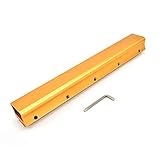


Shortlist by situation
- Long, straight HSS knives used regularly: Look for a wet-grinding system with a long support bed and a guided knife holder. Tormek’s T-8 Original, paired with its SVH-320 planer-jointer knife jig, is a recognizable option for sharpening straight knives within the jig’s capacity.
- Occasional sharpening and a smaller workshop: A guided system can be easier to store and set up than a dedicated industrial knife grinder. Confirm the maximum knife length before buying; many general-purpose sharpening machines cannot support a full planer knife.
- Spiral-head disposable inserts: Use the manufacturer’s replacement or indexing procedure. If the inserts are explicitly specified as resharpenable, choose a fixture made for that insert geometry—not a straight-knife jig.
- Many long knives or production work: Consider a dedicated knife grinder or a sharpening service. The equipment costs more and takes space, but is better suited to repeated, full-length grinding than improvised bench setups.
What the numbers tell you
Capacity figures are not interchangeable: a machine’s wheel width, a jig’s maximum knife length, and the length of the knife being sharpened describe different things. The table gives useful buying checkpoints, not a claim that every machine or accessory has the same specification. Check the current manual and compatibility information for the exact model before ordering.
| System or knife type | Useful capacity checkpoint | Bevel control and setup | Best fit |
|---|---|---|---|
| Tormek T-8 with SVH-320 jig | Jig capacity: straight knives up to 310 mm (12.2 in) | Guided support; setup and alignment take longer than simply indexing an insert | Reusable straight knives that fit the jig |
| Long-bed wet grinder or dedicated knife grinder | Choose a bed longer than your longest knife; common shop knives are 6–13 in (152–330 mm) | Depends on the holder and machine; a continuous support bed helps maintain a consistent edge | Frequent sharpening of full-length knives |
| Replaceable HSS straight knife | Often supplied in matched pairs or sets; measure the installed knife, not just the cutterhead | Can be sharpened only if its maker permits it and the grinder supports its length and bevel | Owners prioritizing a reusable edge and willing to manage setup |
| Disposable carbide insert | Often around 14–15 mm (0.55–0.59 in) across, but dimensions vary by cutterhead | Typically rotated in place; replacement or specialist sharpening is different from straight-knife grinding | Spiral or helical cutterheads with indexed inserts |
The Tormek figure is a useful illustration of why exact jig capacity matters: a knife longer than the stated limit is not made suitable by having a wide grinding wheel. For any other system, use its published maximum knife length and confirm that the holder supports the knife securely at both ends.
Head-to-head: straight knives versus disposable inserts
Reusable HSS straight knives
A long knife needs steady support and repeatable bevel control. A guided wet grinder can reduce heat buildup compared with dry grinding, but it still requires careful alignment and light, even passes. A knife that is not held straight can come out with a tapered edge or uneven bevel, and removing too much material shortens its remaining service life.
Check whether the sharpening system can match the knife’s existing bevel and accommodate its length, thickness, and clamping method. Do not assume all planer knives use the same angle or can be ground to the same profile. If the knife has chips, cracks, or damage beyond light edge wear, ask the knife maker or a sharpening service whether it is economical and safe to regrind.
Disposable and indexable inserts
Many inserts are designed to be rotated to a fresh cutting edge, then replaced when all usable edges are worn. This is usually faster than removing and grinding each insert, and it preserves the cutterhead’s intended geometry. Some inserts are resharpenable, but only when the maker specifies a suitable process; a generic planer-knife jig is not a substitute for an insert fixture.
Before turning an insert, clean the seat and screw, follow the cutterhead maker’s sequence, and use the specified torque. A chip or dust trapped beneath an insert can make it sit proud, producing a ridge or uneven cut. Replace damaged screws and inserts rather than forcing a poor fit.
Match the purchase to your workload
| Your situation | Practical choice | Why |
|---|---|---|
| One or two sharpenings a year; limited bench space | Sharpening service, or a compact guided system if your knives fit | A large grinder may sit idle, while a service avoids setup and storage |
| Regular work with straight HSS knives; comfortable with careful setup | Guided wet grinder with a knife jig sized for the longest knife | Repeatable support matters more than maximum motor power |
| Spiral-head cutterhead with indexed carbide inserts | Use the insert’s additional edges, then buy compatible replacements | Indexing is generally simpler than trying to sharpen inserts in a straight-knife system |
| Production shop sharpening long knives frequently | Dedicated knife grinder or contracted sharpening with planned spare sets | Throughput, bed capacity, and consistent alignment become central |
Setup and ownership: where accuracy is won or lost
- Identify the knife. Record its material, length, thickness, bevel angle if known, and whether the manufacturer permits resharpening. Measure the actual knife rather than relying on a planer’s nominal width.
- Check capacity and clamping. The knife must fit the holder with secure support across its length. If the jig’s published limit is shorter than the knife, choose another method rather than improvising an overhang.
- Set and verify the bevel. Follow the grinder and jig instructions. Make a light initial pass and inspect contact across the edge before removing more material; uneven contact can reveal misalignment early.
- Control heat and debris. Use the machine’s specified grinding method, keep the work area clean, and avoid pressing hard. On wet systems, maintain the water and stone condition recommended by the manufacturer.
- Reinstall and check the cut. Clean the knife bed and clamping surfaces, install the knife evenly, and confirm that it sits correctly before powering up. Make a test cut and look for ridges, tear-out, or uneven thickness.
Common ownership costs include replacement or dressing of the grinding stone, jigs and holders, and the time needed to align knives. The stone or abrasive surface is a wear item; a dull or out-of-true surface can make sharpening slower and less consistent. For insert systems, screws and compatible replacement inserts are the recurring consumables. Keep the correct hex key and torque guidance with the cutterhead instructions, and avoid mixing insert sizes or geometries.
Bottom line
For straight HSS knives, buy around the longest knife you own, the jig’s published capacity, and reliable bevel support—not wheel width alone. A guided wet-grinding system such as the Tormek T-8 with its SVH-320 jig is a specific option for knives within its 310 mm capacity. For disposable inserts, prioritize correct indexing, clean seating, and compatible replacements; buy a sharpening fixture only if the insert manufacturer explicitly supports resharpening. If you sharpen rarely, compare the full cost and setup time of a machine against a qualified sharpening service.