What's inside
As an Amazon Associate I earn from qualifying purchases. This post may contain affiliate links at no extra cost to you.
Cutting a door lock pocket is a job for a chisel, but the best type depends on how much timber must come out and how controlled the cut needs to be. A socket firmer chisel set is built to take mallet blows and remove waste quickly. A bench chisel is slimmer, lighter, and usually better for paring, trimming and cleaning the pocket. In practice, many good installations use both.
As an Amazon Associate we earn from qualifying purchases at no extra cost to you.
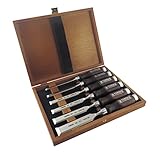
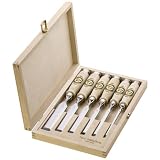


Sections
Our Top Picks


What a door lock pocket involves
A mortice lock pocket is a long, narrow recess cut into the door edge. A typical internal-door lock may need a pocket roughly 100 to 150 mm long, 15 to 25 mm wide and 60 to 100 mm deep, although the lock manufacturer’s dimensions are the authority. The faceplate recess is shallower, commonly 2 to 3 mm deep.
The work has three stages: marking the pocket, removing most of the waste, and bringing the sides and ends accurately to the lines. Chisels are excellent for the second and third stages, but they are not a substitute for accurate marking. Scribe the faceplate with a marking knife or sharp pencil, mark the lock body depth on both door faces, and drill or bore out the centre before chiselling. Removing some waste first reduces the force needed and lowers the chance of splitting the door.
When a mallet chisel is the better choice
A mallet chisel, often sold as a firmer or socket chisel, has a thicker blade and a substantial handle designed for repeated striking. It is the right tool when you need to excavate a long pocket in hardwood, when the lock body is deep, or when the waste is too substantial to remove by hand pressure alone.
Use a mallet chisel with the bevel facing the waste when chopping down into the end of the pocket. Make a series of controlled cuts rather than trying to bury the blade in one blow. For a 20 mm-wide pocket, a 12 mm or 16 mm chisel is usually more useful than a very narrow blade. A 25 mm chisel can remove waste quickly from a broad faceplate recess, but it is too wide for many lock pockets.
The main failure mode is overcutting. Heavy blows can drive the chisel beyond the marked depth, break out the door edge, or split fibres on the far side. This is especially easy with softwood doors, hollow-core doors with thin timber stiles, and veneered doors. A mallet chisel also removes material faster than an inexperienced user may expect. Stop frequently, check the depth with the lock body, and leave the final 1 to 2 mm for controlled trimming.
For repeated site work, choose a heavy-duty firmer chisel set with a striking-capable handle and a blade thickness around 5 to 7 mm. A wooden mallet is generally easier on the handle and gives more forgiving blows than a steel hammer.
When a bench chisel is the better choice
A bench chisel is a general-purpose woodworking chisel. Its blade is usually thinner than a mallet chisel, and its handle is intended mainly for hand pressure or light tapping. It excels at paring the sides of the pocket, squaring corners, trimming the faceplate recess and removing small amounts around the lock for a clean fit.
Bench chisels are also suitable for shallow pockets in softwood, particularly when a drill has removed most of the material. A 10 mm or 12 mm bench chisel can clean the corners of a narrow lock recess more neatly than a thick firmer chisel. The slimmer blade gives better visibility and can reach areas where a bulky chisel binds.
Do not treat an ordinary bench chisel as a demolition tool. Repeated heavy hammer blows may mushroom or split its handle, bend the blade, or damage the cutting edge. A common mistake is using a sharp bench chisel to lever out large chips. The blade can twist in the cut, causing a diagonal gouge that is difficult to hide beneath the faceplate.
Mallet chisel versus bench chisel
| Factor | Mallet chisel | Bench chisel |
|---|---|---|
| Main job | Chopping and removing substantial waste | Paring, trimming and light chopping |
| Blade | Thicker and more resistant to impact | Thinner and easier to control for fine work |
| Best door material | Hardwood, dense softwood and deep pockets | Softwood, shallow pockets and final fitting |
| Typical useful sizes | 12, 16 and 20 mm | 6, 10 and 12 mm |
| Risk | Overcutting, breakout and crushed fibres | Damaged handle or bent blade if struck heavily |
| Buying priority | Strong handle, thick blade and durable edge | Accurate grind, comfortable handle and good sharpness |
A practical method for cutting the pocket
Start by marking the lock body and faceplate accurately. Use a door lock installation jig if you install locks regularly; it keeps the faceplate and spindle positions consistent, though it does not eliminate the need for chiselling.
Clamp the door securely at a comfortable working height. Drill a row of overlapping holes inside the waste area, stopping about 2 to 3 mm short of the final depth and keeping the drill square to the door edge. A sharp brad-point bit or auger bit gives better control than a blunt twist bit. Break out the thin webs between holes with a mallet chisel, working from the centre toward the marked walls.
Chop across the end grain in short steps. Do not start at the final end line with a deep blow: begin 3 to 5 mm inside it, then widen the cut to the line. This supports the fibres and reduces breakout. Pare the long sides with a bench chisel, taking thin shavings until the lock slides in without force. Test-fit the lock repeatedly rather than making the pocket unnecessarily large.
For the faceplate, score the outline deeply with a knife, then pare down to roughly 2 or 3 mm. Keep the chisel flat and work with the bevel down for controlled paring. If the faceplate rocks, find the high spot with pencil marks and remove only that area.
What to buy for occasional and regular work
For one or two softwood doors, the cheaper option is fine: a decent 10 or 12 mm bench chisel, a 16 mm chisel capable of light mallet use, and a wooden mallet will handle the job. You do not need a premium full set if the chisels arrive flat, hold an edge and have handles that tolerate moderate tapping.
If you fit locks regularly, buy a dedicated professional mortice chisel set or combine individual firmer chisels with a few bench chisels. Prioritise 6, 10, 12 and 16 mm sizes, then add a wider chisel for faceplates. Keep the edges sharp: a dull chisel needs heavier blows, increases tear-out and makes both types perform badly.
The simplest decision is this: use the mallet chisel to remove waste, and use the bench chisel to make the pocket fit. If you only want to buy one tool, choose a sturdy 12 mm or 16 mm firmer-style chisel that can accept controlled mallet blows. It will not pare as delicately as a bench chisel, but it gives more useful capacity for the whole lock installation.