What's inside
As an Amazon Associate I earn from qualifying purchases. This post may contain affiliate links at no extra cost to you.
Sections
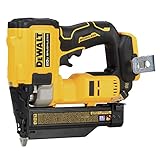
DeWalt 23-Gauge Pin Nailer: What It’s Actually For
A DeWalt 23-gauge pin nailer is a glue-assist tool, not a structural fastener: it fires headless pins about 0.025 inches in diameter that hold small trim, miters, and fragile moldings in place while adhesive cures — and it leaves holes most finishes hide without filler. If you understand that one job, you’ll know instantly whether the tool belongs in your kit. Buy it to replace clamps and tape on delicate work, not to attach baseboard to walls.
What the Fastener Size Means for Holding Power and Visibility
Gauge numbers run backward: the higher the gauge, the thinner the fastener. A 23-gauge pin is the smallest commonly driven nail in woodworking — roughly half the diameter of an 18-gauge brad, with no meaningful head. That geometry is both its strength and its limit.
As an Amazon Associate we earn from qualifying purchases at no extra cost to you.


| Gauge | Diameter | Head | Hole visibility | Holding power | Typical role |
|---|---|---|---|---|---|
| 23 ga pin | ~0.025 in (0.64 mm) | None or micro T-head | Often invisible even unfilled | Low — glue carries the joint | Miter returns, bead molding, glue-assist assembly |
| 21 ga pin | ~0.028 in | Slight head | Very small | Low–moderate | Same work, slightly more bite |
| 18 ga brad | ~0.0475 in (1.2 mm) | Small head | Needs filler on stain-grade work | Moderate | Casing, base shoe, light trim attachment |
| 15/16 ga finish | ~0.063–0.072 in | Full head | Must fill | Strong | Baseboard, crown, casing to framing |
By cross-section, an 18-gauge brad carries roughly 3.5–4× the steel of a 23-gauge pin, plus a real head to resist withdrawal. That’s why a pin alone will let a joint creep apart over a season — but a pin plus glue produces a joint stronger than the wood around it. On the visibility side, a 0.64 mm hole typically vanishes under one coat of paint; on stain-grade work it shows as a faint dot, so angle pins with the grain and touch them with matching filler only where the light hits.
One detail worth knowing about the DeWalt DCN623 specifically: it accepts slight-headed 23-gauge pins as well as true headless ones. The micro T-head adds meaningful withdrawal resistance while staying nearly invisible — useful on applied moldings you can’t clamp.
Jobs Where It Shines — and Where It Doesn’t
Ideal uses:
- Glued miter returns on casing and crown — the classic application. The pin acts as a third hand where clamps can’t reach.
- Bead, dentil, and other small applied moldings that an 18-gauge brad would split or deface.
- Picture frames, small boxes, and drawer parts while glue grabs.
- Edge banding, veneer patches, and thin overlays on plywood.
- Tacking templates, jigs, and stop blocks to MDF in the shop.
Wrong tool for:
- Attaching baseboard or casing to studs — pins lack the bite; use 15/16-gauge finish or 18-gauge brads.
- Any joint that gets pulled, handled, or loaded without glue.
- End grain or short-grain fastening — pins withdraw from end grain with almost no resistance.
- Hard maple or knotty wood without a depth test — thin pins can deflect and exit the side of the workpiece.
The Cordless Question
The DeWalt DCN623 runs on the 20V MAX platform with a brushless motor — no hose, no compressor, no fuel cells. It drives 5/8-inch to 1-1/2-inch pins, offers selectable sequential and contact actuation, tool-free jam clearing, a dry-fire lockout, a depth thumbwheel, and an LED work light.
Cordless matters most on site: no hose dragging across finished floors, no compressor cycling in an occupied house, instant first shot. The trade-offs are weight — about 4.5 pounds bare versus roughly 2.3 pounds for a pneumatic pinner — and a slower rapid-fire cadence, which only registers in high-volume production. Bare tools typically sell in the $350–$400 range, so the math works best if you already own 20V MAX batteries.
DeWalt vs. Milwaukee vs. Pneumatic: Picking by Situation
The obvious rival is the Milwaukee M12 23-gauge pin nailer (2540), which trades pin length and platform voltage for a lighter, cheaper tool. Pneumatics remain the shop-floor benchmark for weight and speed.
| DeWalt DCN623 (20V MAX) | Milwaukee 2540 (M12) | Pneumatic 23 ga (Grex/Cadex class) | |
|---|---|---|---|
| Power source | 20V battery | 12V battery | Compressor, ~70–110 psi |
| Pin length range | 5/8–1-1/2 in | 5/8–1-3/8 in | Up to 2 in on some models |
| Pin types accepted | Headless + slight-head | Headless | Varies by model |
| Weight (bare) | ~4.5 lb | ~3.4 lb | ~2.2–2.6 lb plus hose |
| Runtime | A compact pack covers a typical day of shop pinning | Rated by Milwaukee at up to ~750 pins/charge | Unlimited while compressor runs |
| Typical street price | ~$350–$400 bare | ~$200–$250 bare | ~$150–$350 + compressor |
Numbers are manufacturer-rated or approximate; confirm on current spec sheets before buying.
- Already on DeWalt 20V MAX: The DCN623 is the obvious pick — the extra 1/8 inch of pin length helps on 3/4-inch stock.
- On Milwaukee M12 or prioritizing low weight: The 2540 covers nearly all trim work; 1-3/8-inch max is rarely limiting.
- Shop-bound with a compressor: A pneumatic pinner is lighter, cheaper, and fires faster all day.
- Makita LXT fleet: Makita’s LXT 23-gauge pinner keeps you in-platform rather than buying new batteries.
- A few frames a year: A pin nailer may be overkill — a hand pin pusher plus glue handles occasional work.
Sizing Pins and Getting Clean Results
Working rule: the pin should pass through the trim and bury at least 1/2–3/4 inch into the substrate. For 3/8-inch bead molding onto a cabinet face, a 1-inch pin leaves ~5/8 inch of bite. For 1/2-inch trim, run 1-1/4 or 1-3/8 inch. Through 3/4-inch material, a 1-1/2-inch pin gives ~3/4 inch of embedment — the useful ceiling of this tool class.
Mistakes that cause most pin-nailer grief:
- Skipping glue. Pins alone creep loose within a season — always treat them as clamps.
- Free hand behind the workpiece. Deflected pins exit sideways; clamp thin stock or hold from the edges.
- Firing within ~3/8 inch of edges or ends, where blowout and splitting happen.
- Not test-firing in hardwood — a pin left proud telegraphs through finish and has to be set by hand.
- Stale or rusty pins. The thin wire corrodes fast; store strips dry and clear jams via the tool-free latch rather than forcing the nose.
- On pneumatics: mixing pin brands with different collation, and running past max psi.
Ownership is otherwise light. Cordless pinners need no oiling — keep the nose and magazine free of glue squeeze-out and dust. On pneumatics, add a few drops of tool oil unless the design is oil-free and drain the tank regularly. The driver blade edge wears first under high volume, batteries and O-rings follow, and pins themselves are the cheap consumable — a strip of 100 costs a fraction of what the glue beside them does.
Quick Answers
Can I skip glue if I use enough pins? No. A headless pin’s withdrawal resistance is minimal; extra pins just add holes.
Will it fire into oak or maple? Yes, with depth dialed in on scrap — but thin pins deflect more readily in dense wood, so keep edge distance and fire perpendicular.
Are 23-gauge pins interchangeable between brands? Largely, yes, when collation and pin type match — the DeWalt takes both headless and slight-head strips, while some competitors accept headless only.